The Indian automotive landscape in 2026 continues to be a theater of intense competition and rapid technological shifts. For Toyota Kirloskar Motor (TKM), September 2026 emerged as a month of significant recalibration. While the brand remains a formidable force in the Utility Vehicle (UV) and Hybrid segments, the latest sales data reveals a complex narrative of growth in some niches and strategic cooling in others. With a total domestic dispatch of 25,027 units, Toyota experienced a year-on-year (YoY) decline of 7.61% compared to the 27,089 units recorded in September 2025.
This performance dip, coupled with a sequential monthly decline of 11.91% from August 2026, has resulted in a shift in the industry leaderboard. Kia India has successfully overtaken Toyota to claim the fifth position in the national sales rankings, signaling a tightening race in the mid-to-premium vehicle segments. However, a deeper dive into the numbers suggests that this is not a simple story of waning demand, but rather a calculated transition period marked by product facelifts and inventory management.
1. Main Facts: The Statistical Overview of September 2026
Toyota’s performance in September 2026 was characterized by a sharp dichotomy between its legacy "power brands" and its newer, partnership-derived models. The total sales figure of 25,027 units must be viewed against the backdrop of Q3 2026 (July–September), where Toyota recorded a total of 83,953 units. This represents a marginal decline of 1.87% from the 85,550 units sold during the same quarter in the previous year.
Key Performance Indicators:
- Total Sales (Sep 2026): 25,027 units.
- Year-on-Year Change: -7.61% (vs. 27,089 units in Sep 2025).
- Month-on-Month Change: -11.91% (vs. 28,410 units in Aug 2026).
- Quarterly Performance (Q3 2026): 83,953 units, a 1.87% dip YoY.
- Market Position: Slipped to No. 6, with Kia ascending to No. 5.
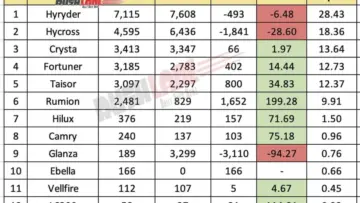
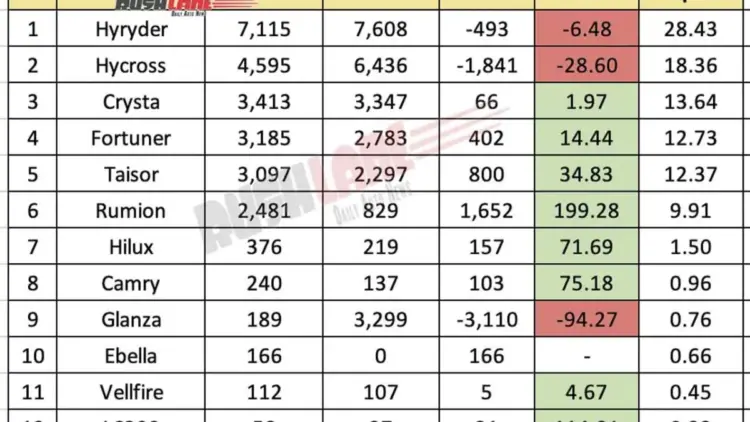
Despite the overall decline, the Urban Cruiser Hyryder maintained its status as the volume driver for the company, contributing nearly 28.5% of the total monthly sales. Conversely, the Glanza hatchback saw a near-total temporary collapse in volumes, falling by over 94%—a phenomenon almost entirely attributed to the transition toward a new facelifted version.
2. Chronology: A Quarter of Transitions
To understand the September dip, one must look at the events unfolding throughout the third quarter of 2026. The quarter began with steady momentum in July and August, but September became the "pivot point" for several key models.

- Early Q3 (July-August): Toyota maintained high dispatch levels, particularly for the Innova Hycross and Hyryder, to satisfy a lingering backlog of orders. The Taisor (a rebadged version of the Maruti Fronx) began gaining significant traction during this period.
- Mid-September 2026: Reports and spy shots emerged of the 2027 Toyota Innova Hycross facelift undergoing rigorous testing. These images, showing hidden touchscreens and revised interior layouts, led to a natural "wait-and-watch" approach among prospective premium MPV buyers.
- Late September 2026: Toyota officially launched the facelifted Glanza. This launch explains the massive drop in September dispatches (only 189 units), as the company cleared out old inventory in August and prepared the pipeline for the new model’s arrival at dealerships in October.
- Closing the Quarter: The month ended with Kia’s aggressive push in the SUV segment, allowing them to edge past Toyota in the monthly tally, setting the stage for a high-stakes battle in the upcoming festive season (Q4).
3. Supporting Data: Model-wise Performance Analysis
The strength of Toyota’s portfolio lies in its diversity, ranging from entry-level hatchbacks to luxury off-roaders. The September 2026 breakup highlights where the brand is gaining ground and where it is facing headwinds.
The Hybrid and MPV Powerhouse: Hyryder and Innova
The Urban Cruiser Hyryder remains the jewel in Toyota’s crown, registering 7,115 units in September. Although it remains the top seller, it faced a 11.70% decline during the Q3 period compared to last year, suggesting increased competition in the mid-size SUV space.
The Innova brand—comprising the Hycross (strong hybrid) and the Crysta (diesel)—remains the backbone of Toyota’s Indian operations.
- Innova Hycross: 4,595 units (Down 28.60% YoY). This decline is likely temporary, linked to the upcoming facelift.
- Innova Crysta: 3,413 units (Up 1.97% YoY). The enduring demand for the Crysta’s rugged diesel engine continues to provide a safety net for Toyota.
- Combined Impact: Together, the Innova siblings accounted for 8,008 units, or roughly 32% of Toyota’s total monthly volume.
The Growth Engines: Rumion and Taisor
The most impressive growth figures came from Toyota’s newer entries. The Rumion (based on the Ertiga) saw its sales nearly triple, jumping from 829 units in September 2025 to 2,481 units in 2026—a 199.28% increase.
The Taisor also proved its mettle, recording 3,097 units, a 34.83% YoY growth. Crucially, the Taisor was the only high-volume Toyota model to grow on both a yearly and a sequential (8.17% MoM) basis, proving that the sub-compact crossover segment remains a goldmine for the brand.

The Premium and Niche Segments
- Fortuner: Despite its premium price point and aging platform, the Fortuner grew by 14.44% YoY with 3,185 units. It remains the undisputed king of the full-size SUV segment.
- Hilux: The lifestyle pickup saw a 71.69% YoY surge, reaching 376 units, as Toyota’s marketing efforts to build a "truck culture" in India begin to yield results.
- Camry and Vellfire: Both luxury offerings saw gains. The Camry grew by 75.18% (240 units), while the Vellfire increased by 4.67% (112 units), reflecting a resilient demand in the executive and luxury chauffeured segments.
- Land Cruiser 300: The flagship SUV recorded 58 units, more than doubling its year-ago tally of 27.
4. Market Dynamics and Official Context
While Toyota Kirloskar Motor has not issued a defensive statement regarding the slip to the No. 6 position, industry analysts and internal sources point toward a "Strategic Inventory Rebalancing."
The massive 94.27% drop in Glanza sales is the most glaring statistic. In the automotive industry, such a drop usually precedes a major product lifecycle event. With the facelifted Glanza launched late in the month, Toyota’s primary focus was on ensuring that BS6 Phase II (or subsequent emission norms of 2026) inventory was cleared and that the supply chain was primed for the new model.
Furthermore, the Innova Hycross facelift, expected to launch by December 2026, has created a natural cooling period. Toyota’s production lines are reportedly being optimized to incorporate the new features—including rumored ADAS (Advanced Driver Assistance Systems) upgrades and a revamped infotainment suite—which has temporarily affected the dispatch of the current-gen model.
Toyota’s strategy continues to revolve around its "Multi-Pathway" approach, balancing Internal Combustion Engines (ICE), Strong Hybrids (SHEV), and niche offerings like the Hilux. The company’s reliance on its partnership with Maruti Suzuki remains a cornerstone of its volume strategy, with rebadged models like the Rumion and Taisor successfully capturing market share that Toyota’s traditional premium lineup could not reach.
5. Implications: What Lies Ahead for Toyota?
The September 2026 sales report is a snapshot of a brand in the middle of a bridge. The implications for the final quarter of the year and the start of 2027 are significant:

1. Reclaiming the Top 5 Spot
The loss of the No. 5 position to Kia is a wake-up call. Kia’s strength lies in its rapid-fire feature updates and aggressive design language. To reclaim its spot, Toyota will need the facelifted Glanza and the upcoming Hycross facelift to perform at peak capacity during the festive season.
2. The Hybrid Dominance Test
As more manufacturers (including Maruti and potentially Hyundai/Kia) look toward hybrid powertrains, Toyota’s "first-mover" advantage with the Hyryder and Hycross will be tested. The decline in Hyryder volumes in Q3 (-11.70%) suggests that the competition is finally catching up, and Toyota may need to revisit its pricing or feature list to maintain its hybrid leadership.
3. The "Badge Engineering" Success
The success of the Rumion and Taisor proves that Indian consumers are increasingly comfortable with Toyota-badged Maruti products, provided they come with Toyota’s superior warranty and service reputation. This likely paves the way for further collaborations, possibly in the electric vehicle (EV) space, where Toyota has been slower to move than its rivals.
4. Anticipation for the 2027 Hycross
The spying of the facelifted Hycross is the most critical "future factor." As Toyota’s most profitable high-volume model, the success of this facelift is non-negotiable. If the update addresses consumer demands for more modern tech while maintaining the bulletproof reliability of the TNGA-C platform, Toyota could see a massive surge in Q1 2027.
Conclusion
September 2026 was a month of "taking one step back to take two steps forward" for Toyota India. The decline in total volumes is a byproduct of a heavy transition phase involving two of its most important models—the Glanza and the Innova Hycross. With the Rumion and Taisor providing a solid floor for sales and the Fortuner remaining an immovable force at the top, Toyota’s fundamentals remain strong. The coming months will determine if the brand can turn this temporary dip into a springboard for a record-breaking 2027.