The Indian automotive landscape in late 2026 continues to be a theater of rapid shifts, technological transitions, and fierce brand rivalries. Toyota Kirloskar Motor (TKM), a perennial heavyweight in the Utility Vehicle (UV) and Multi-Purpose Vehicle (MPV) segments, recently released its sales figures for September 2026. The data paints a complex picture: a brand in the midst of a product lifecycle transition, grappling with aggressive moves from competitors like Kia India, yet finding unexpected strength in its newer, collaborative models.
Main Facts: A Mixed Performance in a Volatile Month
Toyota’s performance in September 2026 can be characterized as a "calculated cooling period." The company reported total domestic sales of 25,027 units. While this figure remains substantial, it represents a 7.61% year-on-year (YoY) decline compared to the 27,089 units sold in September 2025. The sequential data suggests a sharper contraction, with volumes falling 11.91% from August 2026’s 28,410 units.
Perhaps the most significant headline from the September report is the shift in market hierarchy. For the first time in several quarters, Kia India has overtaken Toyota, pushing the Japanese automaker to the No. 6 position in the national sales rankings. This shift underscores the aggressive product offensive by Kia and the temporary supply-side adjustments Toyota appears to be making as it prepares for a flurry of year-end updates.
For the third quarter (Q3) of 2026 (July–September), Toyota’s cumulative sales stood at 83,953 units. This is a marginal dip of 1.87% compared to the 85,550 units recorded during the same period in 2025. Despite the slight overall decline, certain models within the portfolio have shown exponential growth, suggesting that Toyota’s strategy of diversifying its lineup—particularly through its global alliance with Suzuki—is bearing fruit.
Chronology of Sales: From July Optimism to September Consolidation
The trajectory of Toyota’s Q3 2026 performance reveals a steady start followed by a strategic slowdown in September.

- July 2026: The quarter began with strong momentum, driven by high demand for the Urban Cruiser Hyryder and the steady delivery of the Innova Hycross. The company focused on clearing backlogs for its hybrid variants.
- August 2026: Sales peaked for the quarter at 28,410 units. During this month, the Taisor and Rumion began showing significant upward movement, helping Toyota maintain its Top 5 position.
- September 2026: The momentum shifted. The sharp decline in Glanza volumes (down over 94%) and a nearly 29% drop in Hycross sales pulled the overall numbers down. This dip is largely attributed to the transition phase for the facelifted Glanza and the anticipation of the 2027 Innova Hycross facelift, which has already been spotted testing on Indian roads.
Supporting Data: Model-Wise Breakdown
To understand the health of Toyota’s Indian operations, one must look at the performance of individual nameplates, which vary from entry-level hatchbacks to flagship luxury SUVs.
The Volume Drivers: Hyryder and the Innova Legacy
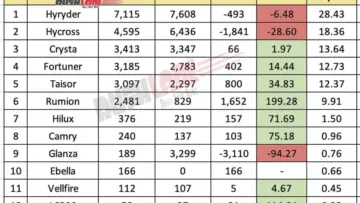
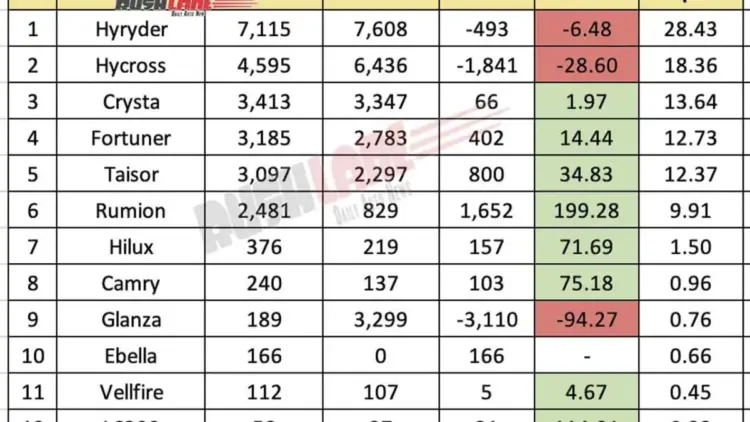
The Urban Cruiser Hyryder remains the crown jewel of Toyota’s current portfolio. In September 2026, it registered 7,115 units, accounting for 28.43% of the company’s total monthly volume. Although it remains the bestseller, it faced a YoY decline of 11.70% for the quarter, reflecting the maturing of its lifecycle and increased competition in the mid-size SUV segment.
The Innova brand—comprising the Hycross and the Crysta—continues to be the backbone of Toyota’s reputation.
- The Innova Hycross saw 4,595 units leave showrooms, a 28.60% drop from the previous year.
- Conversely, the Innova Crysta (the diesel workhorse) grew by 1.97% to 3,413 units.
Combined, the Innova siblings contributed 8,008 units, or roughly 32% of Toyota’s total sales, proving that the "Innova" badge remains the gold standard for Indian MPVs.
The Growth Heroes: Rumion and Taisor
The most startling growth figures came from the Toyota Rumion. Based on the Maruti Ertiga platform, the Rumion saw its sales nearly triple, recording 2,481 units—a staggering 199.28% YoY increase. It also posted a 3.55% monthly gain, suggesting that Toyota is successfully tapping into the budget MPV segment.
Similarly, the Toyota Taisor (a derivative of the Fronx) recorded 3,097 units, growing 34.83% YoY. It was the only high-volume Toyota model to post growth on both an annual and sequential basis in September, signaling strong market acceptance of Toyota’s compact crossover offering.

The Premium and Niche Segments
- Fortuner: The undisputed king of full-size SUVs grew by 14.44%, with 3,185 units sold. Despite its premium price tag, its dominance remains unchallenged.
- Hilux: The lifestyle pickup saw a 71.69% YoY surge, albeit on a lower base, reaching 376 units.
- Camry & Vellfire: The premium hybrid sedan (Camry) grew by 75.18% (240 units), while the luxury MPV (Vellfire) saw a modest 4.67% growth (112 units).
- Land Cruiser 300: The flagship SUV saw sales double from 27 units in Sept 2025 to 58 units in Sept 2026.
The Glanza Anomaly
The most dramatic data point is the Glanza, which plummeted from 3,299 units in September 2025 to just 189 units in September 2026. This 94.27% decline is not a sign of failure but a classic "model changeover" symptom. With the facelifted Glanza launching earlier this month, Toyota likely halted production of the outgoing model to clear inventory and prepare the assembly lines for the updated version, which features ADAS and ventilated seats.
Official Responses and Strategic Outlook
While Toyota Kirloskar Motor has not issued a formal "damage control" statement regarding the loss of the No. 5 spot to Kia, internal sources and industry analysts suggest a focus on "Value over Volume."
A spokesperson for Toyota’s Indian operations previously hinted that the company is prioritizing the transition to "Electrified Diversification." The dip in Hycross sales is viewed internally as a temporary phase as the company prepares for the 2027 Hycross Facelift, expected to debut in December 2026. This update is rumored to include a revamped interior with a larger hidden touchscreen and enhanced Level 2 ADAS features.
Furthermore, Toyota’s reliance on the Suzuki partnership (Glanza, Taisor, Rumion, Hyryder) is a deliberate strategy to maintain a presence in high-volume segments while Toyota focuses its engineering prowess on hydrogen fuel cells and high-efficiency hybrid powertrains for its larger vehicles.
Implications: What This Means for the Indian Market
The September 2026 sales breakup carries several long-term implications for the Indian automotive industry:

- The Rise of the "Second Car" Buyer: The success of the Taisor and Rumion suggests that Toyota is successfully attracting buyers who want the Toyota badge and after-sales reliability but at a more accessible price point.
- Hybrid Dominance vs. EV Expansion: While competitors like Tata and Mahindra are betting heavily on pure Battery Electric Vehicles (BEVs), Toyota’s steady Hyryder and Hycross numbers (even with the slight dip) show that the Indian consumer still views Strong Hybrids as the most practical bridge to a green future.
- The Kia-Toyota Rivalry: Kia’s ascent to the No. 5 spot is a wake-up call. Kia’s strength in the compact and mid-size SUV space (Seltos, Sonet) is currently outperforming Toyota’s traditional MPV strength in terms of sheer volume. Toyota will likely respond not by discounting, but by refreshing its tech suite in the upcoming Hycross and Fortuner updates.
- Inventory Management as a Tactic: The Glanza’s near-zero sales in September illustrate how modern OEMs manage product lifecycles. By drying up the channel before a facelift launch, Toyota ensures that dealers aren’t stuck with old stock, maintaining high resale values—a core pillar of the Toyota brand in India.
Conclusion
Toyota India’s September 2026 performance is a tale of two halves. On one hand, the decline in total volume and the loss of market rank suggest a period of vulnerability. On the other hand, the explosive growth of the Rumion and the resilience of the Fortuner and Crysta indicate a brand with deep-rooted loyalty and a successful diversification strategy.
As the industry moves toward the final quarter of the year, all eyes will be on the launch of the facelifted Hycross and the market reception of the updated Glanza. If these launches hit the mark, Toyota is well-positioned to reclaim its Top 5 status and finish 2026 on a high note. For now, the Japanese giant seems content to trade short-term volume for long-term structural readiness.