

By Special Correspondent
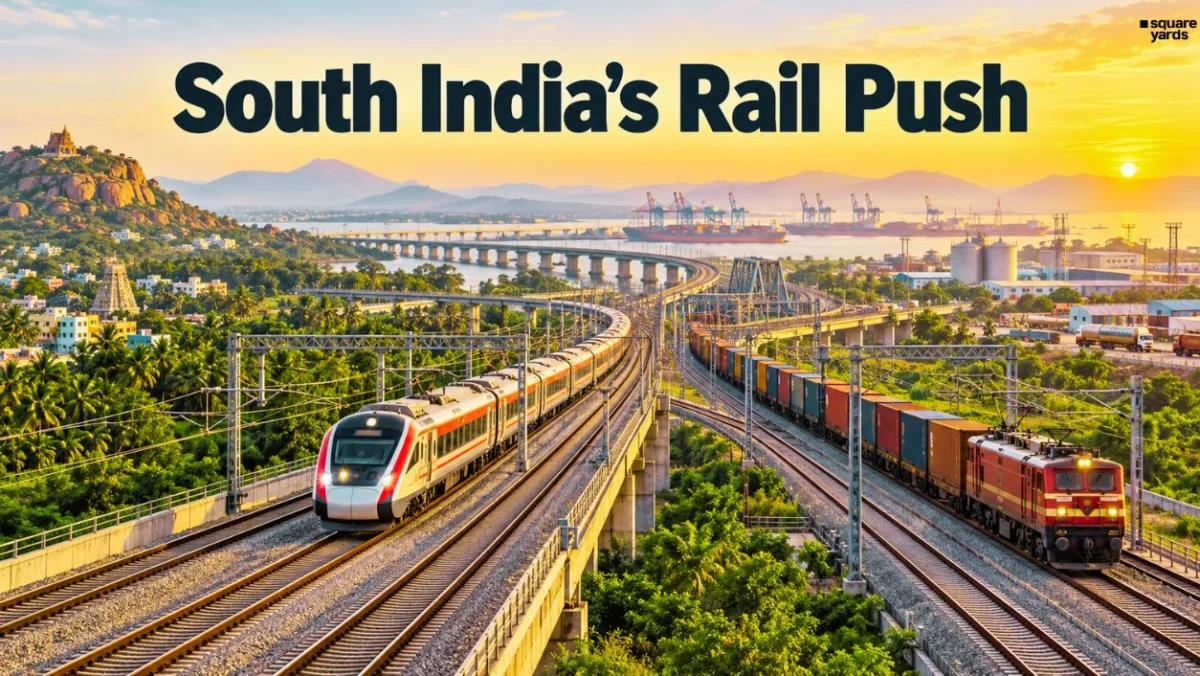
In a decisive move to overhaul the logistics landscape of Southern India, the Cabinet Committee on Economic Affairs (CCEA), chaired by Prime Minister Narendra Modi, has greenlit five massive railway multitracking projects. With a staggering investment of ₹10,021 crore, these projects represent a strategic pivot toward modernizing one of the nation’s most vital economic engines. Spanning four states—Tamil Nadu, Andhra Pradesh, Karnataka, and Telangana—the initiative is set to add approximately 540 kilometers of new tracks, aimed at de-congesting saturated corridors and supercharging the region’s freight-handling capabilities.
Scheduled for completion by the fiscal year 2029-30, these projects are not merely infrastructure upgrades but are foundational elements of the PM-Gati Shakti National Master Plan. This framework emphasizes integrated, multi-modal connectivity, ensuring that rail, road, and port infrastructure work in tandem to drive national productivity.
I. The Strategic Blueprint: Main Facts of the CCEA Approval
The core of the government’s announcement lies in the sheer scale of the expansion. By adding third and fourth lines to existing routes and doubling others, Indian Railways is addressing a chronic bottleneck: the "saturation" of existing tracks where passenger and freight trains often compete for limited slots, leading to delays and inefficiencies.
Scope and Geographic Reach
The project covers 17 key districts across the southern peninsula. The choice of these districts is no coincidence; they represent a mix of industrial hubs, agricultural belts, and major pilgrimage centers. The five projects include:
- Arakkonam–Renigunta (3rd and 4th Line): 77 km
- Whitefield–Bangarapet (3rd and 4th Line): 47 km
- Hosur–Omalur (Doubling): 147 km
- Salem–Karur–Dindigul (Doubling): 159 km
- Secunderabad (Ghatkesar)–Kazipet (Multitracking): 110 km
The Multitracking Advantage
Unlike greenfield projects that require entirely new land acquisitions and environmental clearances, "multitracking" involves adding parallel lines to existing corridors. This approach is significantly more efficient, utilizing existing railway land where possible and allowing for a faster transition from planning to execution. The primary goal is to segregate high-speed passenger traffic from heavy-load freight traffic, thereby increasing the average speed of both.
II. Chronology: The Road to the 2029-30 Vision
The approval of these five projects is the culmination of a multi-year strategy to revitalize the Southern Railway and South Central Railway zones.
- 2021-22: The Genesis of PM-Gati Shakti: The Prime Minister launched the National Master Plan to break departmental silos in infrastructure planning. The five South Indian projects were identified during this phase as "high-impact" corridors.
- 2023: Feasibility and DPR Phase: Detailed Project Reports (DPRs) were submitted by the respective zonal railways, highlighting the critical saturation levels (often exceeding 120% capacity) on routes like Secunderabad-Kazipet and Whitefield-Bangarapet.
- September 2026: Formal CCEA Approval: The Cabinet formally allocates the ₹10,021 crore budget, setting a firm deadline for 2029-30.
- 2026-2027: Tendering and Groundbreaking: The Ministry of Railways is expected to begin the tendering process immediately, with physical construction slated to commence by the first quarter of 2027.
- 2029-30: Target Commissioning: The phased rollout of these lines is expected to conclude by the end of the decade, aligning with India’s goal of becoming a $5 trillion economy.
III. Supporting Data: A Granular Look at the Impact
The government’s data suggests that the ripple effects of this investment will be felt far beyond the railway tracks.
Demographics and Rural Connectivity
According to official estimates, the expansion will provide direct rail access to approximately 2,121 villages. This is expected to benefit a population of roughly 52 lakh (5.2 million) people. For many of these rural communities, the proximity to a multitracked rail line means better access to urban job markets, healthcare in metros like Bengaluru and Hyderabad, and educational institutions.
Freight Capacity and Economic Throughput
Perhaps the most significant figure in the announcement is the addition of 47 million tonnes per annum (MTPA) in freight capacity. Indian Railways remains the backbone for transporting bulk commodities. The projected increase will facilitate the movement of:
- Coal: Vital for the power plants in Telangana and Tamil Nadu.
- Cement and Steel: Supporting the construction boom in the Bengaluru-Chennai industrial corridor.
- Food Grains: Moving produce from the delta regions of Tamil Nadu to the rest of the country.
- Fertilizers: Essential for the agricultural heartlands of Andhra Pradesh.
Environmental Dividends
The shift from road transport to rail transport is a cornerstone of India’s climate commitments. Railways are roughly 70-80% more energy-efficient than road transport for freight. By increasing rail capacity, the government anticipates a significant reduction in CO2 emissions, contributing to the nation’s "Net Zero" targets.
IV. Project Deep Dive: Analyzing the Five Corridors
To understand why these specific routes were chosen, one must look at the economic geography of South India.
1. Arakkonam–Renigunta (77 km)
This corridor is the lifeline between Chennai and the temple town of Tirupati. It currently handles an immense volume of pilgrim traffic. By adding 3rd and 4th lines, the Railways can introduce more "Vande Bharat" and "Amrit Bharat" trains without disrupting the heavy freight flow coming from the Chennai and Ennore ports toward the hinterland of Andhra Pradesh.
2. Whitefield–Bangarapet (47 km)
Whitefield is the tech-hub of Bengaluru, but it is also a major logistics node. The line toward Bangarapet connects the capital of Karnataka to the Kolar Gold Fields (KGF) region and onward to Chennai. This quadrupling will serve the dual purpose of supporting the proposed Bengaluru Suburban Railway and easing the movement of industrial goods from the manufacturing clusters in East Bengaluru.
3. Hosur–Omalur (147 km)
Hosur has emerged as the "Detroit of South India," hosting massive plants for EVs (Ather, Ola Electric) and electronics (Tata Electronics). Doubling the line to Omalur (near Salem) creates a robust supply chain link between these manufacturing hubs and the rest of Tamil Nadu’s industrial grid.
4. Salem–Karur–Dindigul (159 km)
This route is the spine of central Tamil Nadu. Salem is a steel and textile hub, Karur is famous for home textiles and bus-body building, and Dindigul is a major agricultural and leather center. Doubling this line will significantly reduce the "turnaround time" for cargo, making these industries more competitive globally.
5. Secunderabad (Ghatkesar)–Kazipet (110 km)
The Secunderabad-Kazipet section is one of the most congested in the South Central Railway zone. It serves as a gateway for trains moving from South India to North and East India. Multitracking here is essential for the movement of coal from the Singareni Collieries and for connecting the tri-cities of Warangal, Hanamkonda, and Kazipet to the Telangana capital.
V. Official Responses: The Government’s Vision
Following the CCEA meeting, government spokespersons emphasized that these projects are a testament to "Cooperative Federalism," as they involve close coordination with four different state governments for land use and utility shifting.
Prime Minister Narendra Modi noted via social media that the approval underlines the government’s commitment to "Viksit Bharat" (Developed India). He highlighted that modern infrastructure in the South would act as a catalyst for the entire nation’s growth.
The Ministry of Railways issued a statement clarifying that these projects are part of a broader "National Rail Plan" which aims to increase the modal share of railways in freight from the current 27% to 45% by 2050. "These five projects are low-hanging fruits that will provide immediate relief to congested sections and offer a high Internal Rate of Return (IRR)," the statement read.
VI. Implications: Real Estate, Logistics, and Beyond
The infusion of ₹10,021 crore into the rail sector will have a "multiplier effect" on the regional economy.
1. Logistics Cost Reduction
India’s logistics cost currently hovers around 13-14% of GDP, compared to 8% in many developed economies. By enhancing rail capacity and reliability, the government aims to bring these costs down. For a manufacturer in Hosur or a textile exporter in Karur, faster and cheaper rail connectivity directly translates to higher profit margins and better price competitiveness in international markets.
2. Real Estate and Urbanization
Historically, rail expansion has always triggered real estate booms. Towns like Arakkonam, Bangarapet, and Kazipet are likely to see increased demand for warehousing and industrial parks. Furthermore, improved passenger connectivity often leads to "rurbanization," where smaller towns become attractive residential hubs for people working in nearby metros, thus easing the pressure on cities like Bengaluru and Hyderabad.
3. Employment Generation
The construction phase alone is expected to generate millions of man-days of employment. Beyond direct labor, there will be a surge in demand for steel, cement, and local services, providing a localized stimulus to the 17 districts involved.
4. The Execution Challenge
While the announcement has been met with optimism, experts point to the challenges of execution. Completing 540 km of multitracking in less than four years requires meticulous planning. Issues such as land acquisition in densely populated areas of Tamil Nadu and Karnataka, the shifting of high-tension power lines, and ensuring that existing train services are not disrupted during construction will test the Ministry of Railways’ project management capabilities.
Conclusion: A New Era for the South
The ₹10,021-crore rail push is more than a budgetary allocation; it is a strategic investment in the future of South India. By weaving together the industrial prowess of Tamil Nadu, the technological leadership of Karnataka, the mineral wealth of Telangana, and the spiritual heritage of Andhra Pradesh, these five projects promise to create a more integrated and efficient economic corridor.
As the 2029-30 deadline approaches, the focus will shift from policy to performance. If executed successfully, this expansion will stand as a hallmark of the PM-Gati Shakti vision, proving that the tracks laid today are the pathways to the prosperity of tomorrow.
