

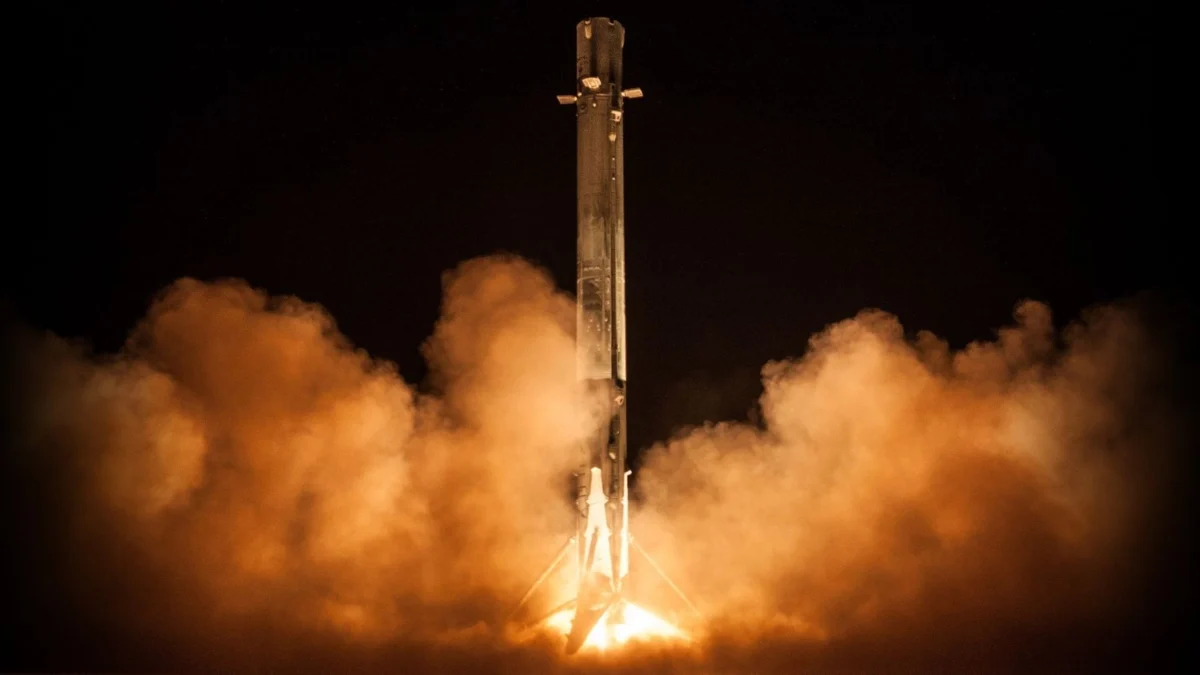
VANDENBERG SPACE FORCE BASE, CA — In the pre-dawn stillness of the California coastline, the aerospace industry witnessed a significant milestone in the history of rapid orbital access. At 3:25 a.m. EDT on Saturday, August 23, 2026, a SpaceX Falcon 9 rocket roared to life, carrying 27 Starlink internet satellites into low-Earth orbit (LEO). While the deployment of internet satellites has become a routine affair for the Hawthorne-based company, this specific mission carried the weight of a major statistical achievement: it marked SpaceX’s 100th Falcon family launch of the 2026 calendar year.
The successful mission underscores a decade of unprecedented growth in launch frequency, further distancing SpaceX from its global competitors. By reaching the 100-launch mark before the end of August, the company continues to demonstrate a cadence that was once thought impossible for liquid-fueled orbital rockets.
Main Facts: A Routine Triumph at Vandenberg
The mission, launched from Space Launch Complex 4 East (SLC-4E) at Vandenberg Space Force Base, followed a flawless countdown. The payload consisted of 27 Starlink satellites, part of the "Group 11" or equivalent shell designed to bolster the constellation’s capacity in high-latitude regions.
The primary objectives of the mission were twofold: the successful insertion of the satellites into their intended orbital plane and the recovery of the first-stage booster, B1100. Approximately 8.5 minutes after liftoff, the booster performed a precise vertical landing on the autonomous droneship Of Course I Still Love You, stationed hundreds of miles downrange in the Pacific Ocean. This marked the ninth successful flight and recovery for this specific booster, reinforcing the economic backbone of SpaceX’s business model—reusability.
While the 100-launch milestone is impressive, it serves as a mid-year check-in for a company that has redefined the "launch season" into a year-round industrial operation. Of the 100 missions conducted so far in 2026, 99 have utilized the workhorse Falcon 9, while a single Falcon Heavy mission in April successfully delivered the Viasat-3 F3 satellite to a geostationary transfer orbit.
Chronology of the Mission: From Ignition to Deployment
The timeline of the Saturday mission followed the high-precision "script" that SpaceX has refined over hundreds of launches:
- T-00:00:00: The nine Merlin 1D engines of the Falcon 9 first stage ignited, generating 1.7 million pounds of thrust. The vehicle cleared the tower at Vandenberg exactly at 3:25 a.m. EDT.
- T+00:02:32: Main Engine Cutoff (MECO) occurred. The first stage separated from the second stage, beginning its controlled descent back to Earth.
- T+00:02:40: The second stage’s single Merlin Vacuum (MVac) engine ignited to begin the trek to orbital velocity. Simultaneously, the fairing halves—the protective nose cone—jettisoned to be recovered later by SpaceX support vessels.
- T+00:08:24: The first stage (B1100) executed its entry burn and subsequent landing burn, touching down softly on the droneship.
- T+00:09:00: The second stage reached its initial parking orbit (SECO-1).
- T+01:01:45: Following a second brief burn of the upper stage to circularize the orbit, the 27 Starlink satellites were deployed in a "tension rod" release sequence.
Within hours of the deployment, SpaceX engineers confirmed that all 27 satellites had initialized their internal systems and began the multi-week process of raising their orbits to their operational altitude using on-board krypton-fueled Hall thrusters.
Supporting Data: The 2026 Launch Cadence in Context
To understand the significance of the 100th launch, one must look at the trajectory of SpaceX’s operational capacity over the last several years.
The Growth Curve
In 2023, SpaceX completed 96 missions. In 2024, that number climbed significantly, and by 2025, the company set a staggering world record of 165 Falcon launches. As of late August 2026, reaching 100 launches suggests an annual pace of roughly 150 missions. While this is slightly below the 2025 record, industry analysts suggest this is due to a strategic shift in payload priority and the transition of some "heavy lift" resources toward the Starship program at Starbase, Texas.
The Starlink Dominance
Data indicates that Starlink remains the primary driver of SpaceX’s launch manifest. Out of the 99 Falcon 9 launches in 2026:
- 76 missions (76%) were dedicated exclusively to Starlink.
- 23 missions (23%) were for external customers, including NASA (Crew and Cargo Dragon), the U.S. Space Force, and commercial telecommunications firms.
Constellation Statistics
With this latest batch, the Starlink constellation now exceeds 11,000 operational satellites. This represents more than 60% of all active satellites currently in Earth’s orbit. SpaceX’s internal data suggests that the constellation is now serving over 6 million subscribers globally, providing high-speed internet to maritime, aviation, and rural residential sectors.
Official Responses: SpaceX and Regulatory Perspectives
While Elon Musk, SpaceX’s founder and CEO, did not issue a lengthy statement, he acknowledged the milestone on the social media platform X (formerly Twitter) with a brief post: "100 Falcon flights in 2026. Great work by the team. Aiming for even higher reliability and lower costs as we transition to Starship V3."
SpaceX’s Vice President of Build and Flight Reliability, William Gerstenmaier, emphasized the "normalization" of spaceflight in a brief post-launch briefing. "The 100th mission of the year is a testament to the maturity of the Falcon 9 platform," Gerstenmaier noted. "We are no longer just a launch company; we are a logistics company for the orbital economy. Our focus remains on the rapid refurbishment of boosters like B1100, which allow us to maintain this tempo without compromising safety."
From a regulatory standpoint, the Federal Aviation Administration (FAA) and the U.S. Space Force have had to adapt to this "new normal." A spokesperson for the Space Launch Delta 30 at Vandenberg stated: "The cadence of launches from the West Coast has necessitated a total overhaul of our range safety and scheduling protocols. SpaceX’s 100th mission of the year reflects a successful public-private partnership in maintaining the U.S. lead in space access."
Implications: The Road to 100,000 Satellites
The successful 100th launch of 2026 is more than a numerical milestone; it is a precursor to a massive shift in how humanity utilizes low-Earth orbit.
1. The Transition to Starship
While the Falcon 9 is the current workhorse, SpaceX has made it clear that the future of the Starlink constellation lies with the Starship launch system. The company’s stated goal of launching 100,000 "Starlink V3" satellites cannot be achieved with Falcon 9 alone. The V3 satellites are significantly larger and heavier, designed to provide "direct-to-cell" connectivity with near-zero latency. The continued high-frequency Falcon launches serve as a bridge, generating the revenue necessary to fund the capital-intensive Starship development.
2. Space Sustainability and Debris
The sheer volume of satellites—11,000 and counting—has raised alarms within the astronomical and orbital safety communities. With 100 launches in just eight months, the "cluttering" of LEO is a primary concern for international regulators. SpaceX defends its record by highlighting its automated collision-avoidance systems and the fact that Starlink satellites are designed to de-orbit naturally within five years if they lose propulsion. However, as the 100-launch-per-year pace becomes standard, the risk of a "Kessler Syndrome" event—a chain reaction of collisions—remains a topic of intense debate at the United Nations Office for Outer Space Affairs (UNOOSA).
3. Geopolitical and Competitive Impact
SpaceX’s dominance has forced other nations and companies to accelerate their own megaconstellation plans. China’s "G60 Starlink" and "Guowang" projects are reportedly ramping up, and Amazon’s Project Kuiper is expected to begin its own high-cadence launch phase by late 2026. The fact that SpaceX can hit 100 launches in eight months using a single, reusable architecture gives the United States a significant strategic advantage in the "New Space Race."
4. Economic Disruption
The cost of reaching space has plummeted. By reusing boosters for the ninth, tenth, or even twentieth time, SpaceX has lowered the price per kilogram to orbit to levels that have disrupted the traditional aerospace industry. This has enabled a new wave of startups in orbital manufacturing, pharmaceutical research in microgravity, and advanced Earth observation that were previously cost-prohibited.
Conclusion: A New Standard for the Final Frontier
As the Falcon 9 upper stage deployed its 27 satellites over the Pacific, the 100th mission of 2026 concluded not with a celebration, but with a pivot to the next mission. For SpaceX, the "Century Mark" is not a finish line, but a baseline.
The company’s ability to treat orbital launches with the same regularity as commercial airline flights has fundamentally changed the human relationship with space. While the record of 165 launches in 2025 remains the high-water mark to beat, the consistency shown in 2026 suggests that the era of the "weekly launch" has evolved into the era of the "every-other-day launch." As Starship nears operational maturity, the milestones of today will likely seem modest compared to the orbital traffic of the next decade.
