

LUCKNOW, Uttar Pradesh – As Uttar Pradesh, India’s most populous and politically pivotal state, gears up for its next round of assembly elections within months, all eyes are on the Bharatiya Janata Party (BJP). After a remarkable 12-year surge that firmly established its hegemony, the party now faces the daunting task of reaffirming its dominance following a notable dip in the 2024 Lok Sabha polls. This recent electoral setback, coupled with discernible signs of discontent among the state’s youth and even segments of its traditional "upper caste" voter base, presents a formidable challenge to the BJP’s seemingly unshakeable fortress.
The electoral narrative in Uttar Pradesh has long been a bellwether for national political trends, and the BJP’s performance here is critical to its broader national ambitions. While the party engineered an extraordinary turnaround from 2014 to 2022, consistently outperforming its rivals, the 2024 general election results introduced a significant deviation from this trajectory. The Samajwadi Party (SP), under the leadership of Akhilesh Yadav, dramatically reversed its fortunes, securing 37 of the state’s 80 Lok Sabha seats, surpassing the BJP’s 33. This unexpected outcome has ignited a fierce debate: was 2024 merely an anomaly, or does it signal a fundamental shift in the state’s intricate political calculus? The BJP’s ability to navigate these crosscurrents and pull off yet another victory will define not only its immediate future in the state but also its long-term electoral strategy across the nation.
Chronology of a Political Transformation: The BJP’s Ascendance and Ebbing Tide
The BJP’s journey to becoming the undisputed political force in Uttar Pradesh is a tale of strategic realignment, robust electoral machinery, and the masterful weaving of cultural nationalism with social engineering. However, the path has not been without its twists and turns, culminating in the recent jolt.
2014 Lok Sabha Elections: The Modi Wave and a Resounding Mandate
The 2014 Lok Sabha elections marked a watershed moment in Indian politics, and Uttar Pradesh was at the epicentre of this seismic shift. The "Narendra Modi wave," propelled by a potent blend of aspirational development, muscular nationalism, and a resurgent Hindutva ideology, swept across the state, delivering the BJP its first simple majority in the Lok Sabha. The scale of the victory was unprecedented for the party in UP.
The BJP, meticulously strategizing to break traditional caste barriers, crafted a broad coalition of support. Beyond its core "upper caste" base, the party made significant inroads among non-Yadav Other Backward Classes (OBCs) and various Dalit sub-castes, groups traditionally aligned with the Samajwadi Party and Bahujan Samaj Party (BSP) respectively. This tactical expansion, coupled with the Modi phenomenon, led to a crushing defeat for both the SP and the BSP. The BJP secured a staggering 71 out of 80 seats, with its ally Apna Dal adding two more. The SP managed just five seats, and the Congress two, while the once-dominant BSP suffered the indignity of drawing a blank – a blow from which it has yet to recover.
The statistical leap was equally dramatic. The BJP garnered an impressive 42.63% of the votes in 2014. This represented an exponential rise from its prior performances; in the 2009 Lok Sabha polls, the party had won only 10 of the 71 seats it contested, with a meagre 17.5% vote share. Similarly, in the 2012 Assembly elections, the BJP secured just 47 out of 398 contested seats, accumulating only 15% of the votes. The 2014 sweep effectively painted the entire state saffron, with only the traditional Yadav strongholds of Firozabad, Mainpuri, Kannauj, and the Muslim-Yadav-dominated Azamgarh and Badaun resisting the wave.
Journalist Nalin Mehta, in his insightful work "The New BJP," highlights the party’s deliberate shift in candidate selection. From fielding a mere 15 OBC candidates in the 2009 Lok Sabha elections in UP, the BJP strategically increased this number to 26 in 2014, with a distinct focus on non-Yadav OBCs (only two were Yadavs) to dismantle the SP’s core base. Crucially, this expansion did not alienate its traditional "upper caste" voters, as the party also nominated 18 Brahmins and 13 Thakurs. This sophisticated social engineering, bolstered by alliances like that with the Apna Dal, was instrumental in the BJP’s comprehensive triumph.
2017 Assembly Polls: Consolidating State Power
The momentum from 2014 carried seamlessly into the 2017 Assembly elections, where the BJP further solidified its grip on Uttar Pradesh, demonstrating a remarkable ability to convert national popularity into state-level dominance. This victory was particularly significant as it came in the aftermath of the controversial demonetisation policy, which critics argued disproportionately impacted cash-reliant parties like the BSP.
The BJP’s performance was nothing short of spectacular, as it secured 312 of the 384 seats it contested in the 403-member Assembly, translating to a commanding 40.54% of the vote share. The Samajwadi Party, despite being routed in 2014, showed a marginal improvement, winning 47 seats and maintaining its 22.3% vote share, but it largely remained confined to its Muslim-Yadav base. The Bahujan Samaj Party continued its downward spiral, managing only 19 seats, a stark contrast to its former stature.
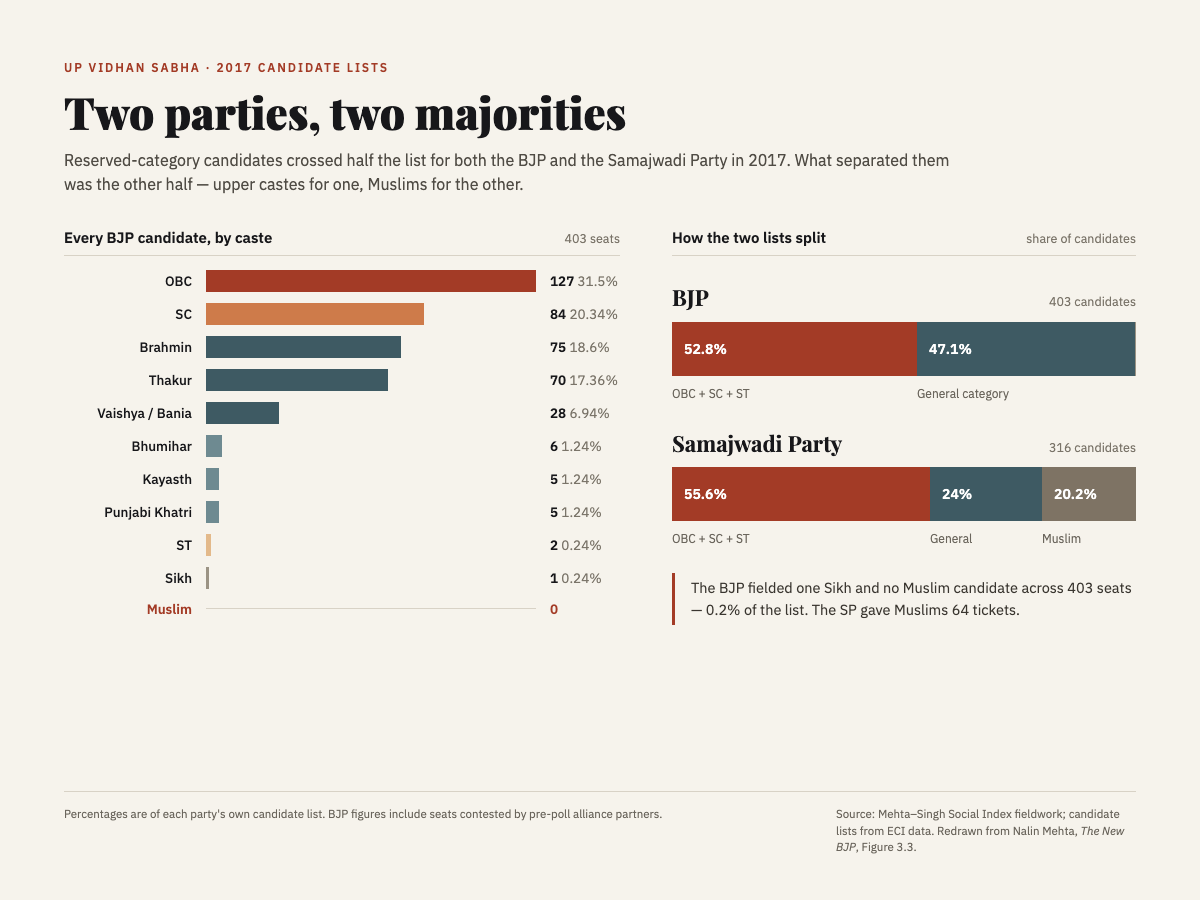
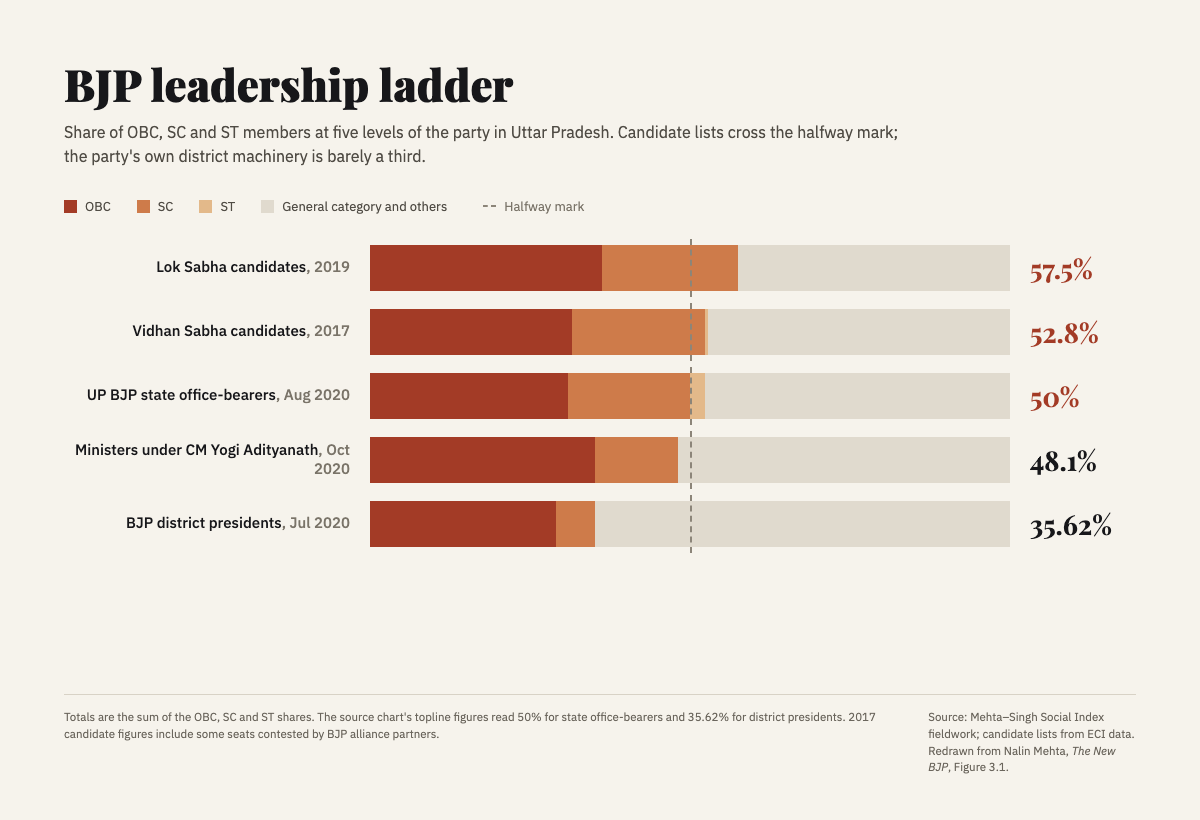
The BJP’s caste strategy, as observed by Mehta, continued its trajectory of outreach to OBCs, with 127 OBC candidates fielded. The combined percentage of OBC and Scheduled Caste candidates on the BJP’s list stood at 52.8%, showcasing a determined effort to broaden its social base. This strategic inclusivity was achieved without alienating "upper caste" voters, as the party continued to field a substantial number of Brahmins (75) and Thakurs (70), a balance facilitated by its deliberate decision not to field Muslim candidates. Key alliances with regional parties like the Apna Dal (Sonelal), which commanded a strong Kurmi base, and the Suheldev Bharatiya Samaj Party (SBSP), appealing to Rajbhars, were pivotal in stitching together this winning coalition.
2019 Lok Sabha Polls: Defying the Grand Alliance
The 2019 Lok Sabha elections presented the BJP with its most formidable challenge yet in Uttar Pradesh: a grand alliance (Mahagathbandhan) forged between the SP, BSP, and Rashtriya Lok Dal (RLD), aiming to consolidate a potent OBC-SC-Muslim vote bank. Despite this formidable opposition, the BJP managed to achieve its high point of dominance in UP, though its seat count declined compared to 2014.
In a testament to a remarkable convergence of votes across the Hindu social spectrum, the BJP won 62 of the 78 seats it contested, achieving an extraordinary vote share of almost 50%. The grand alliance faltered, failing to translate its combined vote bank into seats effectively. The RLD, despite its regional influence, failed to open its account in western UP, clearly indicating that the Jat community had largely deserted it. The BSP secured 10 seats, while the SP managed only five. Analysts noted that while SP votes largely transferred to the BSP, the reverse did not happen convincingly, partly due to lingering wariness among Dalits towards the SP, stemming from instances of attacks on their community following the SP’s 2012 state victory.
Mehta’s analysis again underscores the BJP’s shrewd social engineering. OBCs and SCs constituted 57.5% of the BJP’s candidates, a move that effectively neutralised the grand alliance’s attempted OBC-SC-Muslim consolidation. The election outcome was seen as a manifestation of a "Hindutva-plus-social-justice" vote, with clear indications of a counter-polarisation among Hindus across various castes that significantly benefited the BJP. Furthermore, the national security narrative, amplified by the Balakot airstrikes against Pakistan, added a powerful element of muscular nationalism to the BJP’s electoral appeal. Alliances with the Apna Dal (Sonelal) and the NISHAD Party further expanded the BJP’s social footprint, securing crucial community-specific votes.
2022 Assembly Polls: A Reduced but Resilient Majority
The 2022 Assembly elections witnessed a noticeable shift in the political landscape. While the BJP retained power, its tally took a hit, securing a reduced majority. The Samajwadi Party, under Akhilesh Yadav, displayed significant resurgence, with its "red zones" emerging across eastern, central, and north-west UP, signalling a more competitive contest.
The BJP won 255 seats, a decrease from 2017, but still a comfortable majority. The SP, however, significantly improved its performance, rising to 111 seats, demonstrating its ability to regain lost ground. The BJP maintained a robust 42.2% vote share, while the SP’s share rose to 32.76%. The BSP’s decline continued unabated, securing a solitary seat in Rasra, eastern UP, further cementing its marginalisation.
Beyond general anti-incumbency sentiments, the election became less one-sided due to Akhilesh Yadav’s revamped strategy. He broadened the SP’s appeal by increasing the representation of non-Yadav OBCs and forged an umbrella alliance with Om Prakash Rajbhar’s SBSP, along with other OBC-based parties such as the RLD, Apna Dal (Kamerwadi), Janwadi Party (Socialist), and Mahan Dal. This strategic outreach also involved successfully poaching prominent OBC leaders like Swami Prasad Maurya, Dara Singh Chauhan, and Dharam Singh Saini from the BJP, creating a formidable counter-narrative. The combined vote share of the SP-led alliance rose to 36.4%, though still 7.5 percentage points shy of the NDA’s vote share.
2024 Lok Sabha Polls: A Jolt and a Strategic Recalibration
The 2024 Lok Sabha elections delivered a significant jolt to the BJP in Uttar Pradesh, defying pre-poll predictions and the momentum generated by the grand inauguration of the Ram Temple in Ayodhya. This outcome forced a profound introspection within the party and significantly reshaped the political narrative.
The Opposition, particularly the SP, launched a pointed and effective attack on the BJP, alleging that its ambition for 400-plus seats nationally was a precursor to amending the Constitution and abolishing reservations for OBCs and Dalits. This narrative, amplified through grassroots mobilisation, resonated deeply with segments of these communities. Many within the BJP attributed their fall to 33 seats in the state – an 8 percentage point dip from their 2019 vote share, settling at 41.67% – to a perceived abandonment by sections of OBCs and Dalits. Moreover, signs of unease emerged among other traditional BJP strongholds: Thakurs in western UP reportedly expressed discontent over ticket distribution, while Brahmins in eastern UP felt their concerns were being ignored.
Akhilesh Yadav’s "Pichhda-Dalit-Alpsankhyak" (PDA) outreach proved remarkably effective. He strategically limited Yadav candidates to just five (all from his immediate family), instead fielding 27 non-Yadav OBCs, including a significant nine Kurmis, demonstrating a clear shift away from traditional Yadav-centric politics. The BJP, in contrast, fielded 24 non-Yadav OBCs and only one Yadav. Yadav also made a concerted Dalit outreach, fielding two more Dalits than the number of reserved SC constituencies, and broadened his appeal to "upper castes" by nominating 11 candidates, including four Brahmins. This wide social spectrum experiment clicked, allowing the SP, with 37 MPs, to remarkably edge past the BJP in the state, altering the electoral landscape significantly.
Supporting Data: Electoral Performance Snapshot (Uttar Pradesh)
| Election Year | Party | Seats Won (UP) | Vote Share (%) | Key Highlights
