

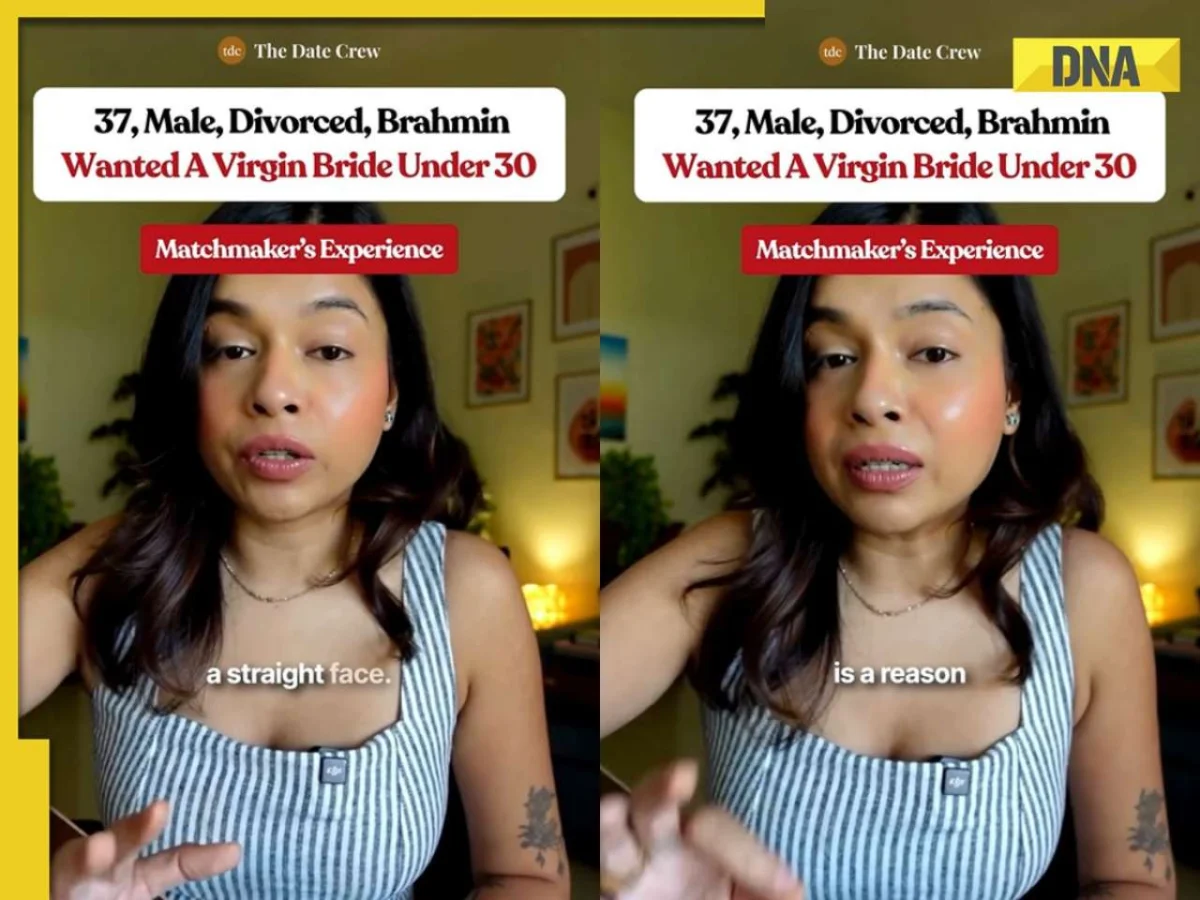
A recent viral social media post by prominent matchmaker and dating coach Oendrila Kapoor has ignited a firestorm of public discussion, exposing a controversial set of demands from a divorced, 37-year-old IIT graduate seeking a new bride. The client’s stringent criteria, which include a woman under 30, from the Brahmin community, with no prior romantic relationships and a virginity stipulation, have been widely condemned as hypocritical, outdated, and deeply misogynistic, prompting a broader re-evaluation of societal expectations in the realm of modern matchmaking and relationships.
The incident, shared by Kapoor on her social media platforms, quickly garnered widespread attention, resonating with thousands of users who expressed outrage and disbelief. The post serves as a stark illustration of the enduring double standards that persist in certain segments of society, particularly within the context of arranged marriages, and highlights the challenges faced by individuals navigating these traditional frameworks in the 21st century.
)
The Unveiling of Unrealistic Expectations: A Client’s Demands
The crux of the controversy lies in the specific requirements presented by the 37-year-old client. According to Oendrila Kapoor’s account, the man is a highly accomplished individual, boasting an educational pedigree from the prestigious Indian Institute of Technology (IIT) and holding a senior corporate position as a director at a billion-dollar company. By societal standards, he represents a desirable catch. However, his own marital history, marked by a previous divorce, did not seem to temper his exacting expectations for a future partner.

His stipulated prerequisites for a bride were notably stringent:
)
- Age: Under 30 years old.
- Community: Belonging to the Brahmin community.
- Relationship History: No prior romantic relationships.
- Sexual History: No past sexual experience, essentially a virgin.
Kapoor, who has extensive experience in facilitating matches, found these demands to be rigid and non-negotiable. The stark contrast between his own divorced status and his insistence on a partner with an unblemished, "untouched" past immediately raised red flags and became a focal point of public scrutiny.
)
Justification Based on Dubious ‘Research’ and Gendered Logic
When questioned about the rationale behind these seemingly contradictory demands, the client reportedly offered a defense rooted in what he claimed was "research." He alleged that his criteria were based on studies suggesting that women with multiple past relationships are more prone to infidelity. This assertion, however, was met with skepticism and criticism, both from Kapoor and the online community.
)
The matchmaker directly challenged the validity and fairness of this reasoning, particularly given his own marital history. She posed the logical question: if the risk of infidelity was a concern, should the same logic not apply to him as a divorced individual? His response, as recounted by Kapoor, further amplified the controversy. He reportedly dismissed the comparison, stating it was "not equivalent." When pressed for further clarification, he allegedly justified the disparity by stating, "Because I am a man."
)
This remark, highlighting a clear and unapologetic gendered double standard, proved to be a pivotal moment in the public discourse. It underscored a deep-seated belief system where men are perceived to be exempt from the same scrutiny and expectations applied to women, especially concerning their sexual and relationship histories. This perceived entitlement and the blatant application of a patriarchal lens were the primary drivers behind the intense criticism that followed.
)
The Matchmaker’s Stance: Refusal to Facilitate Bias
Oendrila Kapoor, a professional tasked with finding compatible partners, ultimately refused to take the client on. Her decision was not merely a matter of personal disapproval but stemmed from a professional assessment of the client’s mindset. She articulated that his expectations were indicative of a desire for control rather than a genuine pursuit of compatibility and a healthy partnership.
)
Kapoor argued that such rigid and biased prerequisites are unrealistic and detrimental to forming a balanced and equitable relationship. She also astutely pointed out a potential societal paradox: a woman meeting his stringent criteria would likely hail from a highly traditional background. It would be improbable for such an individual to readily accept a partner who is divorced and harbors such inflexible and judgmental views about women’s pasts. This highlights the inherent disconnect and the potential for conflict embedded within his expectations.
)
A Social Media Uproar: Condemnation and Shared Experiences
The sharing of this incident on social media platforms unleashed a torrent of reactions, predominantly critical. Users from various backgrounds coalesced to condemn the IIT graduate’s demands, labeling them as:
)
- Hypocritical: Many pointed out the glaring hypocrisy of a divorced man demanding a virgin partner, questioning his moral standing to impose such a condition.
- Outdated: The criteria were widely perceived as belonging to a bygone era, failing to acknowledge the evolving social norms and individual freedoms of women in contemporary society.
- Misogynistic: The underlying sentiment of distrust towards women with past relationships and the assertion of male privilege were seen as clear manifestations of misogyny.
- Unrealistic: The sheer difficulty of finding a woman who meets all these specific and restrictive criteria, coupled with the inherent unfairness, was a common refrain.
The online discourse was not limited to mere condemnation; it also became a platform for shared experiences. Numerous users chimed in with their own encounters with similar expectations within the context of arranged marriage discussions. These anecdotes served to underscore that while this particular case gained viral notoriety, the underlying attitudes and demands are not isolated incidents but are, unfortunately, prevalent in certain social circles.
)
The incident transcended individual client-matchmaker interactions and ignited broader conversations about:
)
- Gender Norms: The persistent and often harmful gender stereotypes that dictate acceptable behavior and expectations for men and women in relationships.
- Fairness and Equality: The fundamental principles of fairness and equality in relationships, questioning why different yardsticks are applied based on gender.
- Evolving Relationship Expectations: The need for individuals to adapt their expectations in line with contemporary societal values, emphasizing mutual respect, understanding, and partnership over control and judgment.
- The Role of Education and Success: The critique that educational achievements and professional success do not automatically translate into progressive or equitable personal values, as exemplified by the client’s archaic mindset.
Supporting Data and Broader Context
While the provided content does not include specific statistical data, the incident taps into a well-documented societal phenomenon. Research on marriage and relationship preferences in India often reveals a persistent emphasis on virginity and a lack of past relationships for brides, while similar expectations are frequently relaxed for grooms. This disparity is a recurring theme in sociological studies examining Indian family structures and marriage practices.
)
Sociologists and cultural commentators have long analyzed the influence of traditional patriarchal structures on modern Indian society. The emphasis on female purity and chastity as a reflection of family honor is a deeply ingrained cultural norm that continues to influence marriage alliances. The IIT graduate’s demands, therefore, can be seen as a manifestation of these deeply entrenched cultural beliefs, albeit amplified by his personal circumstances and perceived social standing.
)
The rise of matrimonial websites and apps has, in some ways, democratized the matchmaking process. However, it has also provided a platform for individuals to explicitly state their preferences, sometimes revealing deeply ingrained biases and expectations that might have remained more private in traditional settings. This case highlights the double-edged sword of such platforms: while they offer convenience, they can also expose and perpetuate societal inequalities.
)
Implications for Modern Matchmaking and Society
The viral post and the ensuing debate have several significant implications:
)
- Challenging the Status Quo: The widespread condemnation serves as a powerful collective voice challenging outdated notions and demanding greater fairness and equality in relationships. It pushes individuals and families to re-examine their own expectations and biases.
- The Role of Professionals: Matchmakers and dating coaches play a crucial role in not just facilitating matches but also in subtly influencing societal attitudes. Kapoor’s decision to refuse the client, coupled with her public sharing of the incident, sets a precedent for professionals to uphold ethical standards and advocate for healthier relationship paradigms.
- Education and Awareness: The incident underscores the need for continuous dialogue and education around gender equality, consent, and healthy relationship dynamics. Simply achieving academic or professional success does not guarantee progressive personal values.
- Intergenerational Dialogue: Such controversies can serve as catalysts for intergenerational conversations within families, prompting older generations to reconsider traditional views and younger generations to articulate their evolving perspectives on love, partnership, and respect.
- The Future of Arranged Marriages: As society evolves, so too must the dynamics of arranged marriages. While tradition holds value, it must be balanced with modern principles of mutual respect, individual autonomy, and genuine partnership. Cases like this highlight the potential for conflict when traditional expectations clash with contemporary realities and individual agency.
In conclusion, the case of the divorced IIT graduate’s demand for a "virgin bride" has transcended a mere social media anecdote. It has become a potent symbol of the ongoing struggle between entrenched patriarchal norms and the evolving aspirations for equality and mutual respect in modern relationships. The public outcry, while sharp, is a necessary reflection of a society grappling with its own inconsistencies and striving towards a more equitable future for all. The debate ignited by Oendrila Kapoor’s post serves as a crucial reminder that true compatibility is built on respect and understanding, not on archaic and discriminatory prerequisites.
