

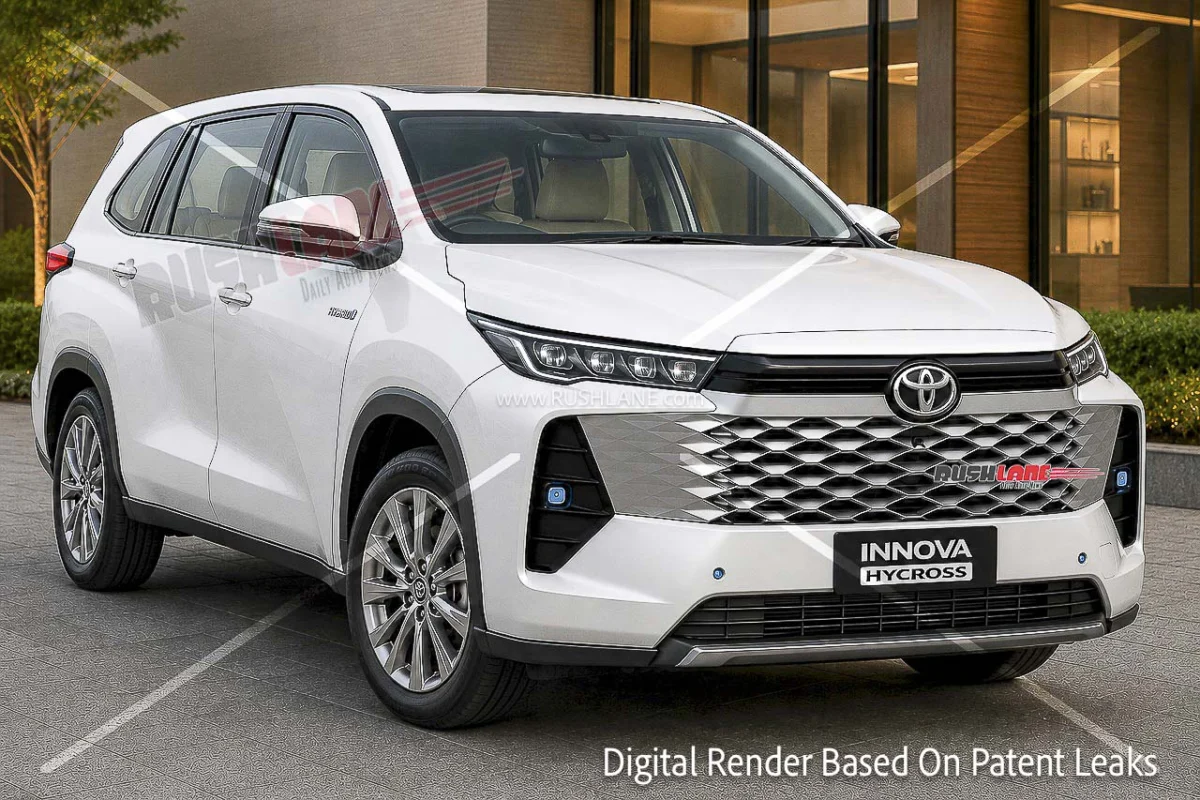
The automotive landscape is witnessing a significant shift as Toyota, the global leader in hybrid technology, prepares to refresh its crown jewel in the Multi-Purpose Vehicle (MPV) segment. The Toyota Innova Hycross, a vehicle that redefined the expectations of family transport by blending efficiency with premium comfort, is slated for a comprehensive mid-life facelift. Recent design patent leaks and test mule sightings have provided a clear window into Toyota’s strategy: a deliberate move to further "SUV-ify" the Hycross, ensuring it remains the dominant force in an increasingly competitive hybrid market.
Main Facts: The "Hilux-fication" of the Hycross
The most striking revelation from the leaked design patents is the bold aesthetic redirection of the Innova Hycross’s front fascia. Toyota appears to be harmonizing its design language across its utility vehicle lineup, drawing significant inspiration from the recently launched new-generation Hilux and the global Tacoma.
A More Assertive Exterior
The 2027 Innova Hycross facelift departs from the softer lines of its predecessor in favor of an upright, muscular stance. Key exterior changes include:

- The Grille: A new diamond-style honeycomb grille dominates the front, framed by a top black trim that mirrors the ruggedness of the Hilux.
- The Lighting: Revised swept-back headlamps integrate seamlessly into the new polygonal fog lamp housings, providing a sharper, more modern "gaze."
- The Silhouette: While the side profile retains its squared wheel arches and distinctive door creases, the more vertical front end gives the vehicle a more planted, SUV-like presence on the road.
- Rear Refinements: At the back, the changes are more subtle but equally impactful, featuring refreshed LED signatures within the existing tail lamp housing and a redesigned lower bumper.
Interior and Technological Infusion
Toyota is not merely focusing on the "skin" of the vehicle. The interior is set to receive a substantial technological upgrade to keep pace with premium rivals.
- Infotainment: The current 10.1-inch screen is expected to be replaced by a larger 12-inch (or potentially larger) high-definition touchscreen unit.
- Connectivity: An updated software suite will likely offer improved wireless integration, advanced voice commands, and enhanced telematics.
- Cabin Ambiance: Early reports suggest a shift in upholstery materials and a more refined fit-and-finish, aiming to bridge the gap between the mass-market MPV and Toyota’s luxury sub-brand, Lexus.
Chronology: From Spy Shots to Patent Leaks
The journey of the 2027 Innova Hycross facelift from a secret project to a public anticipation has followed a classic automotive development cycle.
- Initial Sightings (Early 2024): Heavily camouflaged test mules were first spotted in Southeast Asian markets and subsequently in India. These mules hinted at a redesigned front end, though the specifics remained obscured.
- Technological Rumors (Mid 2024): Industry insiders began reporting on Toyota’s plans to upgrade the interior electronics, specifically targeting the infotainment system and the 360-degree camera resolution, which had been a minor point of criticism in the current model.
- The Patent Leak (August 2024): The most recent and definitive development came via a design patent leak. The images confirmed the Hilux-inspired grille and the slatted lower bumper design, providing the basis for the high-quality digital renders now circulating in the industry.
- Market Positioning: With the patents filed, the vehicle is expected to undergo final testing throughout 2025, with a commercial launch anticipated in late 2026 or early 2027.
Supporting Data: Powertrain and Performance Metrics
Despite the radical visual overhaul, Toyota is expected to lean on its proven TNGA (Toyota New Global Architecture) powertrains. This decision underscores the company’s philosophy of "reliable innovation"—improving the interface and aesthetics while maintaining the mechanical heart that users trust.

The Hybrid Powerhouse
The flagship of the range will continue to be the 2.0-litre TNGA 4-cylinder petrol-hybrid system.
- Engine Output: 183.7 hp (Combined System Power).
- Torque: 188 Nm from the internal combustion engine and a substantial 206 Nm from the electric motor.
- Battery Tech: The system utilizes a Nickel-Metal Hydride (Ni-MH) battery, chosen for its durability and performance in varying temperature extremes.
- Transmission: An e-CVT (electronic Continuously Variable Transmission) manages the power flow, offering seamless transitions between EV, Eco, Normal, and Power modes.
The Standard Petrol Variant
For markets or buyers not yet ready to transition to hybrid tech, the 2.0-litre naturally aspirated engine remains:
- Performance: 173 hp and 204 Nm of torque.
- Transmission: Paired with a refined CVT gearbox focused on smooth urban drivability.
Market Share Data
The importance of this facelift cannot be overstated. Currently, the Innova Hycross commands nearly 50% of the hybrid car market share in India. Its success has been a primary driver in making hybrid technology a mainstream alternative to diesel in the premium MPV segment.

Official Responses and Market Context
While Toyota Kirloskar Motor (TKM) has not officially commented on the specific launch date of the 2027 facelift, the company’s recent actions speak volumes. Toyota has been working aggressively to clear the massive order backlog for the current Hycross, even temporarily pausing bookings for the top-end ZX and ZX(O) trims in the past to manage expectations.
The filing of design patents suggests that Toyota is preparing the ground for a seamless transition. Analysts suggest that the facelift is a preemptive strike to protect Toyota’s "moat" in the three-row vehicle segment. By moving the Hycross closer to an SUV aesthetic, Toyota is targeting buyers who might otherwise look at the Mahindra XUV700 or the Tata Safari, while retaining the unmatched reliability and space efficiency of the Innova brand.
Implications: Navigating a New Competitive Landscape
The 2027 Toyota Innova Hycross facelift arrives at a pivotal moment. The landscape of electrified vehicles is no longer a one-horse race.

Rising Competition
- Kia Sorento Hybrid: Scheduled for a late 2024 launch, the Sorento brings a sophisticated Korean take on the hybrid SUV, offering a different flavor of luxury and tech.
- MG Hector Tomahawk PHEV: MG’s recent entry into the Plug-in Hybrid (PHEV) space, claiming an ambitious 1,100 km range, represents a direct challenge to Toyota’s "strong hybrid" (HEV) dominance.
- The Diesel Factor: As emission norms tighten, the Innova Crysta (the diesel predecessor) continues to sell alongside the Hycross. The facelifted Hycross must be compelling enough to finally convince the "diesel-only" loyalists to make the jump to petrol-hybrid.
The Future of the "Premium MPV"
The implications of this facelift extend beyond Toyota. It signals a trend where the lines between MPVs and SUVs are permanently blurred. The "SUV-ification" of the Hycross suggests that consumers no longer want a vehicle that looks like a van, even if they require the utility of one. They demand the "commanding driving position" and "rugged aesthetics" of an SUV combined with the low floor and ingress/egress ease of an MPV.
Furthermore, by sticking with the existing powertrain, Toyota is betting that the current infrastructure (or lack thereof) for EVs still favors the self-charging hybrid. While competitors experiment with PHEVs and pure EVs, Toyota is doubling down on a formula that requires zero lifestyle changes from the consumer while delivering nearly 20-23 km/l in real-world city conditions.
Conclusion
The 2027 Toyota Innova Hycross facelift is a masterclass in strategic evolution. By borrowing the "tough" DNA of the Hilux and Tacoma and marrying it to the sophisticated hybrid internals of the TNGA platform, Toyota is ensuring that its bestseller remains relevant for the next decade. For the consumer, this means a vehicle that is more stylish, more technologically advanced, and just as bulletproof as the Innovas of the past. As the competition heats up, the Hycross is not just defending its territory—it is expanding it.
