

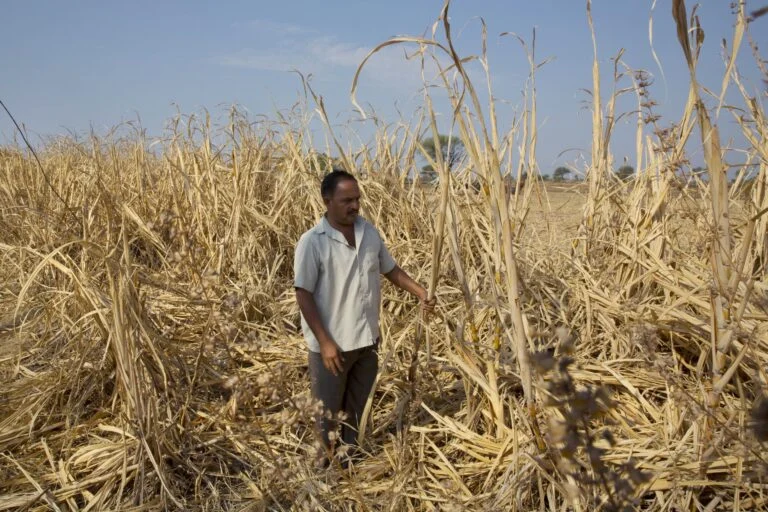
New Delhi — As the specter of El Niño looms over the Indian subcontinent, the Union Government has moved into a high-alert phase, identifying 315 districts across the country as vulnerable to the dual threats of a weak monsoon and water stress. Among these, 111 districts have been classified as "highly vulnerable," prompting an urgent overhaul of agricultural strategies and rural relief mechanisms.
The announcement comes at a critical juncture for the Indian economy, which remains deeply tethered to the performance of the southwest monsoon. With the India Meteorological Department (IMD) and global climate agencies confirming the onset of El Niño conditions, the government is racing against time to mitigate a potential agricultural crisis that could impact food security and rural livelihoods.
Main Facts: A Landscape of Vulnerability
The Ministry of Agriculture and Farmers Welfare, in coordination with the Ministry of Rural Development, has conducted a granular mapping of the country’s agricultural landscape to identify regions most at risk. The classification of the 315 districts is primarily based on their irrigation infrastructure and historical rainfall patterns.
The Tiered Vulnerability Scale
The government has categorized the affected districts into three priority levels:
- High Priority (111 Districts): These are the most critical zones where irrigation coverage is below 25%. These regions are almost entirely dependent on timely rainfall for Kharif sowing. Any significant delay or deficit in the monsoon in these areas leads to immediate crop failure and fodder shortages.
- Medium Priority (76 Districts): These districts possess irrigation coverage between 25% and 50%. While they have some access to groundwater or canal systems, they remain highly susceptible to prolonged dry spells.
- Low Priority (128 Districts): These regions have irrigation coverage exceeding 50%, supported by robust dam networks and perennial river systems. While they are "low priority" in the context of this specific crisis, they still face challenges related to reservoir depletion and groundwater recharge.
Geographical Hotspots
The vulnerability is not uniform across the country. The identified districts are concentrated in the agricultural heartlands and the rain-shadow regions of India. The primary states under watch include Madhya Pradesh, Maharashtra, Gujarat, Uttar Pradesh, Rajasthan, Karnataka, Bihar, Jharkhand, Telangana, Andhra Pradesh, and Odisha.
In Maharashtra’s Marathwada and Vidarbha regions, and parts of North Karnataka, the lack of perennial water sources makes the 2026 Kharif season particularly precarious. Similarly, the rain-fed belts of Jharkhand and Odisha are facing the threat of delayed sowing, which could drastically reduce yields for staple crops like paddy and pulses.
Chronology: From Forecast to Crisis Management
The current situation is the result of a developing climatic phenomenon that has been monitored since the beginning of the year.
- Early 2026: Global meteorological agencies, including the National Oceanic and Atmospheric Administration (NOAA) and the Australian Bureau of Meteorology, began flagging the transition from La Niña to El Niño conditions.
- April 2026: The IMD released its first long-range forecast, suggesting a "below normal" monsoon. This was a significant shift from the previous three years of relatively stable rainfall.
- May 2026: The IMD confirmed that southwest monsoon rainfall was likely to be only 90% of the Long Period Average (LPA). Following this, the central government directed states to prepare "contingency plans" for every district.
- June 2026: The onset of the monsoon was significantly delayed. By mid-June, the rainfall deficit was recorded at a staggering 43% below the normal levels for the period.
- Late June 2026: Union Minister for Agriculture and Farmers Welfare, Shivraj Singh Chouhan, addressed the media to announce the identification of the 315 vulnerable districts and the establishment of dedicated monitoring units.
Supporting Data: The Science of the Deficit
The current alarm is backed by data that paints a sobering picture of India’s water security. The IMD’s definition of a "below normal" monsoon (90% of LPA) is often the threshold where agricultural output begins to decouple from economic targets.
The El Niño Factor
El Niño involves the unusual warming of surface waters in the eastern Pacific Ocean. This phenomenon disrupts the global atmospheric circulation, typically leading to suppressed rainfall over the Indian subcontinent. Historically, El Niño years in India—such as 2009 and 2015—have been associated with severe droughts, a spike in food inflation, and a contraction in rural demand.
Current Rainfall Statistics
As of the third week of June, the national rainfall deficit stands at 43%. While some parts of Northeast India have seen excess rain, the "breadbasket" regions of Northwest and Central India are experiencing a dry start. This delay has a domino effect: it pushes back the sowing of Kharif crops (rice, maize, cotton, soybean, and pulses), shortening the growing season and making the final harvest more susceptible to the withdrawal phase of the monsoon.
Production Targets
Despite the grim forecast, the government has set an ambitious food grain production target of 176 million tonnes for the Kharif 2026 season. Achieving this will require nearly perfect execution of the "alternative crop strategy" in the 111 high-priority districts.
Official Responses: Strategies for Resilience
Union Minister Shivraj Singh Chouhan has emphasized that while the situation is serious, it is manageable through "preparedness and collective action." The government’s response is multi-pronged, focusing on agricultural adaptation, resource management, and administrative oversight.

1. The "Short-Duration" Crop Pivot
The Ministry of Agriculture has issued advisories to states to promote short-duration crop varieties. These are seeds engineered to mature in 60 to 90 days, as opposed to the standard 120-day cycle.
"Changing crop strategy in rain-fed areas has become the need of the hour," Chouhan stated. If the rainfall gap extends beyond the normal sowing window, farmers are being encouraged to switch from water-intensive crops like paddy to millets, oilseeds, or pulses, which require significantly less moisture.
2. Water Conservation and MGNREGA
The Ministry of Rural Development has been directed to prioritize water harvesting projects under the Mahatma Gandhi National Rural Employment Guarantee Act (MGNREGA). By focusing on desilting ponds, building check dams, and constructing "farm ponds," the government aims to provide immediate employment to distressed farmers while simultaneously building infrastructure to capture whatever rainfall does occur.
3. Fodder and Livestock Protection
A weak monsoon often leads to a "green fodder" famine, which can devastate the dairy sector—a secondary source of income for millions of Indian farmers. The Union Government is currently mapping fodder-surplus regions (largely in the north) to create a logistics pipeline to transport fodder to deficit areas in the west and south.
4. Institutional Oversight
To ensure that the response is dynamic, two new bodies have been activated:
- The El Niño Monitoring Cell: A cross-departmental unit that tracks Pacific sea-surface temperatures and their real-time impact on Indian weather patterns.
- The Crop Weather Watch Group: A technical committee that meets weekly to assess crop health, soil moisture levels, and pest infestations, which often increase during dry, humid conditions.
Minister Chouhan also confirmed that secretary-level reviews are being conducted every week to ensure that the states are not lagging in their implementation of the contingency plans.
Implications: The Broader Socio-Economic Lens
The identification of 315 vulnerable districts is more than an agricultural statistic; it is a warning for the broader Indian economy. The implications of a weak monsoon under El Niño are far-reaching.
Food Inflation and the Economy
Agriculture contributes approximately 15-18% to India’s GDP but employs nearly half of the workforce. A shortfall in Kharif production, particularly in pulses and oilseeds, could lead to a surge in food inflation. This, in turn, would limit the Reserve Bank of India’s (RBI) ability to lower interest rates, potentially slowing down industrial growth.
Rural Distress and Migration
In the 111 highly vulnerable districts, a failed crop often leads to a cycle of debt. If the alternative crop strategies fail, there is a high risk of increased rural-to-urban migration as laborers seek work in cities to compensate for lost agricultural income. The government’s reliance on MGNREGA is a strategic move to provide a "safety net" to keep the rural workforce anchored.
The Climate Change Context
The current crisis underscores a larger trend: the increasing unpredictability of the Indian Monsoon due to climate change. While El Niño is a natural phenomenon, its frequency and intensity are being modulated by global warming. The government’s shift toward "short-duration varieties" and "water-thrifty crops" marks a necessary transition toward climate-resilient agriculture.
Energy Demand
A weak monsoon also implies higher temperatures and lower reservoir levels. This creates a double-whammy for the energy sector: increased demand for electricity to power irrigation pumps in parched fields, and reduced hydroelectric power generation. The government will need to manage the coal and renewable energy mix carefully to prevent power outages during the peak of the dry spell.
Conclusion
The Union Government’s proactive identification of 315 districts signals a departure from "reactive" disaster management toward a "preventative" framework. By categorizing districts based on irrigation and providing a clear roadmap for crop substitution, the administration is attempting to decouple agricultural success from the vagaries of the clouds.
However, the success of this plan rests on the last-mile delivery—ensuring that seeds for alternative crops reach the smallest farmers in the remotest parts of Jharkhand or Maharashtra. As Minister Chouhan noted, there is "no need to panic," but the coming months will undoubtedly test the resilience of India’s agricultural infrastructure and the efficiency of its federal coordination. For the millions of farmers in the 111 high-priority districts, the next few weeks of the monsoon’s trajectory will be the difference between a difficult season and a full-scale livelihood crisis.
