

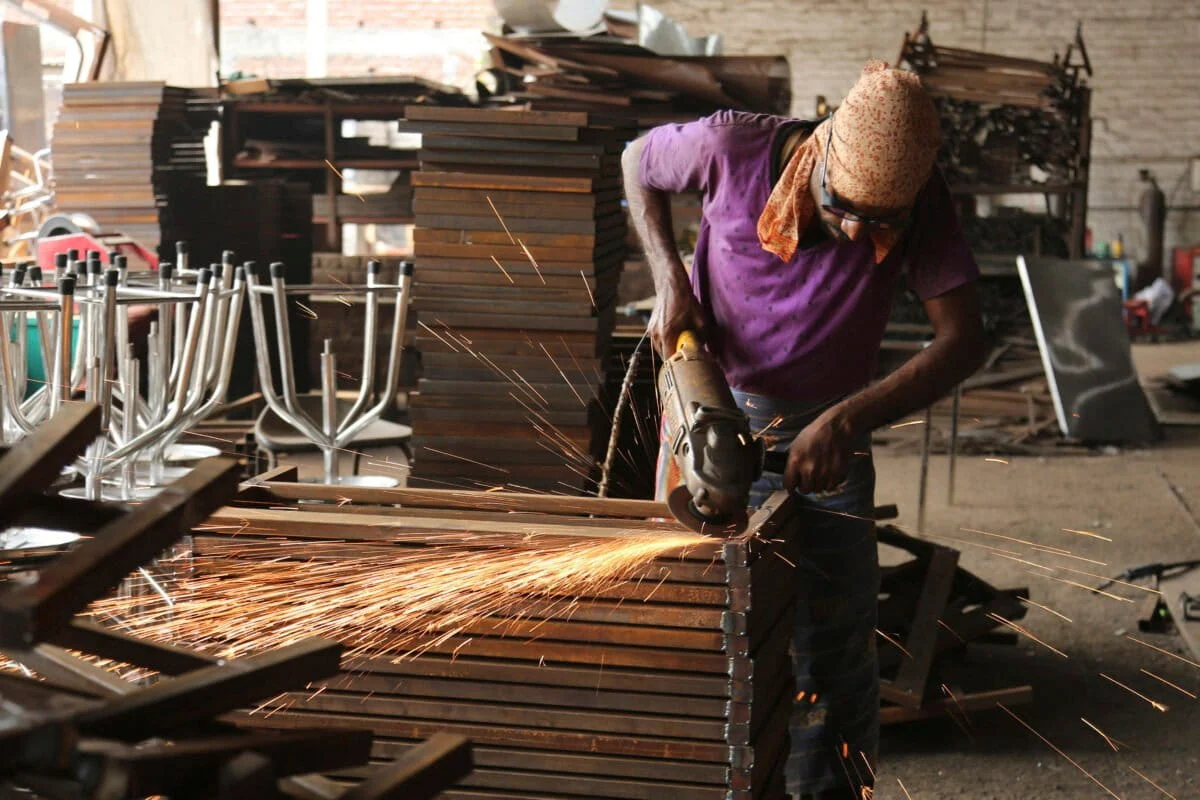
India’s industrial backbone is currently facing an existential transformation. For decades, the clanging of hammers in Kolhapur and the roaring kilns of Raipur have defined the nation’s journey toward becoming a global manufacturing powerhouse. However, as the world pivots toward a low-carbon economy, these traditional industrial clusters—dominated by Micro, Small, and Medium Enterprises (MSMEs)—find themselves caught between the demands of domestic growth and the stringent environmental regulations of the international market.
The central challenge is two-fold: India must decarbonize its secondary steel sector to meet its 2070 net-zero targets, while simultaneously shielding its MSMEs from the economic shock of the European Union’s Carbon Border Adjustment Mechanism (CBAM). This report examines the historical evolution of these clusters, the data behind their environmental footprint, the policy gaps in current green schemes, and the looming implications for India’s position in the global trade arena.
1. Main Facts: The Engine of India’s Secondary Steel
India is currently the world’s second-largest producer of crude steel, but the structure of its industry is unique. Unlike many Western nations where production is concentrated in a few massive plants, a significant portion of India’s output comes from the "secondary" route.
The Secondary Sector Defined
Secondary steel production involves melting scrap metal and other processed forms of iron, such as Direct Reduced Iron (DRI) or "sponge iron," in electric arc furnaces (EAF) or induction furnaces (IF). This is distinct from the "primary" route, which produces iron directly from ore using massive blast furnaces. The secondary sector contributes approximately 30-35% of India’s total crude steel capacity.

The Geographic Hubs
Two regions exemplify the diversity and scale of this sector:
- Raipur, Chhattisgarh: Located near the historic Bhilai Steel Plant (one of India’s first public sector giants), Raipur has evolved into a hub for MSME steel units. It is the heart of India’s sponge iron industry, helping Chhattisgarh become the nation’s third-largest crude steel producer.
- Kolhapur, Maharashtra: This region’s industrial identity grew from its agricultural roots. The demand for irrigation pumps and farming machinery in the 1960s birthed a massive foundry industry. Today, Kolhapur is one of India’s largest foundry clusters, contributing 7-8% of the country’s total casting production, serving sectors from automobiles to textiles.
The Carbon Footprint
While these MSMEs are the lifeblood of local economies, they are also significant emitters. The secondary steel route accounts for more than 50 million tonnes (MT) of greenhouse gas emissions annually. To put this in perspective, this exceeds the total annual emissions of Norway (46.7 MT). Within the MSME sector specifically, the forging, foundry, and steel re-rolling industries alone emitted 32 million tonnes of CO2 equivalent in 2022.
2. Chronology: From Industrial Roots to Trade Barriers
The journey of India’s steel MSMEs is a timeline of rapid expansion followed by a sudden collision with global climate policy.
- 1950s-1960s: The Foundation. Post-independence India establishes the Bhilai Steel Plant. Simultaneously, Kolhapur’s agricultural boom creates a localized demand for metal castings, leading to the birth of the foundry clusters.
- 1990s-2010s: The MSME Explosion. Liberalization and infrastructure growth lead to the mushrooming of scattered steel units in Raipur and other regions. These units fill the gap for construction-grade steel (TMT bars) and specialized castings.
- 2021: The CBAM Proposal. The European Union proposes the Carbon Border Adjustment Mechanism, a "carbon tax" on energy-intensive imports including steel, aluminum, and cement.
- 2022-2023: India’s Response. India raises concerns at the World Trade Organization (WTO), arguing that CBAM is a trade barrier that unfairly penalizes developing nations. Domestically, the Ministry of MSME launches the RAMP (Raising and Accelerating MSME Performance) program to encourage green transitions.
- January 2026: The New Reality. CBAM becomes fully operational. Simultaneously, the EU and India sign a Free Trade Agreement (FTA) on January 27, 2026. Despite Indian lobbying, the FTA provides no exemptions for MSMEs, offering instead a €500 million support package for industrial transformation.
3. Supporting Data: The Financial and Technical Gap
Despite the availability of government schemes, the transition to "Green Steel" is stalled by low uptake and structural barriers. Data from the 2025 Institute of Energy Economics and Financial Analysis (IEEFA) report and government portals reveal a stark disparity between policy intent and ground reality.
The Failure of Subsidy Schemes
The RAMP program introduced two primary sub-schemes to aid MSMEs, yet the disbursement rates are alarmingly low:

-
MSE-SPICE (Circular Economy):
- Goal: Promote circular economy practices with a 25% capital subsidy.
- Target: 3,400 units.
- Actual Benefit: Only 7 units have utilized the scheme.
- Disbursement: Just ₹7.553 million out of a ₹4.5 billion outlay (0.16%).
-
MSE-GIFT (Green Investment):
- Goal: Provide a 2% interest subvention on green technology loans.
- Outlay: ₹4.78 billion.
- Disbursement: Only ₹287.3 million (8.2%) has been reached.
Barriers to Entry
Why are MSMEs not taking the money? Industry experts point to several systemic issues:
- Subsidy Caps: In Chhattisgarh, a small steel re-rolling mill with 1 MW of solar capacity costs nearly ₹10 million. A 2% interest subvention on a ₹20 million loan cap is viewed by owners as insufficient to offset the high capital risk.
- The Audit Hurdle: To qualify for green funds, a company must conduct a detailed energy audit and prepare a complex Project Report (DPR). Most MSMEs are "single-person" managed companies that lack the technical staff to navigate this bureaucracy.
- Accounting Standards: Many smaller units do not maintain the formal accounting practices required by banks to secure loans, effectively locking them out of the formal financial system.
4. Official Responses: The Policy Debate
The tension between the Indian government’s diplomatic stance and the EU’s regulatory framework has created a complex landscape for trade negotiators.
The Trade Perspective
Sangeeta Godbole, a former trade negotiator, emphasizes that empowering MSMEs is no longer optional. "If India really has to access the global market, you need to empower the MSMEs," she notes. However, the legal reality is sobering. R.V. Anuradha of Clarus Law Associates points out that by including a "CBAM Annex" in the latest FTA, India may have tacitly acknowledged the tax as a legitimate measure, making it harder to challenge at the WTO in the future.

The Government’s Defense
Vinamra Mishra, Joint Secretary of the Ministry of MSME, acknowledges the low uptake of schemes but points to a lack of "rigorous looking" at circular solutions by the MSMEs themselves. The government is now planning to expand the scope of these schemes to include "greenfield" (new) projects and increase the quantum of financial assistance.
The EU’s Commitment
The European Union has committed €500 million over two years to help India cut emissions. However, this support is subject to "EU budgetary rules," and critics argue it is a drop in the ocean compared to the billions required to overhaul India’s entire secondary steel infrastructure.
5. Implications: The Future of "Made in India"
The survival of India’s steel MSMEs depends on their ability to pivot from coal-heavy production to renewable energy and efficient technologies. The implications of this transition are far-reaching:
1. The Export Crisis
India’s iron and steel sector is the most exposed to CBAM. Without a rapid shift to lower-carbon production, Indian steel will become significantly more expensive in European markets, potentially handing a competitive advantage to countries with cleaner power grids or more advanced primary steel sectors.
2. The Need for ESCOs
Experts like Shantanu Srivastava of IEEFA suggest that the government must bridge the gap using Energy Service Companies (ESCOs). These companies can fund the upfront capital for green projects and be paid back through the energy savings realized by the MSME. This removes the debt burden from the MSME’s balance sheet.

3. The "Green Premium" Problem
Perhaps the most significant hurdle is the lack of a market incentive. As Vijay Patil of Caspro Metal Industries in Kolhapur noted, even after installing 1.9 MW of solar power, green-produced castings do not fetch a higher price than conventional ones. Without a domestic or international "green premium," MSME owners see decarbonization as a cost rather than an investment.
4. Skill and Technology Management
The "old pattern" of steelmaking is deeply ingrained. Decarbonization is not just about changing a fuel source; it requires a complete re-skilling of the workforce to manage electric furnaces, scrap sorting technologies, and energy management systems.
Conclusion
Raipur and Kolhapur represent the dual nature of India’s industrial ambition: a sector with the power to drive national growth but burdened by a legacy of carbon-intensive technology. As the EU’s carbon wall rises, the Indian government’s challenge is no longer just about providing subsidies—it is about creating a comprehensive ecosystem of technical support, formal financing, and market-based incentives. For the thousands of small mills across the country, the next five years will determine whether they remain the backbone of India’s economy or become a casualty of the global climate transition.
