

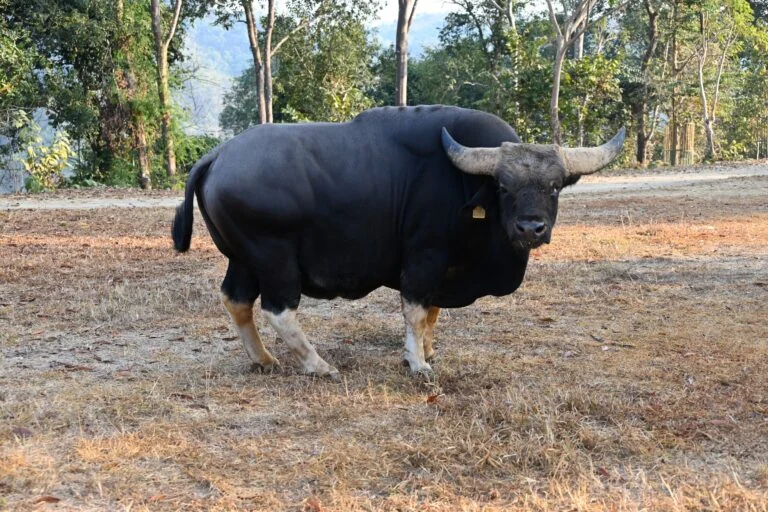
In the rugged, mist-shrouded hills of Arunachal Pradesh, the measure of a man is not always found in his bank balance or the make of his car. For the Indigenous communities that have inhabited these eastern Himalayan slopes for millennia, prestige is measured in muscle, horns, and the semi-wild grace of the mithun (Bos frontalis). However, behind the traditional reverence for this unique bovine lies a complex story of cultural anxiety, genetic vulnerability, and a pioneering scientific effort to save a species from a slow, invisible decline.
Main Facts: The Bovine of Prestige and the Science of Survival
The mithun, often described as the "Pride of the Northeast," occupies a biological niche that defies easy categorization. Neither fully domesticated like cattle nor truly wild like the gaur, it is a semi-free-ranging bovine that roams the community forests of Arunachal Pradesh, Nagaland, Manipur, and Mizoram. It is central to the socio-economic and cultural fabric of tribes such as the Adi, Nyishi, Galo, and Mishmi.
Recent scientific breakthroughs have shifted the focus from the animal’s cultural value to its genetic integrity. A landmark study, the first population-level whole-genome analysis of the Arunachali mithun, was published in the International Journal of Molecular Sciences. This research, led by scientists at the ICAR-National Research Centre (NRC) on Mithun, has identified a distinct genetic population now known as the "Siangmi" breed.

The study’s findings are a double-edged sword. While they confirm the existence of a unique, genetically homogeneous breed in the Siang region, they also reveal a concerning trend: a shrinking "effective population size." Despite a census population of nearly 384,000 mithuns in India—70% of which reside in Arunachal Pradesh—the genetic diversity of the animals is under threat due to traditional husbandry practices that inadvertently encourage inbreeding.
Chronology: From Ancestral Wealth to Genomic Mapping
The evolution of mithun management has transitioned through several distinct phases, moving from purely customary law to modern genomic intervention:
- Pre-Colonial to Late 20th Century: For generations, mithuns served as the primary currency for bride prices, dispute settlements, and ritual sacrifices. Ownership was a transparent indicator of a family’s standing. The animals were left to roam village territories, mating naturally in the wild with minimal human interference.
- 2019: The 20th Livestock Census of India provided the most comprehensive count to date, highlighting Arunachal Pradesh as the global stronghold for the species. This data spurred the ICAR-NRC to begin a more rigorous characterization of different mithun populations.
- 2023: A major milestone was reached when the ICAR-NRC on Mithun successfully registered the "Nagami" mithun as the world’s first recognized breed. This established a precedent for formal breed recognition, which is a prerequisite for accessing federal livestock benefits.
- Early 2024: Researchers published the whole-genome re-sequencing of the Arunachali mithun. By analyzing 30 gigabases of DNA sequence from representative animals, they established a genomic baseline, identifying five million high-quality single nucleotide polymorphisms (SNPs) that act as genetic markers for the breed.
- Present Day: The Jomlo Mongku Mithun Farmers’ Federation, in collaboration with ICAR, has begun a massive ear-tagging and vaccination drive, covering over 16,000 "Siangmi" mithuns to date, preparing the ground for an official Geographical Indication (GI) tag.
Supporting Data: The Genetic Warning Signs
The genomic study provides a granular look at the health of the mithun population that observational data simply cannot capture. The research focused on the Siang region, encompassing districts such as East Siang, Upper Siang, and Shi Yomi.
The "Siangmi" Identity
The study confirmed that the mithuns in the Siang region are phenotypically and genetically distinct. They possess a characteristic convex forehead and horns that are shorter and smoother than other populations. The lack of genetic sub-structure among the sampled animals indicates that the "Siangmi" is a homogeneous, connected population—a vital finding for its registration as a formal breed.

The Inbreeding Paradox
Using a metric known as Runs of Homozygosity (ROH), scientists looked for segments of the genome where an individual inherits identical genetic sequences from both parents. While 93% of these segments were relatively short (suggesting historical rather than recent intensive inbreeding), the cumulative data points toward a "moderate" level of genomic inbreeding.
The Effective Population Size (Ne)
Perhaps the most startling data point is the "effective population size." While the census suggests there are 20,000 Siangmi mithuns, the genetic Ne—the number of individuals effectively contributing to the next generation’s gene pool—is estimated at just 160.
"This Ne size suggests the population has not yet reached a stage of irreversible genetic erosion," explains Harshit Kumar, a scientist in Animal Genetics and Breeding at NRC-Mithun. "But it is at a point where timely interventions are needed to prevent a further decline in the population’s ability to resist disease and adapt to environmental changes."
Official Responses: Bridging Tradition and Policy
The move to modernize mithun rearing is met with both enthusiasm and a sense of urgency from officials and community leaders.

Girish Patil S, Director of the ICAR-NRC on Mithun and lead on Project Siangmi, emphasizes that formal breed recognition is not just a scientific exercise but an economic necessity. "Unless a population is recognized as a breed, farmers cannot effectively avail the benefits of Central Sector schemes, like the National Livestock Mission and the Rashtriya Gokul Mission," Patil stated. These programs provide the subsidies and infrastructure support necessary to transition from subsistence rearing to sustainable commercial ventures.
Tadang Tamut, chairman of the Jomlo Mongku Mithun Farmers’ Federation, represents the voice of the breeders. For him, the scientific discovery of the "Siangmi" breed validates centuries of Indigenous knowledge. "We have been rearing mithuns for generations, yet we never knew they were a different breed. According to scientists, this is probably the oldest mithun breed in the world," Tamut said.
The Federation has signed a Memorandum of Understanding (MoU) with the NRC-Mithun to implement a structured management system. This includes individual animal identification—a radical shift for a community where animals are traditionally identified by ear notches or general appearance.
Implications: Status, Economics, and Conservation
The shrinking number of mithuns owned by individual families, as seen in the case of entrepreneurs like John Pei Cander, reflects a broader socio-economic shift. Cander, who owns an SUV and a two-story concrete house, still feels a sense of loss because his herd has dwindled from his father’s 30 animals to just four. This "shame of the single digit" highlights that for the people of Arunachal, the mithun is an "inheritance of status" that modern wealth cannot fully replace.

The implications of the genomic study suggest three critical paths forward for the conservation of the species:
1. From Counting to Genetic Management
The study argues that conservation must move beyond simple population counts. The "semi-free-ranging" system, while culturally vital, allows for "sire dominance," where a few strong bulls father most of the calves in a territory. Over decades, this reduces genetic variance. Scientists are now advocating for a system of "parentage verification" using the genomic tools developed in the study to ensure that breeding bulls are rotated and that mating between close relatives is avoided.
2. The GI Tag and Economic Protection
The pursuit of a Geographical Indication (GI) tag for the Siangmi breed is seen as a shield against crossbreeding. As cattle and other livestock are introduced to the region, the risk of hybridization increases. A GI tag would provide legal protection to the Siangmi’s unique identity and potentially increase the market value of its meat and milk, which was recently approved for commercial consumption by the FSSAI.
3. Infrastructure and Record Keeping
The study identified a massive gap in performance records. Currently, there is no data linking specific animals to traits like growth rate, fertility, or disease resistance. By combining the new genomic baseline with individual ear-tagging and biometric identification, the ICAR-NRC hopes to create a "performance-linked" breeding program. This would allow farmers to select for the healthiest and most productive animals, ensuring the breed’s survival in an increasingly volatile climate.

As Arunachal Pradesh continues to modernize, the mithun stands at a crossroads. The transition from a symbol of ancestral wealth to a scientifically managed genetic resource is fraught with challenges, but it may be the only way to ensure that the "Pride of the Northeast" does not fade into a mere memory of a father’s legacy. The genome of the Siangmi has been mapped; the task now is to ensure that the animal continues to roam the hills for generations to come.
