

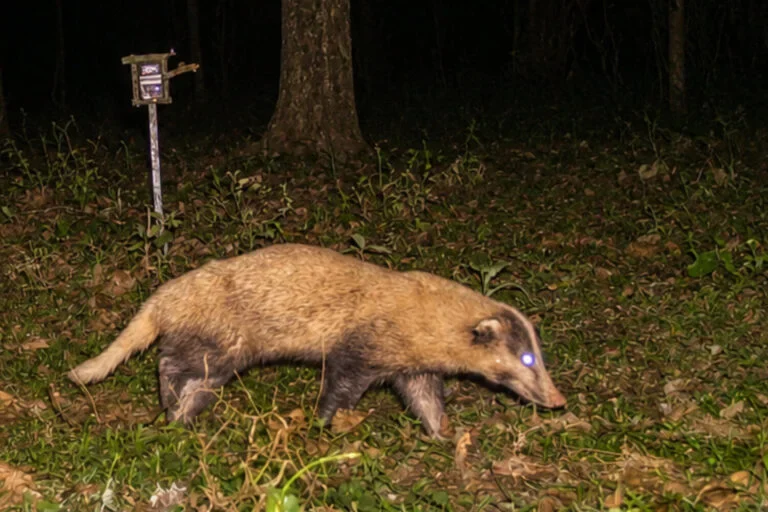
For decades, the dense woodlands and sprawling tall grasslands of Kaziranga National Park and Tiger Reserve (KNPTR) in Assam have been defined in the public imagination by their "Big Five": the one-horned rhinoceros, the Royal Bengal tiger, the Asian elephant, the wild water buffalo, and the swamp deer. However, beneath the canopy and within the undergrowth of this UNESCO World Heritage site exists a world of elusive "mesocarnivores"—smaller predators that play vital but often overlooked roles in the ecosystem.
Chief among these enigmatic residents is the greater hog badger (Arctonyx collaris). While forest guards on night patrols have long reported sporadic sightings of a pig-snouted, badger-like creature scurrying into the shadows, the species remained a scientific mystery in the region. That changed in June with the publication of the park’s first-ever comprehensive scientific assessment of the species. The study, a collaborative effort between the Kaziranga Tiger Cell, the Wildlife Conservation Trust (WCT), and The Fishing Cat Project, has finally provided a data-driven baseline for one of Asia’s least-studied mammals.
Main Facts: A Baseline for a Hidden Resident
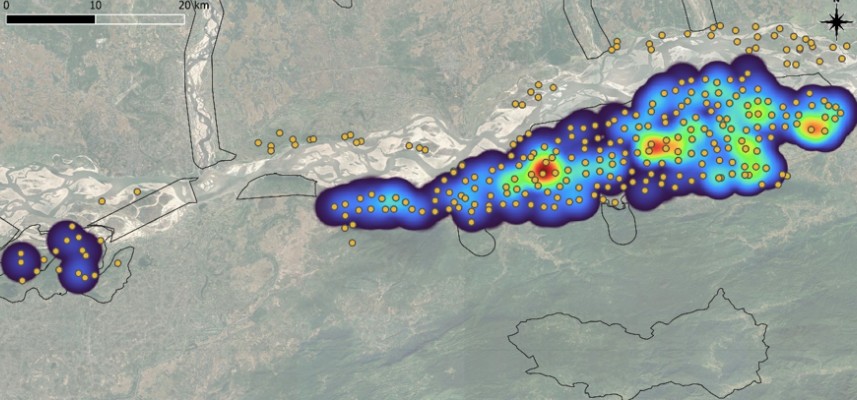
The assessment reveals that the greater hog badger is far more prevalent in the Kaziranga landscape than previously assumed. Surveying an area of 1,100 square kilometers, researchers estimated a minimum population of 55 individuals. While that number might seem modest for a landscape of such size, the data suggests a high level of distribution; the species was found to occupy nearly 50% of the surveyed grids.
Listed as "Vulnerable" on the International Union for Conservation of Nature (IUCN) Red List, the greater hog badger is a nocturnal mammal characterized by its distinctive elongated snout, powerful claws for digging, and a stocky build. In India, it is afforded the highest level of legal protection under Schedule I of the Wildlife (Protection) Act, 1972, placing it on par with the tiger and the rhino in terms of conservation priority.

Despite this legal status, the "mati gahori"—or "earth pig," as it is known in Assamese—has suffered from a "research vacuum." Because it is nocturnal and elusive, gathering reliable data on its population density, habitat preferences, and behavior has historically been difficult. The new assessment marks a turning point, transforming anecdotal evidence into a scientific foundation for future conservation strategies.
Chronology: From Tiger Tracks to Badger Burrows
The journey toward this discovery began not with a search for badgers, but as part of the massive All India Tiger Estimation (AITE) 2026 exercise. Between February and May, hundreds of camera traps were deployed across the diverse terrain of Kaziranga to monitor the park’s apex predator.
As researchers began the painstaking process of analyzing thousands of images, a pattern emerged. The greater hog badger, though rarely seen by human eyes, was frequently triggering the infrared sensors of the camera traps. Recognizing a unique opportunity to study a neglected species, the Kaziranga Tiger Cell partnered with specialized NGOs to extract and analyze data specifically pertaining to Arctonyx collaris.
Over the four-month period, the species was independently detected 140 times across 857 different camera-trap locations. This data was then processed using the Royle-Nichols occupancy-abundance model. This statistical method is particularly favored by wildlife biologists because it accounts for "imperfect detection"—the high likelihood that an elusive animal is present in an area even if it doesn’t happen to walk past a camera during the survey period.
By June, the findings were finalized, offering the first clear map of the badger’s spatial distribution across the park. The results were a revelation for park management, proving that the species was not just a peripheral resident but a core component of the Kaziranga ecosystem.
Supporting Data: Understanding the Occupancy Model
The data derived from the 2026 assessment provides a nuanced look at how the greater hog badger utilizes the Kaziranga landscape. The Royle-Nichols model estimated that while the minimum count is 55, the true population is likely significantly higher. This discrepancy is explained by the "detection probability," which was calculated at only 20% per survey occasion.
"The survey was originally designed for tigers," explained C. Ramesh, the Director of Kaziranga National Park. "Tigers have massive home ranges, and camera traps are spaced accordingly. A smaller mammal like the hog badger has different movement patterns and a smaller range. If we were to design a survey specifically for badgers with tighter camera spacing, we would almost certainly find a much larger population."
The assessment also highlighted a clear habitat preference. While the hog badger is often found near the edges of Kaziranga’s famous tall grasslands, it is most active within the woodland areas. The study showed that the species thrives in "pristine" environments—areas with minimal human disturbance and high ecological integrity.
Interestingly, the data also served as a diagnostic tool for habitat health. In grids where invasive plant species had begun to choke the native undergrowth, hog badger activity dropped significantly. This makes the species an "indicator species," whose presence or absence can signal the early stages of habitat degradation.
Official Responses: The Importance of Mesocarnivores
The publication of the assessment has been met with enthusiasm by both park officials and conservationists, who believe it signals a shift toward a more holistic approach to park management.

C. Ramesh emphasized the psychological impact of the species on those who work in the field. "The greater hog badger is an elusive nocturnal mammal. Spotting one in the wild is rare; it could be a ‘call it a day’ moment for a researcher or a guard—a sign of immense good luck," he said. He noted that the camera trap results were "quite surprising," particularly the fact that they appeared in half of the surveyed grids.
Arun Vignesh, the Divisional Forest Officer (DFO) of Kaziranga, highlighted the species’ role as a sentinel for the park. "If there is a reduction in sightings in an area where we used to see them regularly, our staff report it through the M-STrIPES (Monitoring System for Tigers – Intensive Protection and Ecological Status) application," Vignesh stated. "This allows us to assess what ecological changes, such as the spread of invasive species, might be occurring."
However, despite the scientific interest, there remains a cultural gap. Uttam Saikia, a former Honorary Wildlife Warden of Kaziranga, pointed out that the hog badger is virtually absent from the rich oral traditions of the region. "Unlike the rhino or the elephant, which are central to Assamese folklore, there are no oral tales associated with the greater hog badger," Saikia noted. "Even local communities know very little about them, other than the name mati gahori."
Ecological Implications: The Hidden Architect
The greater hog badger is more than just a biological curiosity; it is a "hidden architect" of the forest floor. As a fossorial (burrowing) species, its daily activities have a profound impact on the physical and chemical makeup of the soil.
1. Soil Aeration and Nutrient Cycling:
By constantly digging for tubers, roots, and invertebrates, the hog badger churns the soil. This behavior enhances soil aeration, allowing oxygen to reach plant roots more effectively. Furthermore, as they dig, they incorporate leaf litter and organic matter into the deeper soil layers, accelerating the redistribution of nutrients.

2. Seed Germination and Microhabitats:
The disturbances created by their digging provide ideal conditions for the germination of certain plant seeds that require "scuffed" earth to take root. Additionally, the small pits and burrows they leave behind create microhabitats for smaller vertebrates and invertebrates, fostering a more diverse micro-ecosystem.
3. The Flood Survival Mystery:
One of the most pressing questions remaining for researchers is how the hog badger survives Kaziranga’s legendary annual floods. Every monsoon, the Brahmaputra River overflows, submerging vast tracts of the park. While larger animals migrate to the Karbi Anglong hills, the movements of the hog badger remain unknown.
"They hardly move to human settlements during floods," said Uttam Saikia. "Some of our staff have reported seeing them climb trees or perched on fallen logs to stay above the water level." Arun Vignesh added that the park is keen to study their nesting habits specifically to see if their burrows are engineered with flood-resistance in mind—a common trait among highly adapted floodplain species.
Conclusion: Looking Beyond the Icons
The assessment of the greater hog badger represents a maturing of wildlife conservation in India. For years, the focus was understandably on "charismatic megafauna"—the giants of the jungle whose survival was at a tipping point. However, as the populations of tigers and rhinos stabilize in Kaziranga, the focus is expanding to include the smaller, quieter components of the ecosystem.
The discovery that the hog badger is widespread across 50% of the park is a testament to the health of Kaziranga’s woodlands, but it also serves as a warning. As habitat fragmentation and road development continue around the park’s periphery, these elusive mammals are often the first to suffer from "silent" population declines.

For now, the Kaziranga Tiger Cell plans to integrate hog badger monitoring into its regular camera-trapping cycles. By keeping a watchful eye on the "earth pig," park authorities are ensuring that the hidden architects of the forest continue to dig, aerate, and sustain the landscape for generations to come. The story of the greater hog badger is a reminder that in the wild, the most important work is often done in the dark, beneath the soil, and far from the spotlight.
