

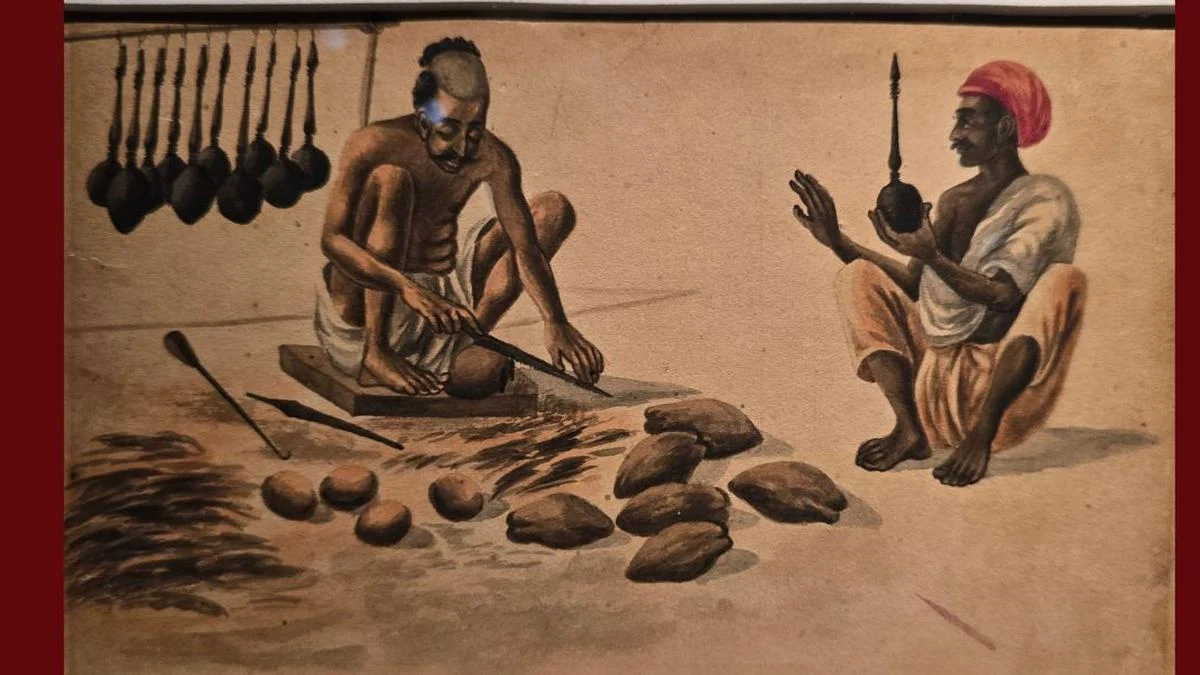
In the quiet corridors of the Bihar Museum, far from the honking rickshaws and bustling markets of modern-day Patna, a window into the 18th century has been carefully propped open. Here, the artworks do not depict the divine or the royal in the traditional, grandiosity-laden manner of Indian history. Instead, they offer a stark, delicate realism: two men in dhotis laboring over the vats of a distillery; a woman in a vibrant blue-and-yellow ghaghra dancing with rhythmic abandon in a palace hall; a roadside baniya (grocer) meticulously weighing pulses.
These are the hallmarks of Patna Kalam, a unique school of painting that served as the pre-photographic visual documentation of North Indian life. Long relegated to the dusty archives of London’s Victoria & Albert Museum or locked away in private trunks in Bihar, this nearly extinct art form is currently witnessing a tentative but passionate revival. Following a major exhibition at the Bihar Museum Biennale 2025 and the Patna Kalam: Ek Virasat showcase, the art world is asking a vital question: can a tradition built to capture the vibrant pulse of daily life survive outside the sterile protection of a glass display case?

I. The Essence of the "People’s Art"
Patna Kalam occupies a unique niche in the history of Indian aesthetics. Often categorized under the broader umbrella of the "Company School" (an Anglo-Indian style influenced by British patronage), it developed a personality entirely its own, rooted deeply in the soil of Patna.
Technical Precision and Minimalist Beauty
Unlike the opulent Mughal miniatures that preceded it, Patna Kalam is characterized by its restraint. According to art teacher Dinesh Kumar, the style is largely bereft of heavy ornamentation. There is no dramatic play of light and shadow, nor are there the elaborate, crowded backgrounds found in Rajasthani or Pahari paintings. Instead, the focus is singular and sharp.

The artists typically used watercolours on imported paper or, quite uniquely, on sheets of mica (locally known as abrak). The technique, often referred to as Kajli Syahi, involved using the brush directly to create the image without a preliminary pencil sketch. This required an extraordinary level of confidence and precision. The backgrounds were often left pale or entirely bare, ensuring that the human subject—their posture, their clothing, and their labor—remained the undisputed protagonist.
A Secular Documentation
The most striking feature of Patna Kalam is its subject matter. While other contemporary schools focused on the lives of gods or kings, Patna Kalam looked toward the street. It captured the "firka"—sets of paintings depicting various occupations. These included:

- Artisans at work: Blacksmiths, weavers, and carpenters.
- Daily Chores: Servants fetching groceries or women peeking through the red curtains of a palanquin (purdah-nasheen).
- Cultural Life: Local festivals, musicians, and the distinct attire of the era’s diverse social strata.
II. A Chronology of Migration and Metamorphosis
The history of Patna Kalam is a story of displacement, survival, and eventual decline, mirroring the shifting geopolitical tides of the Indian subcontinent.
1750–1760: The Seeds are Sown
The school’s origins lie in the collapse of the Mughal Empire. As the imperial court in Delhi lost its luster and patronage dwindled, artists began to migrate toward regional centers of power. Initially, many settled in Murshidabad, West Bengal, under the patronage of the Nawabs. However, the political upheaval following the Battle of Plassey in 1757 forced another exodus. Artists moved westward to Patna, which was then emerging as a major hub for the British East India Company. By 1760, the seeds of a distinct "Patna" style had been planted.

1790–1850: The Golden Age
By the late 18th century, painters like Sewak Ram and Hulas Lal had pioneered the naturalistic style that would define the school. Patna became a thriving workshop center. Cousins Shiva Lal and Shiva Dayal Lal emerged as leaders of the tradition between 1815 and 1840, establishing workshops that catered to both local elites and British officials who wanted "souvenirs" of Indian life to send back to Europe.
1880–1947: The Advent of the Lens
The decline of Patna Kalam was swift and tied to technological advancement. The arrival of photography in India offered a faster, more "accurate" way to document life. Simultaneously, the demand for cheap, mass-produced lithographs—popularized by figures like Charles D’Oyly—undercut the market for hand-painted miniatures. By the early 20th century, the last great master of the form, Ishwari Prasad Verma, was among the few still practicing. After India’s independence, the tradition effectively fell into a state of dormancy.

III. Guardians of the Flame: Supporting Data and Collections
While the art form vanished from the streets, it survived in the hands of a few dedicated collectors and institutions.
Institutional Holdings
Today, the most significant collections of Patna Kalam are held abroad. The British Museum and the Victoria & Albert Museum in London house extensive archives, a testament to the colonial-era fascination with the style. Within India, the Patna Museum holds a vital repository, though many pieces remained inaccessible to the public for decades, stored in administrative trunks.

The Jalan Legacy and "Planet Patna"
A crucial figure in the preservation of Patna Kalam was Dewan Bahadur Radha Krishna Jalan, a businessman and art connoisseur. His great-grandson, Aditya Jalan, recently opened "Planet Patna," a private museum aimed at democratizing access to his family’s massive collection.
The story of the Jalan collection is one of legendary passion. Aditya recounts how his father, Bal Manohar, once exchanged valuable colonial-era stamps for Patna Kalam paintings. The family’s residence, the century-old Quila House, remains a landmark for art lovers, housing not just paintings but historical artifacts like Napoleon’s bed. By opening Planet Patna with a modest entry fee of ₹100, the family has moved the art from a private "locked museum" to a public-facing heritage site.

The Descendants
Sanjay Kumar, a resident of Dhanbad and a descendant of the pioneering artist Hulas Lal, represents the living link to this history. His family has lent several works to recent exhibitions, ensuring that the ancestral legacy of painters like Shyam Bihari Lal is recognized by a new generation of Indians.
IV. Official Responses and the Path to Revival
The recent resurgence of interest is not accidental; it is the result of a concerted effort by the Bihar State Government and cultural organizations.

The Bihar Museum’s Vision
Anjani Kumar Singh, Director General of the Bihar Museum, expressed pleasant surprise at the public’s response to the recent workshops. "We have plans for dedicating a gallery to exhibit Patna Kalam paintings permanently," he stated. Singh’s vision extends beyond mere display; he aims to find art trainers who can impart the technical skills of the 18th century to contemporary students, effectively "re-starting" the school with modern themes.
INTACH’s Grassroots Efforts
The Indian National Trust for Art and Cultural Heritage (INTACH) has been instrumental in the practical revival. Since 2023, the Patna chapter, led by convenor Bhairav Lal Das, has organized 11 workshops. These sessions have attracted a diverse group of participants, from art students like Anurag Kumar Verma—who was inspired to join the Faculty of Fine Arts at Maharaja Sayajirao University, Baroda—to seasoned folk artists.

Interestingly, Jitendra Mohan, a Fine Arts professor who conducts these workshops, noted that "fresh artists" often perform better than traditional folk artists (such as those trained in Madhubani) when it comes to Patna Kalam. This is because Patna Kalam requires a specific mastery of human anatomy and proportion that differs from the stylized, symbolic nature of folk art.
V. Implications: Can Tradition Survive Modernity?
The survival of Patna Kalam faces a paradox. It was an art born of the street, yet the modern streets of Patna are too "chaotic" for its creation.

The Challenge of the Environment
Architect and sketcher Aditya Kumar Singh points out a logistical hurdle: a Patna Kalam painting requires three days of absolute dedication and a peaceful environment for its nuanced brushwork. In the noise of a 21st-century metropolis, the "peace and space" required for such art are luxuries.
A Commercial Future?
For the art to survive, it must move beyond museums and into the economy. Sunita Prakash, a textile designer, has begun training women to apply Patna Kalam motifs to fabric through her company, Bandhani. By transitioning the art from paper and mica to wearable textiles, she is providing a commercial incentive for artists to maintain the skill.

Similarly, Bhairav Lal Das of INTACH suggests that the organization will work to build a "bank" of paintings to promote and sell, ensuring that budding artists see a financial future in the craft.
Comparison with Tikuli Art
The revival of Patna Kalam is often compared to Tikuli art, another Patna-born tradition. Tikuli, which uses enamel paint on hard surfaces like coasters and trays, was successfully revived in the mid-20th century and thrives today as a popular craft. While Tikuli is influenced by Patna Kalam, it is more decorative. The challenge for Patna Kalam will be to maintain its "high art" technical integrity while finding the same level of market penetration that Tikuli enjoys.

Conclusion: Beyond the Glass
The resurgence of Patna Kalam is a testament to the enduring power of Bihar’s cultural heritage. From the migration of Mughal artists to the dedicated preservation efforts of the Jalan family, the school has survived against the odds. However, as Ashok Kumar Sinha, deputy director of the Bihar Museum, notes, many people are still unaware of this heritage.
The transition from a "lost art" behind glass to a living, breathing contemporary practice is fraught with difficulty. Yet, in the hands of young students and innovative designers, the delicate brushwork of the 18th century is beginning to find its way back into the world. If successful, Patna Kalam will once again do what it does best: document the life, the people, and the spirit of its time—not just as a relic of the past, but as a vibrant part of the present.
