

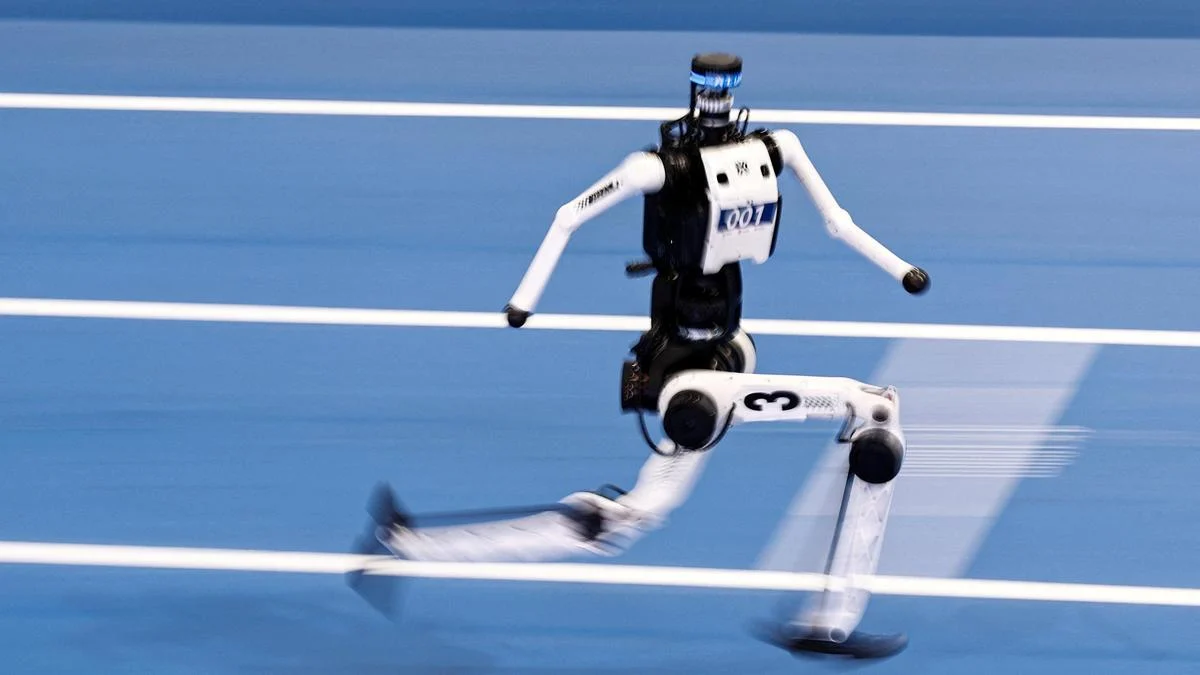
More than 2,000 humanoid robots from 16 participating countries, including Germany, Japan, and the U.S., descended upon the National Speed Skating Oval – a legacy venue from the 2022 Winter Olympics – for the five-day spectacle. The Games, featuring 51 events and over 1,000 competitions ranging from running and table tennis to soccer, weightlifting, and tug-of-war, serve as a potent demonstration of China’s ambition to lead the next technological revolution.
The record-breaking performances coincided with the 2026 World Robot Conference, also held in Beijing, where approximately 3,000 cutting-edge products, including a new generation of humanoid robots, were showcased to global audiences. This dual event solidified Beijing’s position as a global hub for robotics innovation, even as the burgeoning industry finds itself at the heart of an escalating technological and economic rivalry between major powers.
A New Era of Athleticism: Robots Redefine Records
The opening ceremony on August 22 was a meticulously choreographed marvel. Hundreds of humanoid robots marched in synchronized formation onto the field, their metallic limbs moving with an eerie precision that captivated the thousands in attendance. It was during the subsequent competitions that the true scale of their advancement became apparent.
In a moment that sent ripples through the scientific and athletic communities, a Chinese humanoid robot from Beijing-based X-Humanoid company achieved an astonishing 100-meter sprint time of 9.39 seconds. This performance not only broke previous robotic records but decisively surpassed the human world record of 9.58 seconds, set by Jamaican sprinting legend Usain Bolt in 2009. The achievement marked a significant milestone, demonstrating a level of speed and agility in bipedal locomotion previously thought to be years away for humanoid machines.
The high jump competition further cemented the robots’ athletic dominance. Another humanoid robot, also from X-Humanoid, soared to an incredible height of 2.88 meters in a standing high jump. This dramatically outstripped last year’s robotic best of 0.95 meters and, more importantly, eclipsed the human world record of 2.45 meters set by Cuba’s Javier Sotomayor in 1993. The visual spectacle of the machine launching itself skyward with such power and precision was a testament to sophisticated engineering, advanced materials, and highly refined control algorithms.
Adding to the list of triumphs, Chinese smartphone company Honor announced that one of its humanoid robots had completed a 100-meter sprint in an even faster trial run, clocking an astounding 9.32 seconds at a peak speed of 14.5 meters per second. While this trial record was not set during the official opening day events, it underscored the rapid pace of development across various Chinese tech firms investing heavily in humanoid robotics. The "Tiangong Ultra humanoid robot," featured prominently in demonstrations, showcased the pinnacle of current capabilities, blending intricate balance, powerful actuators, and real-time environmental processing.
These record-breaking performances represent a dramatic leap forward from just a few years prior, when similar "robot Olympics" events often featured more crashes and collapses than fluid athletic prowess. The seamless execution observed this year highlights a maturity in design, control systems, and artificial intelligence that is rapidly closing the gap between human and machine physical capabilities.
The World Humanoid Robot Games: A Grand Spectacle
Now in its second year, the World Humanoid Robot Games has rapidly evolved into a premier international platform for showcasing the bleeding edge of humanoid robotics. The sheer scale of participation – over 2,000 robots engaging in more than 1,000 competitions across 51 diverse events – makes it an unparalleled demonstration of robotic versatility and endurance.
The events are designed to test a wide spectrum of robotic attributes. Running events assess speed, endurance, and balance; table tennis and soccer demand complex real-time perception, strategic planning, and fine motor control; while weightlifting and tug-of-war push the boundaries of robotic strength and stability. The inclusion of 16 international teams signals a growing global interest and participation in the advancement of humanoid technology, fostering a competitive yet collaborative environment for innovation.
The choice of the National Speed Skating Oval, a venue steeped in Olympic history, adds a symbolic layer to the Games. It evokes the spirit of human athletic achievement, now being challenged and redefined by artificial competitors. The coinciding World Robot Conference further amplifies Beijing’s message, transforming the city into a temporary capital for global robotics, attracting researchers, investors, and policymakers alike. Companies from around the world showcased everything from industrial automation robots to service robots, but it was the humanoid segment that truly captured public imagination, embodying the dream of human-like machines.
China’s Robotics Ascent: A Geopolitical Undercurrent
The World Humanoid Robot Games are more than just a sporting event; they are a powerful geopolitical statement. China currently manufactures the majority of the world’s humanoid robots, and the Games serve as an overt demonstration of the nation’s rapid progress and strategic commitment to advanced robotics. This relentless pursuit of technological leadership is at the heart of an intensifying technology race with the United States.
Beijing views robotics, particularly humanoid platforms, as a critical pillar for future economic growth, industrial automation, and even national security. Investing heavily in research and development, subsidizing domestic companies, and creating supportive policy environments, China aims to dominate key emerging technologies, artificial intelligence being paramount among them. The impressive capabilities displayed at the Games are a direct result of these concerted national efforts.
Experts suggest that China’s strategy is multi-faceted: to reduce reliance on foreign technology, to establish global standards, and to export its technological solutions worldwide. The sophisticated coordination and record-breaking performances seen in Beijing are not merely for show; they reflect underlying advancements in AI, machine learning, sensor technology, and mechanical engineering that have broad implications for various industries, from manufacturing and logistics to healthcare and defense.

Escalating Tensions: U.S. Scrutiny and Bans
The rapid ascent of China’s robotics sector has not gone unnoticed by Washington, which views Beijing’s technological ambitions with increasing concern. The U.S. has stepped up scrutiny of Chinese-made robots, citing national security implications and intellectual property concerns.
Just last month, the U.S. Federal Communications Commission (FCC) announced a sweeping ban on imports of new foreign-made humanoid robots, explicitly targeting China. The FCC justified its decision by invoking national security, expressing fears that advanced Chinese robotics could be exploited for espionage, data collection, or even military applications, potentially undermining U.S. infrastructure and security interests. This move echoes previous actions taken by the Trump administration, which had also targeted Chinese technology firms with similar bans to protect U.S. AI buildout.
Further escalating tensions, the Pentagon recently added Unitree, one of China’s leading humanoid robot manufacturers, to its list of companies deemed to have ties with the Chinese military. Unitree, known for its agile robot dogs and increasingly for its humanoid prototypes, vehemently denied these accusations, stating its focus is purely on commercial applications and research. Beijing, in turn, has vociferously hit back at these allegations, condemning them as protectionist measures and attempts to stifle China’s technological development under false pretenses.
This tit-for-tat dynamic highlights the broader U.S.-China technology war, which extends beyond robotics to semiconductors, AI, and telecommunications. The U.S. actions aim to slow China’s progress, protect its own domestic industries, and prevent potential dual-use technologies from falling into the hands of a strategic rival. For China, these bans are seen as an attempt to deny its legitimate right to technological advancement and economic development, reinforcing its resolve to achieve self-sufficiency in critical tech sectors. The "robot Olympics" thus become a stage for showcasing defiance and capability in the face of external pressure.
Beyond the Arena: The Future and Public Perception
Despite the awe-inspiring demonstrations at the World Humanoid Robot Games, experts caution that humanoid robots are still primarily used for demonstrations, performances, and research. Mass real-world deployment for widespread practical applications remains a future prospect, requiring further advancements in robustness, cost-effectiveness, and autonomous decision-making capabilities in complex, unpredictable environments.
"Humanoid robots are evolving rapidly, no doubt," remarked Li Yanfeng, an education worker and Beijing resident attending the Games. Her perspective reflects a common sentiment. "At first, I wasn’t very accepting of artificial intelligence. I was even a bit resistant to it, because of the possibility that it might replace or displace humans. But now that I see this development is unstoppable, I decided to come and take a look." Her evolving view encapsulates a broader societal shift, from apprehension to a grudging, or even enthusiastic, acceptance of AI’s pervasive future.
Yang Shangzheng, another spectator, echoed this sense of wonder: "These sports are perfectly normal for humans, but now robots can do them. I find it amazing." Liu Tao, attending with his son, articulated a desire to witness "the best robots China currently has to offer," underscoring a sense of national pride and anticipation for future innovations.
The public’s evolving perception is crucial. While the fear of human displacement by AI and automation remains a potent concern, the Games offer a vision of what advanced robotics can achieve, transforming abstract fears into tangible, albeit spectacular, realities. This shift in perception is vital for the eventual integration of humanoid robots into daily life, whether in hazardous environments, service industries, or even as companions.
The Road Ahead: Challenges and Opportunities
The impressive feats at the World Humanoid Robot Games mark a significant leap, yet the journey toward widespread, practical deployment of humanoid robots is fraught with challenges. Technical hurdles include improving battery life, enhancing dexterity for intricate tasks, ensuring robust navigation in dynamic human environments, and developing sophisticated ethical frameworks for autonomous decision-making. The current demonstrations, while spectacular, often occur in controlled settings, and real-world scenarios present a far greater degree of complexity.
Economically, the cost of manufacturing and maintaining these advanced machines remains high, posing a barrier to mass adoption. However, as production scales and technology matures, costs are expected to decrease, opening up new market opportunities. The geopolitical competition, particularly the U.S. bans, also presents both challenges and opportunities for China. While it may hinder access to certain components or markets, it simultaneously accelerates domestic innovation and self-reliance in critical areas.
The philosophical implications of robots outperforming humans in sports are profound. They force a reconsideration of human exceptionalism and the boundaries of physical and cognitive achievement. As robots continue to advance, questions about their role in society, their legal status, and their potential impact on human identity will only intensify.
Conclusion
The second World Humanoid Robot Games in Beijing have etched a new chapter in the history of robotics, with Chinese humanoid robots definitively breaking human world records in athleticism. These achievements are not merely scientific curiosities but powerful symbols of China’s relentless pursuit of technological leadership, set against a backdrop of escalating geopolitical tensions with the United States.
As spectators marvel at the seemingly unstoppable evolution of these machines, the world grapples with the profound implications of an increasingly robotic future. While mass deployment may still be some time away, the spectacular displays in Beijing signal that the era of advanced humanoid robots is no longer a distant dream but a rapidly unfolding reality, promising to reshape industries, economies, and perhaps, the very definition of human potential. The race for robotic supremacy is on, and Beijing has just fired a powerful shot across the bow.
