

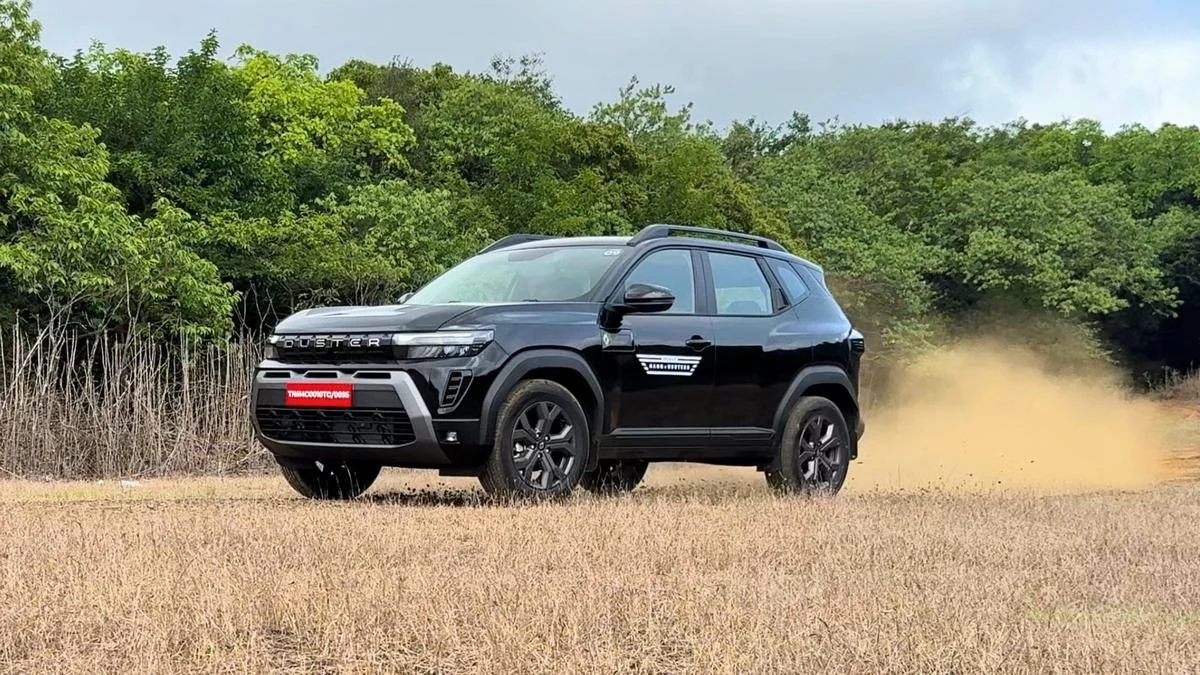
In the competitive landscape of the Indian automotive market, there exists a long-standing prejudice among buyers: the "displacement bias." For decades, the prevailing wisdom suggested that for a vehicle to possess the gravitas and capability of a Sport Utility Vehicle (SUV), it required a large-capacity engine. The assumption was that a bigger block naturally translated to effortless cruising, better hill-climbing ability, and superior longevity.
However, the automotive world is currently undergoing a radical transformation. As emission norms tighten and turbocharging technology matures, the "replacement for displacement" is no longer a theoretical concept—it is a mechanical reality. Enter the Renault Duster TCe 100. On paper, its specifications—a 999cc, three-cylinder turbocharged engine—might cause traditionalists to scoff. Yet, in practice, this vehicle serves as a profound rebuttal to the skeptics, proving that engineering finesse and torque management are far more critical to the driving experience than raw cubic capacity.
Main Facts: The Duster TCe 100 at a Glance
The Renault Duster TCe 100 represents a strategic pivot for the French automaker. It positions itself as an accessible yet sophisticated entry point into the "European-spec" SUV experience.
Key Technical Specifications:

- Engine: 1.0-litre (999cc), 3-cylinder, Turbocharged Petrol.
- Maximum Power: 100 PS.
- Peak Torque: 160 Nm available from 2,000 rpm.
- Transmission: 6-speed manual (specifically calibrated for this unit).
- Price Range: ₹10.49 lakh to ₹13.49 lakh (ex-showroom).
- Target Segment: Compact SUV / C-SUV (Competing with the likes of the Volkswagen Taigun and Skoda Kushaq).
The TCe 100 is not merely about economy; it is about providing a "sweet spot" in the Duster lineup. While the larger 1.3-litre turbo engine caters to the performance enthusiast, the 1.0-litre unit is designed for the pragmatic driver who refuses to sacrifice the joy of driving for the sake of utility.
Chronology: The Evolution of a Legend
To understand the significance of the TCe 100, one must look at the Duster’s lineage. The original Renault Duster was the pioneer of the compact SUV segment in India, launching over a decade ago and carving out a niche for its rugged "go-anywhere" suspension and honest mechanicals.
- The Foundation (2012–2021): The first-generation Duster established Renault as a serious player in India. It was celebrated for its ride quality but eventually aged out as competitors introduced more modern interiors and sophisticated petrol powertrains.
- The Transition: Following the global phase-out of diesel engines within the Renault-Nissan alliance, the focus shifted toward high-efficiency turbocharged petrol (TCe) units.
- The Re-Engineering Phase: Renault took the basic 1.0-litre block used in smaller models like the Kiger and Magnite and subjected it to a comprehensive re-engineering program. The goal was to adapt the powertrain for the heavier, more substantial chassis of the Duster.
- The Current Launch: The TCe 100 arrives as the fruition of this effort, featuring a 6-speed manual gearbox (an upgrade over the 5-speed units usually paired with 1.0L engines) and refined NVH (Noise, Vibration, and Harshness) levels.
Supporting Data: Performance and Real-World Driveability
The most striking aspect of the Duster TCe 100 is how it defies its 1.0-litre label. The secret lies in the torque curve. Unlike naturally aspirated engines that require high revs to find their "legs," this turbocharged unit delivers its 160 Nm of torque as low as 2,000 rpm.
Urban Agility and Highway Composure
In city traffic, the engine exhibits a "crisp" throttle response. There is a noticeable absence of the traditional "turbo lag" that often plagues small-displacement forced-induction engines. The tractability is such that the vehicle can pull cleanly from 25–30 km/h in third gear, reducing the need for constant downshifting in stop-and-go traffic.

On the open highway, the Duster TCe 100 settles into a refined cruise. At 100 km/h, the engine remains within its power band. A gentle squeeze of the accelerator—without downshifting—is often enough to execute clean overtakes. This flexibility gives the driver the illusion of piloting a 1.5-litre or 1.6-litre naturally aspirated engine.
Mountain and Gradient Performance
The ultimate litmus test for any small engine is a steep incline. During testing on mountain roads, the Duster TCe 100 maintained its composure. While hill driving naturally requires more engagement with the 6-speed gearbox, the engine never felt "out of breath." The generous mid-range torque allowed it to tackle gradients and dispatch slower moving trucks with a level of ease that genuinely exceeded expectations.
Ride and Handling Dynamics
Renault has retained the Duster’s "Magic Carpet" DNA. The suspension setup is slightly firm, which aids in body discipline at high speeds, yet it remains remarkably absorbent over broken patches and dirt tracks.
- Steering Connection: Perhaps the standout feature is the steering. In an era where many SUVs move toward light, disconnected electronic power steering, the Duster offers a communicative and naturally weighted rack. It provides the driver with a genuine sense of connection to the road, making it one of the most engaging steerings in its segment.
Official Responses and Engineering Philosophy
Renault’s engineering team has been vocal about the "right-sizing" philosophy applied to the TCe 100. While the engine shares a basic architecture with the Renault Kiger’s motor, official communications highlight that this is not a "carry-over" part.

Key Engineering Enhancements:
- Transmission Calibration: The inclusion of a 6-speed manual was a deliberate choice to optimize the engine’s power band. The shorter initial ratios provide better low-end punch, while the sixth gear acts as an overdrive for fuel-efficient highway cruising.
- NVH Insulation: Renault has invested heavily in sound-deadening materials and engine mounts to mask the characteristic "thrum" of a three-cylinder engine.
- Chassis Integration: The Duster’s chassis was tuned specifically to handle the lighter front-end weight of the 1.0L engine compared to the old diesel or 1.3L units, resulting in a more balanced and "pointy" front end during cornering.
By focusing on the "perceived performance" rather than just the "paper performance," Renault’s engineers have aimed to create a vehicle that feels mature and "grown-up."
Interior Sophistication and Technology
The cabin of the Duster TCe 100 reflects a move toward a more premium aesthetic without succumbing to "gimmickry." The use of dual-tone finishes and fabric inserts on the dashboard, center console, and door trims provides a tactile warmth that was missing in previous iterations.
Feature Highlights of the Techno Variant:

- Infotainment: A responsive touchscreen with seamless Android Auto and Apple CarPlay integration.
- Comfort: Automatic climate control with rear AC vents, a sunroof, and a light-action clutch for fatigue-free driving.
- Safety: All-wheel disc brakes (a rarity in this price bracket) and 17-inch alloy wheels that provide a commanding stance.
- Practicality: A spacious boot and a cabin that comfortably accommodates a family of four, though three adults in the rear may find shoulder room slightly snug.
Areas for Improvement:
Despite the overall excellence, there are notable omissions. In the Indian climate, the absence of ventilated seats is a missed opportunity. Additionally, while the powered tailgate is a convenient "wow" feature, many buyers might have preferred electrically adjustable front seats for daily ergonomic convenience.
Implications: The Shift Toward Value-Driven European Dynamics
The emergence of the Renault Duster TCe 100 has significant implications for the Indian SUV market and the broader automotive industry.
- Challenging the "Bigger is Better" Narrative: The TCe 100 proves that a well-tuned small engine can outperform a mediocre large engine. This success will likely encourage other manufacturers to bring their advanced, small-displacement global engines to the Indian market.
- Market Realignment: At a price point of ₹13.49 lakh for the top-end variant, the Duster is positioned as a high-value alternative to the Volkswagen Taigun and Skoda Kushaq. It offers a similar "European" driving feel—characterized by stability and steering feedback—at a more accessible price and with slightly more rugged "go-anywhere" capability.
- The Democratization of Turbo-Petrols: By offering a 6-speed manual paired with a sophisticated turbo engine at this price, Renault is making enthusiast-grade driving dynamics available to the mass-market buyer.
- Sustainability: Smaller engines are inherently lighter and, when driven sensibly, more fuel-efficient. The TCe 100 represents a bridge between the high-emission SUVs of the past and the electrified future, offering a lower carbon footprint without sacrificing the utility of an SUV.
Conclusion: The New Sweet Spot
The Renault Duster TCe 100 is a vehicle that rewards those who look beyond the spec sheet. It is a triumph of calibration over capacity. By combining a punchy, torque-rich engine with a chassis that is arguably the best in its class for ride and handling, Renault has created what might be the most balanced SUV in the segment.
It doesn’t just transport a family from point A to point B; it does so with a sense of character and mechanical honesty that is increasingly rare in modern, screen-heavy cars. For the buyer who values the way a car "talks" to them through the steering wheel and the pedals, but also needs to manage a budget, the Duster TCe 100 is no longer just a choice—it is a compelling argument for the future of the compact SUV.
