

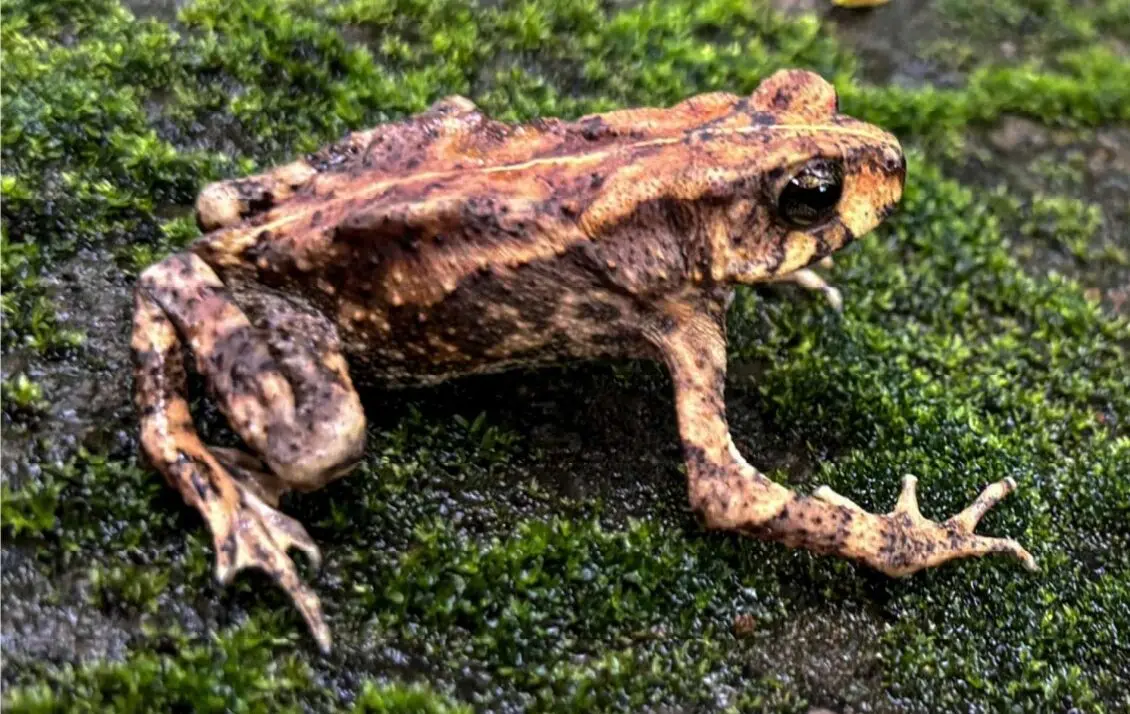
MIZORAM, INDIA – In the mist-shrouded peaks of the Eastern Himalayas, where the borders of India and Myanmar blur into a tapestry of dense bamboo and ancient rhododendrons, scientists have uncovered a new inhabitant of the "Sky Islands." A study published in May 2026 has officially described Duttaphyrnus phawngpui, a new species of toad found exclusively on the highest reaches of Mizoram’s Phawngpui Mountain.
The discovery, led by a collaborative team of researchers from Mizoram University, Assam Don Bosco University, and the Guwahati-based non-profit Help Earth, highlights the extraordinary but fragile biodiversity of the Indo-Burma hotspot. This new species, named after the "Blue Mountain" (Phawngpui), represents not just a victory for Himalayan taxonomy, but a stark warning about the looming threat of "dark extinction"—the loss of species before they are even known to science.
Main Facts: A Specialist of the Blue Mountain
Duttaphyrnus phawngpui is a member of the genus Duttaphyrnus, a group of "true toads" widely distributed across South and Southeast Asia. While many members of this genus are generalists—often found in urban areas or even polluted environments—this newly described species is a high-altitude specialist.
The specimens were located at elevations exceeding 2,000 meters above sea level (masl), near the summit of Phawngpui, which stands as Mizoram’s highest point at 2,157 meters. The toad’s habitat is characterized by high humidity, dense ground cover, and a complex mosaic of grassy patches and forest streams. Unlike its more resilient cousins, D. phawngpui appears to be hyper-sensitive to its environment, requiring specific micro-climates that are only found on these isolated mountain tops.
Morphologically, the species was distinguished through a combination of traditional physical examination and modern genetic sequencing. DNA analysis confirmed that while it shares a lineage with species like D. stuarti, D. chandai, and D. dhara, it possesses distinct genetic markers and physical traits that justify its classification as a unique species.
Chronology: From the Forest Floor to the Laboratory
The journey to the description of D. phawngpui began with a series of high-altitude surveys in the Phawngpui National Park. This region, located in southeastern Mizoram, has long been of interest to herpetologists due to its isolation and unique ecological niches.
- The Field Encounter: During an expedition to the summit of the Blue Mountain, researchers encountered two individuals of the then-unknown toad. They were found among the leaf litter along the edge of a trail leading to the peak. The observation occurred in an area dominated by shrubbery and bamboo, relatively undisturbed by human activity.
- Specimen Collection and Observation: The researchers noted the toad’s behavior and immediate surroundings. They observed that the individuals were ground-dwelling and utilized the dense ground cover for camouflage. Preliminary observations suggested a diet consistent with other mountain toads—primarily termites, locusts, and other small insects.
- Laboratory Analysis (2024–2025): Following the field collection, the specimens underwent rigorous morphological comparisons with existing museum samples of Duttaphyrnus. This was followed by molecular analysis at Mizoram University, where DNA sequencing provided the definitive evidence needed to separate D. phawngpui from its closest relatives in the Eastern Himalayas.
- Formal Publication (May 2026): The findings were synthesized into a comprehensive study and published in the journal Taprobanica, officially introducing Duttaphyrnus phawngpui sp. nov. to the global scientific community.
Supporting Data: The Science of the "Sky Island" Toad
The discovery of D. phawngpui provides critical data on the evolution of amphibians in isolated mountain ecosystems. Biologists often refer to these high-altitude habitats as "Sky Islands"—isolated mountain ranges separated from one another by "seas" of drastically different lowland environments.
Morphological Distinctions
The researchers focused on several key physical attributes to distinguish the new species. These included the shape and size of the parotid glands—large salivary-like glands located behind the eyes that secrete toxins. In D. phawngpui, these glands are part of a defense mechanism; they secrete a foul, toxic fluid that renders the toad unpalatable to predators, particularly the various species of snakes that inhabit the Mizoram hills.
Genetic Lineage
DNA barcoding played a pivotal role. The Eastern Himalayas are home to several look-alike species. By sequencing the mitochondrial DNA, the team was able to place D. phawngpui within the Duttaphyrnus phylogeny while demonstrating a significant genetic distance from D. stuarti (found in Myanmar and parts of Northeast India) and D. chandai. This genetic isolation suggests that the population on Phawngpui has been separated from other populations for a significant evolutionary period, adapting specifically to the peak’s unique climate.
Ecological Requirements
The study emphasizes that D. phawngpui is a "habitat specialist." Its survival is tethered to:

- High Humidity: Essential for amphibian respiration through the skin.
- Grassy Patches and Leaf Litter: Necessary for foraging and protection from desiccation.
- Perennial Forest Streams: Vital for the breeding cycle, as the larvae (tadpoles) require clean, slow-moving water to develop.
Official Responses: The Voice of the Researchers
Jayaditya Purkayastha, a co-author of the study and general secretary of the NGO Help Earth, has been at the forefront of amphibian conservation in Northeast India for two decades. Speaking on the significance of the find, Purkayastha emphasized the fragility of the species.
"They are habitat specific, not generalists," Purkayastha noted. "Meaning they can only survive in certain conditions. D. phawngpui is a ground-dwelling frog that requires grassy patches, high humidity, and forest streams, especially for breeding. Unlike the common toads you might see in a garden or a city drain, these mountain species have no ‘Plan B’ if their environment changes."
Purkayastha and his colleagues at Mizoram University and Assam Don Bosco University have now helped describe over 38 species, including the urban bent-toed gecko and Sengupta’s cricket frog. However, he warns that the pace of discovery is being outrun by the pace of environmental degradation.
"The species is very susceptible to ecosystem changes," he added. "They cannot adapt to high temperatures. As climate change impacts worsen and human encroachment continues up hilltops, these species are pushed further and further toward the edge. We are facing the threat of dark extinction—the loss of species before we even have the chance to discover and name them."
Implications: Climate Change and the Threat of "Dark Extinction"
The discovery of Duttaphyrnus phawngpui carries profound implications for conservation policy in the Eastern Himalayas. As a "Sky Island" species, it is essentially trapped on its mountain peak.
The Upward Squeeze
Climate change is causing a "thermophilization" of mountain ecosystems, where rising temperatures allow lowland species to move upward, while high-altitude specialists are forced even higher. For a species already living at the summit of Mizoram’s highest mountain, there is nowhere left to go. This phenomenon, often called the "escalator to extinction," is a primary concern for the researchers.
The Role of Taxonomy in Conservation
The formal description of D. phawngpui is a necessary legal and scientific step for its protection. In many jurisdictions, including India, conservation funding and the designation of "protected species" under the Wildlife Protection Act are often tied to recognized taxonomic names. Without a name, a species cannot be factored into Environmental Impact Assessments (EIAs) for infrastructure projects or climate adaptation strategies.
Addressing Human Encroachment
While Phawngpui is a National Park, the edges of these protected areas face constant pressure from shifting cultivation, infrastructure development, and tourism. The researchers noted that while the current habitat of D. phawngpui has "relatively low human disturbance," any increase in trail development or forest clearing near the summit could disrupt the delicate micro-hydrology of the forest floor, drying out the leaf litter and destroying the toad’s breeding grounds.
Future Research
The team suggests that further surveys are needed across other high peaks in the Indo-Burma range. It is highly probable that other "Sky Islands" in the region harbor their own unique, undescribed species of amphibians. The discovery of D. phawngpui serves as a call to action for increased funding for field taxonomy in Northeast India, a region that remains one of the last great frontiers of biological discovery on the Asian continent.
As the sun sets over the Blue Mountain, the small, toxic toad with the name of a peak continues its silent existence among the bamboo. Whether it survives the coming century will depend less on its own toxic defenses and more on the human capacity to protect the vanishingly small islands of cool, damp forest it calls home.
