

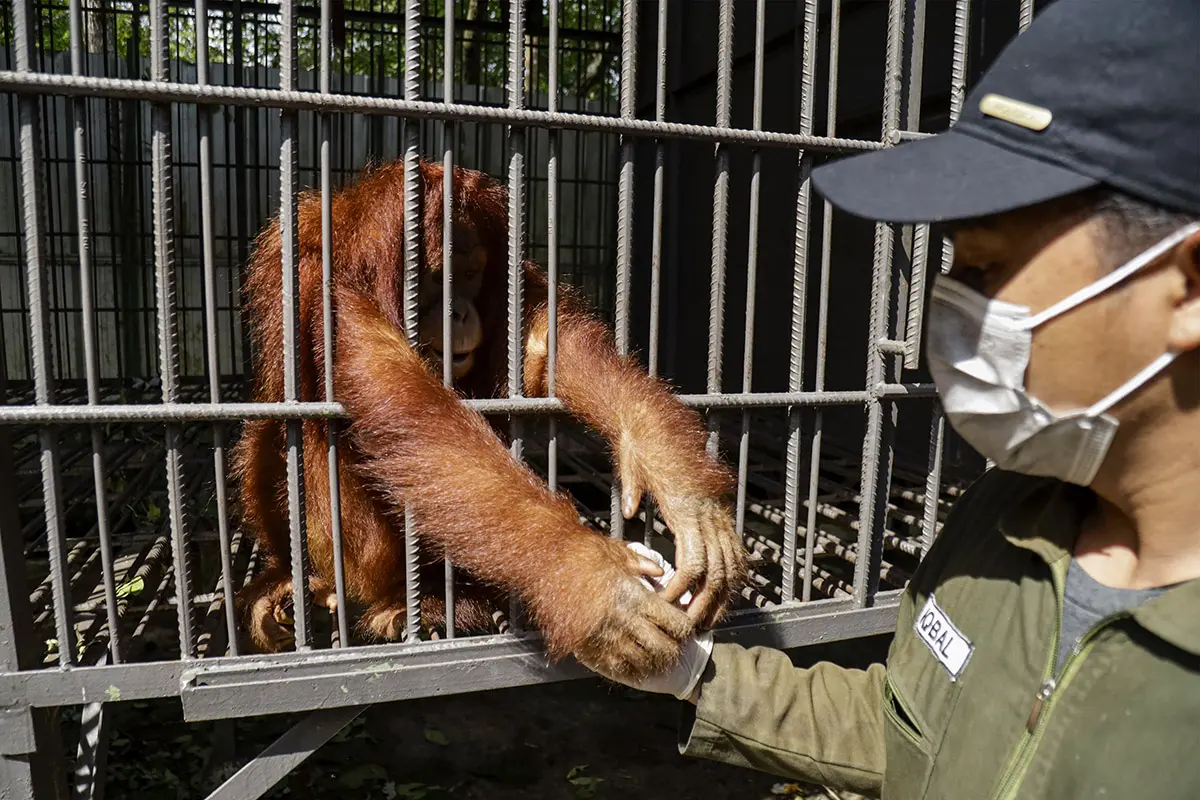
ODISHA, India – In the quiet, coastal woodland of Bichitrapur, located in the Balasore district of Odisha, a discovery on September 8 sent shockwaves through the international conservation community. Five infant orangutans, far from their native tropical rainforests in Southeast Asia, were found wandering alone. Their presence in eastern India—thousands of miles from the only two countries where they exist in the wild—serves as a grim testament to the reach and ruthlessness of global wildlife trafficking networks.
As these infants sit in quarantine at the Nandankanan Zoological Park in Bhubaneswar, a complex international investigation is unfolding. Conservationists warn that while the animals have been "rescued," their journey home will be a grueling trek through a labyrinth of legal hurdles, diplomatic negotiations, and bureaucratic red tape between India and Indonesia.
The Discovery and Immediate Facts
The five orangutans were spotted by local villagers in a forested area that is not typical habitat for large primates, let alone species native to the Malay Archipelago. Upon notification, forest officials moved in to secure the infants, who appeared distressed and malnourished.
Orangutans are found only on the islands of Borneo (shared by Indonesia, Malaysia, and Brunei) and Sumatra (Indonesia). The distance from Sumatra to Odisha is approximately 2,000 kilometers across the Indian Ocean, a journey that no orangutan could make naturally. Their arrival in India is the result of a sophisticated, multi-stage smuggling operation that likely began with the killing of their mothers.
“This starts with hunting in the wild, separating babies from their mothers, and transporting them across various regions, then selling them or keeping them as exotic pets,” explains M. Indra Kurnia, director of conservation at the Sumatran Orangutan Lestari Foundation-Orangutan Information Center (YOSL-OIC).

The infants, currently under the care of specialized veterinarians, are estimated to be between one and two years old. In the wild, orangutans remain with their mothers for up to eight or nine years, learning the essential skills for survival. The trauma of their separation and subsequent transport in cramped, hidden conditions often results in long-term psychological and physical damage.
A Chronology of Increasing Trafficking Incidents
The Odisha discovery is not an isolated event but rather the latest in a series of alarming seizures that suggest India is becoming a major transit hub—and potentially a destination—for the illegal trade in great apes.
- September 2022: Authorities in northern Mizoram recovered two juvenile Sumatran orangutans. Forestry officials suspected the animals had been smuggled across the porous border with Myanmar. Both were estimated to be less than a year old.
- October 2023: A single Sumatran orangutan was intercepted in a vehicle in Seling village, Mizoram, just 55 kilometers from the Myanmar border.
- September 2024: The discovery of five infants in Odisha marks the largest single seizure of orangutans in India in recent history, suggesting an escalation in the volume of the trade.
According to SCENTS (Sustainable Conservation Networks), an Indonesian organization specializing in wildlife trafficking research, the five infants found in Odisha are believed to have originated from the Aceh Tamiang district in Indonesia’s Aceh province. This region is a known biodiversity hotspot and a frequent target for poachers.
Mapping the "Sumatra-to-India" Corridor
The logistics of moving five great apes across international borders without detection require a well-oiled criminal machine. Experts at SCENTS have mapped a probable route that highlights the vulnerability of regional borders.
The Transit Route
- Origin: Aceh Tamiang, Sumatra (Indonesia).
- Maritime Exit: Smuggled via small boats across the Malacca Strait to Malaysia.
- The Mainland Trek: Transported through Thailand into Myanmar.
- The South Asian Entry: From Myanmar, the animals are moved into Bangladesh or directly into the northeastern Indian states like Mizoram.
- Internal Distribution: From the Northeast, they are moved toward Odisha or other major Indian states, which serve as transit points before being shipped to final buyers or international markets.
“Odisha or Mizoram generally serve as transit points,” says Dwi Nugroho Adhiasto, a wildlife trade expert and senior adviser at SCENTS. He notes that the shift toward using Odisha as a staging ground suggests traffickers are diversifying their routes to evade the increased scrutiny on the Mizoram-Myanmar border.

Scientific Identification and the Role of Genetics
While initial morphological assessments—looking at hair color, facial structure, and size—suggest the infants are Sumatran orangutans (Pongo abelii), certain identification is required for legal repatriation.
There are three distinct species of orangutan: the Bornean (Pongo pygmaeus), the Sumatran (Pongo abelii), and the Tapanuli (Pongo tapanuliensis). Each has different conservation requirements and geographic origins.
“YOSL-OIC encourages morphological examination, health, and genetic analysis as part of the investigation,” says Indra Kurnia. DNA analysis is the "gold standard" in these cases. By comparing the genetic profiles of the five infants against a database of known wild populations, scientists can pinpoint exactly which forest they were stolen from. This data is vital not only for returning the animals to the correct habitat but also for law enforcement to target specific poaching "hotspots" in Indonesia.
Official Responses and Repatriation Challenges
The Odisha state government has officially handed the investigation over to the Wildlife Crime Control Bureau (WCCB), India’s federal agency tasked with combating organized wildlife crime. Simultaneously, the Indonesian Ministry of Environment and Forestry has confirmed it is coordinating with Indian authorities and CITES (the Convention on International Trade in Endangered Species of Wild Fauna and Flora).
However, the path to repatriation is fraught with difficulty. “When the Indonesian authorities attempted to repatriate or return wildlife in the past, the process often hit a dead end,” says Panut Hadisiswoyo, director of the nonprofit Green Justice Indonesia.

Obstacles to Return:
- Legal Systems: Differences in evidentiary requirements between Indian and Indonesian courts can stall the release of animals.
- Health Protocols: Strict quarantine laws are in place to prevent the cross-border spread of zoonotic diseases.
- Funding: The cost of transporting great apes via specialized air freight, accompanied by veterinary teams, is immense.
- Bureaucracy: The process requires high-level diplomatic clearance from multiple ministries in both nations.
Ristianto Pribadi, a spokesperson for the Indonesian forestry ministry, stated that the government is committed to bringing the infants back. “If any Indonesian citizen is found to be involved, we will take firm legal action commensurate with the prevailing laws,” he added.
Conservation Implications: A Species on the Brink
The loss of five infant orangutans is a devastating blow to a species already teetering on the edge of extinction. All three species of orangutan are listed as Critically Endangered on the IUCN Red List.
Population Statistics:
- Bornean Orangutans: Estimated at 104,700 (as of 2016), with an 86% decline projected between 1950 and 2025.
- Sumatran Orangutans: A 2026 study estimated only 11,694 remain in the wild, a nearly 20% drop since 2011.
- Tapanuli Orangutans: The rarest of all great apes, with only 716 individuals remaining.
Orangutans have an incredibly slow reproduction rate; females only give birth once every seven to nine years. When an infant is taken, the mother is almost always killed, meaning the trade effectively removes two generations from the wild population at once. Habitat loss due to palm oil expansion and logging further exacerbates the crisis, making it easier for poachers to access previously remote areas.
The Need for "Crime Network-Oriented" Conservation
The discovery in Odisha has prompted a call for a paradigm shift in how wildlife authorities handle such cases. For too long, the focus has been on "rescue and rehabilitate"—treating the symptoms rather than the cause.
“The approach to orangutan trafficking must evolve from being rescue-oriented to being crime network-oriented conservation,” argues Indra Kurnia. This means treating the seizure of the five infants not just as a welfare case, but as a lead into a transnational criminal syndicate.

Law enforcement must trace the "Aceh route" in its entirety: from the local hunters in the Indonesian bush to the middle-men in Malaysia and Thailand, the transporters in Myanmar and Bangladesh, and finally, the high-net-worth buyers in India and beyond who fuel the demand for "exotic pets."
As the five infants begin their long recovery at Nandankanan Zoo, their fate remains uncertain. They are the faces of a global crisis—displaced, orphaned, and caught in the middle of a struggle between international law and the ruthless efficiency of the black market. Their journey home will be the ultimate test of whether international cooperation can triumph over the shadows of the illegal wildlife trade.
