

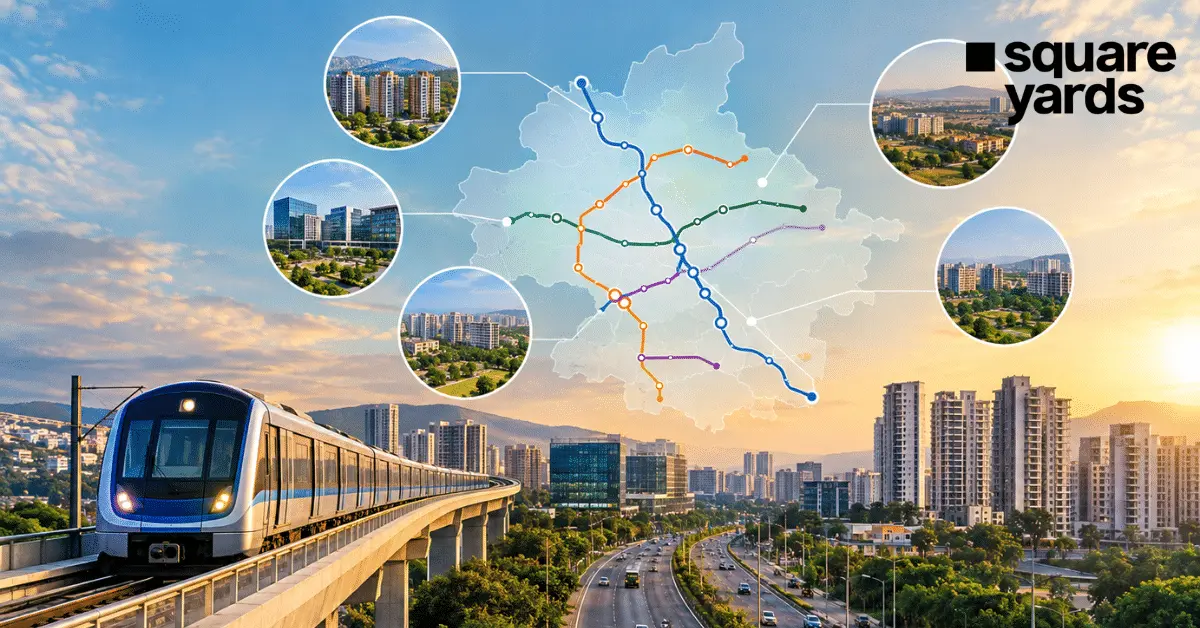
PUNE – In a move destined to redefine the urban landscape of Western India, the Maharashtra state government and regional development authorities have unveiled the "Pune 2036 Development Roadmap." This ambitious master plan, structured as the Pune Economic Region Growth Hub, envisions a massive capital infusion of between Rs 9 lakh crore and Rs 10 lakh crore over the next decade. The roadmap is designed to transition Pune from a regional IT and automobile hub into a global mega-city, supported by a 250-km Metro network, high-speed road corridors, and a burgeoning ecosystem for Global Capability Centers (GCCs).
With the recent in-principle approval of a Rs 1,826-crore infrastructure package specifically for the industrial and tech corridors of Chakan and Hinjewadi, the first phase of this transformation is set to break ground in December 2026. This comprehensive report explores the main facts, the timeline of development, the infrastructure data, and the profound implications for the real estate and economic sectors of the region.
1. Main Facts: The Pillars of the 2036 Roadmap
The Pune 2036 plan is not merely a collection of transport projects; it is a holistic economic strategy. The primary objective is to create a "Growth Hub" that integrates the Pune Municipal Corporation (PMC), Pimpri-Chinchwad Municipal Corporation (PCMC), and the wider metropolitan areas under the Pune Metropolitan Region Development Authority (PMRDA).
Key Statistics of the Plan:
- Total Investment: Estimated between Rs 9,00,000 crore and Rs 10,00,000 crore.
- Metro Expansion: A proposed 250-km network, significantly expanding upon the current operational lines.
- Public Transport: Deployment of 12,000 to 14,000 electric and CNG buses and the creation of six multimodal transport hubs.
- Road Network: 13 major road projects, including the 83.12-km Inner Ring Road and the 35-km High Capacity Mass Transit Route (HCMTR).
- Economic Targets: Generation of 15 to 20 lakh new jobs and the establishment of 400 additional GCCs under the Maharashtra GCC Policy 2025.
- Railway Infrastructure: 11 dedicated railway projects to improve regional suburban connectivity.
2. Chronology: From Concept to Execution
The evolution of Pune’s 2036 vision has been a multi-stage process involving state planning boards, international consultants, and local municipal bodies.
- Early 2024: Conceptualization of the "Growth Hub" model to address the rapid urbanization of the Pune-Pimpri-Chinchwad belt.
- September 2024: Formalization of the Maharashtra GCC Policy 2025, providing the fiscal framework to attract global tech and engineering firms.
- September 30, 2026: Finalization of the priority list containing 58 key projects. The state grants in-principle approval for the Rs 1,826-crore immediate package for Chakan and Hinjewadi.
- December 2026 (Projected): Commencement of physical work on the Chakan road improvements and Hinjewadi last-mile connectivity projects.
- 2027–2030: Completion of Metro Line 3 (Hinjewadi-Shivajinagar) and the first phases of the Pune Inner Ring Road.
- 2030–2036: Full integration of the extended Metro corridors to the southern suburbs (Undri, Yewalewadi) and eastern corridors (Loni Kalbhor).
3. Supporting Data: Infrastructure and Connectivity Breakdown
The 2036 roadmap is categorized into three major domains: Mass Transit, Regional Roadways, and Industrial Infrastructure.
The 250-km Metro Vision
The backbone of the plan is the Metro. While Line 3 (Hinjewadi to Shivajinagar) is the immediate priority—linking the IT heartland with the city center—the 250-km vision extends deep into the suburbs.
- Southern Extension: A 20-km extension is planned from Shivajinagar to Yewalewadi. This will pass through high-density areas like Camp, Pulgate, and Kondhwa, with a vital branch off NIBM Junction to Undri.
- Eastern-Western Spine: A corridor connecting Khadakwasla to Kharadi via Swargate and Hadapsar will facilitate seamless movement across the city’s width.
- Airport Connectivity: Proposals to extend the network from Hadapsar toward Loni Kalbhor and Saswad are strategically aimed at supporting the future Purandar airport zone.
The Ring Road and HCMTR
To solve Pune’s notorious traffic congestion, the plan emphasizes two "loops":
- The Inner Ring Road (83.12 km): This road will bypass the city center, connecting peripheral areas like Solu, Nirgudi, Pisoli, and Ambegaon Khurd. It is designed to divert heavy industrial traffic from the Chakan and Talegaon belts away from residential streets.
- The HCMTR (35 km): This elevated corridor will serve as a "fast lane" through 15 key urban neighborhoods, including Kothrud, Aundh, and Yerawada, specifically designed for high-capacity public transport and rapid transit.
Industrial and Road Corridors
The roadmap identifies three "mega-corridors" for road widening and flyover construction:
- Kharadi Junction to Shirur (53.4 km): Essential for the IT-Manufacturing link.
- Talegaon-Chakan-Shikrapur (53.2 km): The "Industrial Spine" of the region.
- Hadapsar to Yavat: Strengthening the link to the eastern agricultural and industrial hinterland.
4. Official Responses and Economic Strategy
The Pune 2036 plan is closely aligned with the Maharashtra GCC Policy 2025. Government officials have noted that infrastructure is the "primary prerequisite" for attracting the next wave of global investment.
State Planning Perspective:
Officials from the PMRDA have emphasized that the Rs 1,826-crore package for Chakan and Hinjewadi is a response to long-standing demands from the manufacturing and IT industries. In Chakan, the focus is on 75 km of road improvements and 38 km of stormwater drainage to prevent the monsoon-related disruptions that have previously hampered the automotive supply chain.
The GCC Magnet:
Pune already hosts over 500 Global Capability Centers. The 2036 roadmap seeks to double this presence. By focusing on AI, Biotechnology, and Engineering, the state aims to create 4 lakh high-skilled jobs in the GCC sector alone. The broader target remains 15-20 lakh jobs, spanning from shop-floor manufacturing in Chakan to high-end software development in Kharadi.
5. Implications: Real Estate and Market Dynamics
The most immediate impact of the 2036 roadmap is being felt in the real estate sector. As infrastructure "follows the plan," property values in previously underserved areas are seeing a steady climb.
The "Metro Effect" on Residential Hubs
Connectivity is the primary driver of capital appreciation in Pune.
- Hinjewadi & Wakad: With Metro Line 3 nearing operations, this belt remains a top choice for investors. Current prices range from Rs 10,000 to Rs 13,000 per sq. ft., but the addition of last-mile connectivity is expected to push these figures higher as "walk-to-work" becomes a reality.
- Kharadi: Now established as the second-largest IT hub after Hinjewadi, Kharadi’s prices (Rs 12,000 – Rs 15,000 per sq. ft.) reflect its premium status. The proposed Kharadi-Shirur elevated corridor will further cement its role as a regional gateway.
The Rise of the Southern and Eastern Corridors
The extension of the Metro to Undri, Kondhwa, and Yewalewadi is a game-changer for South Pune.
- Undri & Yewalewadi: Currently priced between Rs 7,600 and Rs 12,000 per sq. ft., these areas offer a "liveability" quotient that central Pune lacks. The Metro branch from NIBM Junction is expected to trigger a surge in premium township projects.
- Wagholi: Positioned as a cost-effective alternative to Kharadi, Wagholi (Rs 7,500 – Rs 9,000 per sq. ft.) stands to benefit from the Pune-Ahilyanagar Highway upgrades.
Price Insights Table: Current Market Benchmarks
| Locality | Average Price per Sq. Ft. (Rs) | Primary Growth Driver |
|---|---|---|
| Kharadi | 12,000 – 15,000 | IT Hub, GCC Concentration |
| Hinjewadi | 10,000 – 13,000 | Metro Line 3, Tech Parks |
| Undri | 8,000 – 12,000 | Metro Extension, Residential |
| Kondhwa | 8,800 – 10,700 | Transit connectivity to South Pune |
| Wagholi | 7,500 – 9,000 | Proximity to Kharadi, Highway access |
| Yewalewadi | 7,600 – 8,300 | Future Metro Terminus, Purandar link |
| Chakan | 4,500 – 7,000 | Industrial/Logistics Growth |
| Talegaon | 5,300 – 6,500 | Manufacturing Hub, Road Corridors |
| Shirur | 4,600 – 6,200 | Industrial expansion, Road Widening |
| Shikrapur | 3,500 – 6,800 | Industrial/Logistics Corridor |
6. Conclusion: A Decade of Transformation
The Pune 2036 Development Roadmap represents one of the most ambitious urban planning exercises in India’s history. By committing nearly Rs 10 lakh crore to a multimodal transport network and economic growth hubs, the state is betting on Pune’s potential to become a top-tier global city.
However, the success of this roadmap hinges on the timely execution of the "58 priority projects." While the in-principle approval for the Chakan and Hinjewadi packages is a promising start, the integration of the 250-km Metro and the completion of the Inner Ring Road will be the true tests of the plan’s efficacy.
For residents, the plan promises a future of reduced commute times and improved public spaces. For investors, it outlines a clear path of appreciation along the new transport spines. As work begins in December 2026, all eyes will be on Pune to see if it can successfully balance its rapid industrial growth with the high-quality infrastructure required for a 21st-century metropolis.
Disclaimer: Infrastructure project timelines and investment figures are based on current government roadmaps and are subject to change based on policy updates and fiscal allocations. Real estate prices are market averages and may vary based on specific project amenities and locations.
