

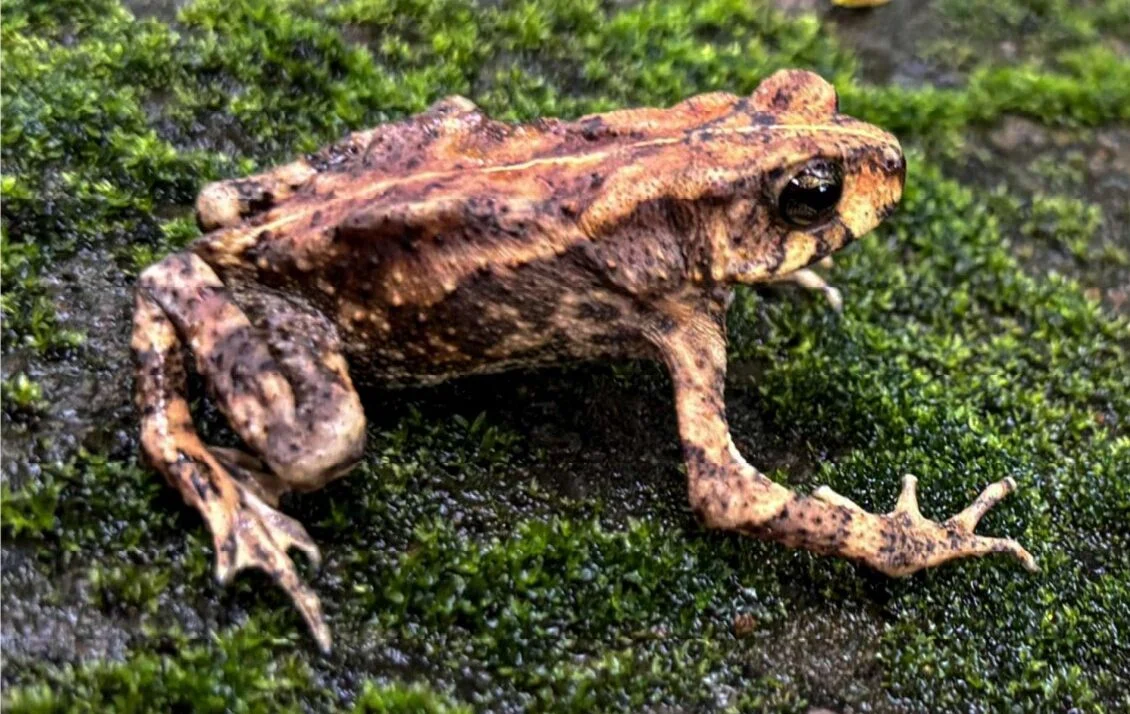
PHAWNGPUI, MIZORAM – In the mist-shrouded peaks of the Indo-Myanmar border, where the earth meets the sky at over 2,000 meters, scientists have documented a new inhabitant of the clouds. A peer-reviewed study published in May 2026 has officially described Duttaphyrnus phawngpui, a new species of toad found exclusively in the high-altitude reaches of Phawngpui National Park.
The discovery, led by a collaborative team of herpetologists and researchers from Mizoram University, Assam Don Bosco University, and the Guwahati-based non-profit Help Earth, highlights the extraordinary but fragile biodiversity of India’s Northeast. Named after Phawngpui—the "Blue Mountain" and the highest peak in Mizoram—the toad represents a significant addition to the Duttaphyrnus genus, providing critical insights into how evolution functions in isolated mountain ecosystems.
Main Facts: A Specialist in a World of Generalists
The genus Duttaphyrnus is well-known across South and Southeast Asia. Many of its members are "generalists," meaning they are highly adaptable and can thrive in diverse environments ranging from pristine forests to heavily polluted urban centers. However, Duttaphyrnus phawngpui breaks this mold.
Unlike its more common cousins, this new species is a high-altitude specialist. Found at elevations exceeding 2,000 meters above sea level (masl), it is part of a rare group of toads, including D. stuarti, D. chandai, and D. dhara, that are restricted to the higher ranges of the Eastern Himalayas.
Key Characteristics of Duttaphyrnus phawngpui:
- Habitat: Specifically restricted to the summit regions of Phawngpui (2,157 masl).
- Ecology: Ground-dwelling (terrestrial), preferring leaf litter, bamboo patches, and dense shrubbery.
- Biological Traits: Possesses prominent parotid glands that secrete toxic fluids to deter predators.
- Diet: Likely insectivorous, feeding on termites, grasshoppers, and beetles.
- Status: Highly vulnerable due to habitat specificity and the "Sky Island" effect.
Chronology: From the Field to the Laboratory
The journey to identifying Duttaphyrnus phawngpui began with rigorous field surveys conducted in the rugged terrain of southeastern Mizoram. Researchers focused on the trail leading to the summit of Phawngpui, an area characterized by high humidity, low human interference, and a unique microclimate.
The Encounter
During the expedition, the team encountered two distinct individuals among the damp leaf litter at the forest floor near the mountain’s peak. The location was significant: the edge of a trail above the 2,000-meter mark, where the vegetation transitions into a mix of sub-tropical broadleaf forests and montane grasslands.
The Analysis Phase
Following the collection of the specimens, the researchers moved from the field to the lab to confirm their suspicions that they had found a new species. The identification process involved two primary methods:
- Morphological Analysis: A detailed physical comparison was conducted against known species in the Duttaphyrnus genus. Researchers measured snout-vent length, head width, and the specific texture of the skin, noting subtle but consistent differences that set the Phawngpui specimens apart.
- Molecular Phylogenetics (DNA): DNA sequencing provided the "smoking gun." By analyzing genetic markers, the team was able to place D. phawngpui within the evolutionary tree, confirming it as a distinct lineage separate from its closest relatives in the Eastern Himalayas.
The culmination of this work was the formal publication of the study in May 2026, officially introducing the species to the global scientific community.
Supporting Data: The Ecology of a High-Altitude Resident
The data gathered during the study paints a picture of a species that is perfectly synchronized with its environment but dangerously dependent on it.
Preferred Ecosystem Features
The researchers noted that the toads were found in areas with "dense ground cover in the form of shrubbery as well as bamboo patches." These features are essential for maintaining the high humidity levels the species requires. Unlike lowland toads that might tolerate drier conditions, D. phawngpui is tied to the moist microclimates of the Blue Mountain.
The Role of Parotid Glands
One of the most defining features of the Duttaphyrnus genus is the parotid gland, located behind the eyes. In D. phawngpui, these glands are a primary defense mechanism. When threatened, the toad secretes a foul-smelling, toxic fluid. This chemical defense makes the toad unpalatable to snakes and other small carnivores that roam the forest floor, allowing a slow-moving amphibian to survive in a predator-rich environment.
Feeding Behavior
While the specific stomach contents of the two collected specimens were not the primary focus of the initial description, observations of related species in the same landscape suggest a diet rich in forest-floor invertebrates. Termites, locusts, grasshoppers, and cockroaches are the likely staples. This makes the toad an essential component of the ecosystem’s nutrient cycle and a natural controller of insect populations.

Official Responses: Insights from the Research Team
Jayaditya Purkayastha, a prominent herpetologist and the general secretary of Help Earth, served as a co-author of the study. His insights provide a sobering look at the challenges facing this newly discovered species.
"They are habitat-specific, not generalists," Purkayastha explained. "This means they can only survive in certain conditions. Duttaphyrnus phawngpui is a ground-dwelling frog that requires grassy patches, high humidity, and forest streams, especially for breeding."
Purkayastha also highlighted the broader work of Help Earth, which has been instrumental in documenting the hidden biodiversity of Northeast India. Since 2006, the organization has helped describe over 38 new species, including the urban bent-toed gecko (Cyrtodactylus urbanus) and Sengupta’s cricket frog (Minerva sengupti).
However, the thrill of discovery is often tempered by the reality of environmental degradation. Purkayastha warns that the species is "very susceptible to ecosystem changes." He noted that as human encroachment continues up the hillsides and climate change alters the temperature of these high-altitude zones, the window for protecting these species is closing.
Implications: The "Sky Island" Crisis and Dark Extinction
The discovery of Duttaphyrnus phawngpui carries significant implications for conservation biology, particularly regarding the concept of "Sky Islands."
The Sky Island Phenomenon
Phawngpui acts as a "sky island"—an isolated mountain peak surrounded by radically different lowland environments. For species like D. phawngpui, the surrounding lowlands are as impassable as an ocean is to a land animal. This isolation drives the evolution of new species but also makes them incredibly vulnerable. As the climate warms, these species are forced to move higher up the mountain to stay within their required temperature range. Eventually, they reach the summit, and there is nowhere left to go—a phenomenon often called the "escalator to extinction."
The Threat of "Dark Extinction"
One of the most poignant points raised by the research team is the threat of "dark extinction." This term refers to the loss of species before they are even discovered or described by science.
"Human pressures can trigger dark extinction," Purkayastha warned. "The loss of species before we even discover them is a silent tragedy."
The discovery of D. phawngpui is a reminder of how much remains unknown. If researchers had not conducted these surveys now, this toad could have vanished as the climate shifted, leaving no record of its existence.
Conservation Recommendations
The study underscores the need for localized conservation efforts that focus on mountain summits. While Phawngpui is a protected National Park, the researchers argue that specific management plans are needed to:
- Protect Breeding Sites: Ensuring that high-altitude forest streams remain uncontaminated and free-flowing.
- Limit Encroachment: Restricting further human development or trail expansion near the summit to preserve the dense ground cover.
- Climate Monitoring: Establishing long-term temperature and humidity monitoring stations to track the changing conditions of the sky island.
Conclusion: A Call to Protect the Unknown
The naming of Duttaphyrnus phawngpui is more than a taxonomic exercise; it is a tribute to the cultural and natural heritage of Mizoram. By naming the species after the state’s highest peak, researchers have linked the identity of the toad to the identity of the land.
As the world grapples with a global biodiversity crisis, the story of the Phawngpui toad serves as a beacon for the importance of field taxonomy. It proves that even in well-traveled areas, there are still secrets hidden in the leaf litter. However, it also serves as a final warning. In the high, thin air of the Blue Mountain, a tiny toad is sounding the alarm for an entire ecosystem under threat. The challenge now lies in ensuring that this newly discovered sentinel does not become a ghost of the mountains it calls home.
