CHENNAI – In a significant move to bolster the transport infrastructure and economic landscape of Southern India, Prime Minister Narendra Modi officially inaugurated a series of high-impact railway projects across Tamil Nadu on October 11, 2026. The infrastructure package, valued at approximately Rs 750 crore, marks a pivotal moment in the state’s developmental journey, focusing on the dual objectives of enhancing passenger experience and streamlining freight logistics.
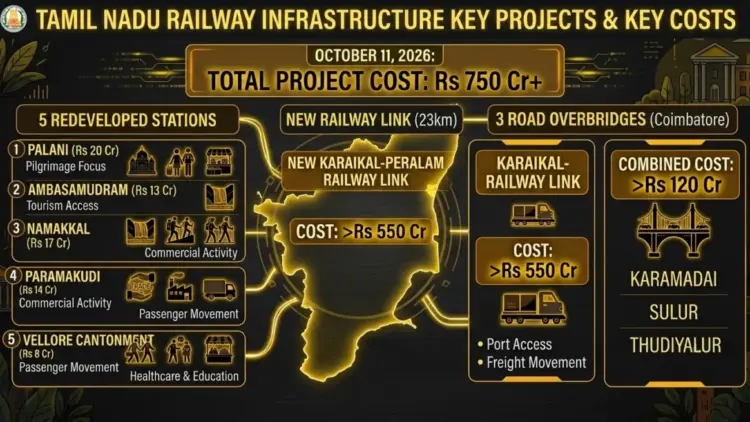
The centerpiece of this announcement includes the redevelopment of five strategic railway stations under the ambitious Amrit Bharat Station Scheme, the commissioning of a crucial 23-km new railway line between Karaikal and Peralam, and the opening of three major road overbridges (ROBs) in the Coimbatore industrial belt. These projects are expected to serve as catalysts for regional growth, directly influencing property markets and commercial ecosystems in nine distinct locations.
1. Main Facts: A Multi-Modal Infrastructure Push
The infrastructure blitz announced by the Prime Minister is not merely a collection of isolated projects but a coordinated effort to improve the "Ease of Living" and "Ease of Doing Business" in Tamil Nadu.
Key Components of the Package:
- Station Redevelopments: Five stations—Palani, Ambasamudram, Namakkal, Paramakudi, and Vellore Cantonment—have been transformed into modern transit hubs.
- New Rail Connectivity: The 23-km Karaikal-Peralam line (costing over Rs 550 crore) restores a historic link, providing a direct route for the Karaikal Port to the hinterland.
- Urban Decongestion: Three road overbridges at Karamadai, Sulur, and Thudiyalur (totaling over Rs 120 crore) aim to eliminate traffic bottlenecks in the Coimbatore region.
- Total Investment: Approximately Rs 750 crore.
These projects integrate the "Amrit Bharat" philosophy, which focuses on long-term master planning and the creation of "City Centres" at railway stations, ensuring they serve as more than just transit points.
2. Chronology: From Blueprint to Inauguration
The journey of these projects reflects the Union Government’s accelerated pace of infrastructure execution.
- 2023-2024: Conceptualization and Allotment: Under the Amrit Bharat Station Scheme, the Ministry of Railways identified stations with high footfall and historical significance. The Karaikal-Peralam line, originally a colonial-era meter-gauge track closed decades ago, was approved for broad-gauge conversion and reconstruction to support the growing needs of the Karaikal Port.
- 2025: Intensive Construction Phase: Throughout 2025, work progressed on the five stations simultaneously. The focus was on "local-centric" architecture—incorporating Dravidian design elements into the station facades while installing modern amenities like lifts, escalators, and high-speed Wi-Fi.
- Early 2026: Safety Inspections: The Commissioner of Railway Safety (CRS) conducted rigorous trials on the Karaikal-Peralam line and the new overbridges in Coimbatore.
- October 11, 2026: The Virtual Launch: Prime Minister Narendra Modi, via video conferencing, dedicated these projects to the nation, emphasizing that modern infrastructure is the foundation of a ‘Viksit Bharat’ (Developed India).
3. Supporting Data and Regional Breakdown
The Rs 750 crore investment is distributed across various sectors, each with specific socio-economic goals. Below is a detailed look at the projects and their localized impact.
A. The Amrit Bharat Stations: Modernizing the Passenger Experience
Palani (Investment: Rs 20 Crore)
Palani is the gateway to the Arulmigu Dhandayuthapani Swamy Temple. The redevelopment focused on handling massive seasonal surges in pilgrim traffic.
- Upgrades: Expanded waiting halls, aesthetic facade improvements reflecting temple architecture, and enhanced pedestrian flow management.
- Property Impact: There is a growing demand for hospitality assets. Retail spaces near the station are seeing a premium as footfall increases.
Ambasamudram (Investment: Rs 13 Crore)
Serving the eco-tourism circuit of Papanasam and the Western Ghats, this station now features upgraded parking and better connectivity to local tourist spots.
- Property Trend: Potential for "second home" markets and eco-resorts in the surrounding rural-urban fringe.
Namakkal (Investment: Rs 17 Crore)
As a hub for the poultry and trucking industries, Namakkal’s station redevelopment facilitates better business travel.
- Upgrades: Improvements to the station building and high-capacity parking for commercial commuters.
Paramakudi (Investment: Rs 14 Crore)
Located on the Madurai-Rameswaram route, the station is a vital transit point for both traders and pilgrims.
- Focus: Segregated pedestrian access and wider vehicle lanes to reduce congestion during peak travel hours.
Vellore Cantonment (Investment: Rs 8 Crore)
Vellore is a global destination for healthcare (CMC) and education (VIT).
- Real Estate Data: According to Square Yards, the average asking price for villas in Vellore stands at Rs 4,750 per sq. ft. While this reflects an 8.91% dip in the recent comparison period, the station upgrade is expected to stabilize the market by improving access for the thousands of medical tourists and students who arrive daily.
B. The Coimbatore Overbridges: Solving the "Last Mile" Bottleneck
Coimbatore, the "Manchester of South India," has long struggled with railway crossings that paralyzed local traffic. The three new ROBs at Karamadai, Sulur, and Thudiyalur (Rs 120+ crore) are game-changers.
- Thudiyalur: This area has seen a massive 12.38% increase in villa prices (Rs 5,400 psf) and a 7.29% rise in apartment prices (Rs 6,500 psf). The overbridge is expected to further fuel this bullish trend.
- Karamadai: Villa prices have risen by 3.61% to Rs 3,950 psf, offering a more affordable alternative to the Coimbatore city center.
- Sulur: Despite a minor dip in prices (Apartments at Rs 5,250 psf), the new overbridge provides the necessary connectivity to reverse this trend as the area becomes more accessible to the city’s industrial hubs.
C. Karaikal-Peralam Line: The Freight Powerhouse (Investment: Rs 550 Crore)
This 23-km stretch is the most capital-intensive part of the package. By connecting Karaikal Port to the main rail network via Peralam, the project facilitates the seamless movement of coal, fertilizers, and food grains.
- Real Estate Data: Villa prices in Karaikal have already climbed 6.94% to Rs 4,850 psf. With logistics and warehousing demand expected to surge, commercial land values along the corridor are projected to rise significantly.
4. Official Responses: The Vision for a Connected Tamil Nadu
In his inaugural address, Prime Minister Narendra Modi emphasized the strategic importance of Tamil Nadu in India’s growth story. "The redevelopment of these stations and the completion of the Karaikal-Peralam line are not just about steel and concrete. They are about connecting dreams to opportunities. Whether it is a pilgrim in Palani or a businessman in Coimbatore, these projects will save time and create new avenues for income," the PM stated.
Union Railway Minister Ashwini Vaishnaw highlighted the technical excellence of the projects, noting that the Amrit Bharat Scheme is designed with a 50-year horizon. "We are creating multi-modal hubs where the station becomes the heart of the city’s commercial life. The integration of local art and culture with world-class amenities is our priority," he said.
State Government officials also welcomed the development, noting that the road overbridges in Coimbatore would significantly reduce the carbon footprint by minimizing idling time at railway crossings, thus aligning with the state’s green energy goals.
5. Implications: Economic and Real Estate Outlook
The inauguration of these projects is expected to trigger a multi-dimensional impact on the state’s economy.
I. Real Estate Transformation
The data indicates a clear "infrastructure premium." In areas like Thudiyalur, where connectivity has improved, property values are already outperforming the market. Conversely, in areas like Vellore, the infrastructure upgrade acts as a "value floor," preventing further depreciation and setting the stage for a recovery driven by better accessibility.
II. The "Pilgrim-Economy" Boost
By upgrading stations like Palani and Paramakudi, the government is tapping into the massive "spiritual tourism" market. Improved station facilities lead to longer visitor stays, which directly benefits the local hospitality sector, including budget hotels, restaurants, and traditional retail.
III. Logistics and Industrial Growth
The Karaikal-Peralam line is a strategic asset for the maritime economy. Improved freight connectivity will likely lead to the establishment of new private freight terminals and warehouses along the route. This will shift the economic profile of the region from purely agrarian to a mix of agriculture and logistics.
IV. Urban Decongestion and Quality of Life
In the Coimbatore region, the three overbridges will save thousands of man-hours daily. This improvement in the quality of life is a major driver for residential demand. As the commute to the city center becomes more predictable, peripheral areas like Karamadai and Sulur will become increasingly attractive to middle-income homebuyers.
Conclusion
The October 2026 infrastructure rollout in Tamil Nadu serves as a blueprint for how targeted railway investments can rejuvenate local economies. By balancing the needs of religious tourism, industrial logistics, and urban mobility, the Rs 750 crore package addresses both immediate bottlenecks and long-term growth prospects. As these projects become operational, the focus will now shift to the secondary wave of development—private sector investment in real estate, retail, and logistics—that invariably follows world-class infrastructure.