By [Your Name/News Bureau]
Published: October 22, 2026
The traditional image of an interior designer—hunched over a drafting table with a compass and a stack of physical mood boards—is rapidly becoming a relic of the past. In its place, a digital revolution is unfolding, one where algorithms and neural networks collaborate with human creativity to reshape our living spaces.
As the real estate and prop-tech sectors undergo a massive technological overhaul, Artificial Intelligence (AI) has emerged as the cornerstone of this transformation. Leading the conversation on this shift is Kanika Gupta Shori, COO and Co-Founder of Square Yards, who recently shared her insights via Sugermint on how AI is moving beyond mere novelty to become a critical decision-support tool.
This comprehensive report explores the multifaceted role of AI in interior design, the shifting dynamics of the industry, and why the human touch remains the ultimate arbiter of a house becoming a home.
1. Main Facts: The AI Integration into Interior Design
The integration of AI into interior design is not merely about "pretty pictures"; it is about the synthesis of data, aesthetics, and functionality. Currently, the industry is witnessing a shift from static 2D blueprints to dynamic, AI-driven environments.
The Rise of Generative Design
AI tools today utilize generative adversarial networks (GANs) to process thousands of design permutations in seconds. A homeowner can upload a photo of a vacant room, and within moments, an AI can populate that space with furniture, suggest a Mid-Century Modern or Scandinavian aesthetic, and even adjust the lighting based on the room’s actual geographical orientation.
Bridging the Visualization Gap
According to Kanika Gupta Shori, one of the primary hurdles in traditional design was the "visualization gap." Homeowners often struggled to interpret 2D sketches or even 3D models into a lived experience. AI bridges this gap by providing hyper-realistic renderings that allow users to "walk through" their future homes before a single brick is laid or a single gallon of paint is purchased.
Personalization at Scale
AI algorithms analyze user preferences—often gleaned from social media likes, Pinterest boards, and past purchases—to suggest highly personalized design schemes. This level of customization, which previously required weeks of consultation, is now available instantaneously, making high-end design sensibilities accessible to a broader demographic.
2. Chronology: From Blueprints to Neural Networks
To understand the magnitude of the AI revolution, one must look at the technological trajectory of the interior design industry over the last few decades.
- The Manual Era (Pre-1990s): Interior design was a labor-intensive process involving hand-drawn sketches, physical material swatches, and physical scale models. Revisions were costly and time-consuming, often leading to miscommunications between the client and the contractor.
- The CAD Revolution (1990s – 2000s): Computer-Aided Design (CAD) software digitized the drafting process. While this increased precision, the tools were complex and required specialized training, keeping the design process firmly in the hands of professionals.
- The 3D Rendering & VR Wave (2010 – 2020): High-quality 3D rendering and Virtual Reality (VR) began to enter the mainstream. Platforms like Houzz and Pinterest democratized inspiration, but the "execution gap" remained—homeowners had ideas but no easy way to apply them to their specific floor plans.
- The AI & Generative Era (2021 – Present): The emergence of Large Language Models (LLMs) and Image Generation AI (like Midjourney and DALL-E) transformed the industry. Design moved from "drawing" to "prompting." In 2024-2026, firms like Square Yards began integrating these tools into their core platforms, allowing for real-time, AI-assisted space planning and material procurement.
3. Supporting Data: The Economic and Functional Impact
The shift toward AI is backed by compelling data that suggests a permanent change in consumer behavior and industry economics.
Market Growth and Efficiency
Industry reports suggest that the global AI in the interior design market is projected to grow at a CAGR of nearly 25% through 2030. This growth is driven by the demand for "Smart Homes" and the need for cost-efficient planning.
- Time Reduction: Traditional design phases that used to take 4 to 6 weeks for initial concept approval are now being completed in 48 to 72 hours using AI-assisted tools.
- Error Mitigation: Industry estimates suggest that AI-driven spatial planning can reduce material waste by up to 15% by providing more accurate measurements and optimizing furniture placement.
Consumer Accessibility
A survey conducted in early 2026 revealed that 68% of first-time homeowners felt "more confident" in their purchasing decisions when using AI visualization tools. Furthermore, 55% of respondents stated they were willing to pay a premium for real estate listings that included "AI-staged" interactive previews of potential interior layouts.
The Prop-Tech Synergy
Square Yards, as a leader in the prop-tech space, has seen a significant uptick in engagement on platforms that offer integrated design-and-buy journeys. By linking AI design tools directly to e-commerce inventories, the "visual-to-cart" conversion rate has increased by an estimated 30% across the industry.
4. Official Responses and Expert Perspectives
The industry’s leading voices are cautious but optimistic, emphasizing that AI is a tool of empowerment, not replacement.
The Square Yards Perspective
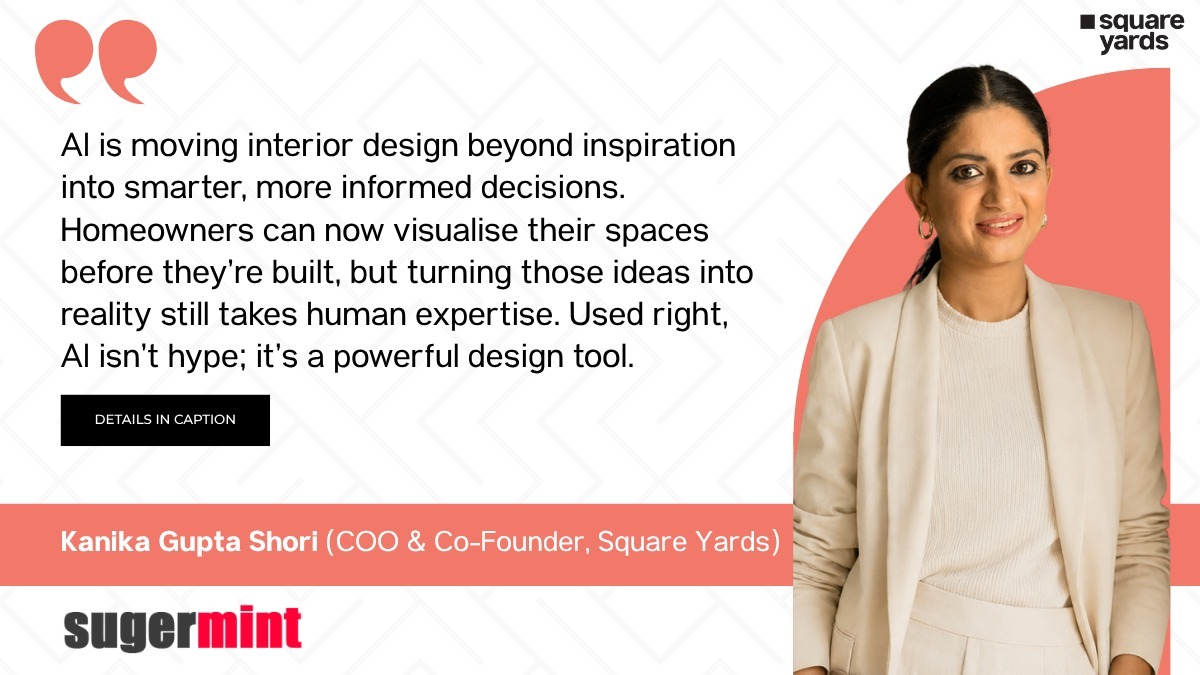
Kanika Gupta Shori, COO & Co-Founder of Square Yards, emphasizes that AI is evolving from a source of inspiration to a "smarter, more practical decision-making" engine. Shori notes that while AI can handle the "heavy lifting" of visualization and alternative comparison, it serves to simplify the early-stage planning that often overwhelms homeowners.
"AI should not be viewed merely as a source of inspiration," Shori noted in her feature with Sugermint. "Used effectively, it can become a valuable decision-support tool that bridges the gap between visualizing a dream space and bringing it to life."
The Designer’s Standpoint
Professional design bodies, such as the International Interior Design Association (IIDA), have released statements acknowledging AI’s role in "democratizing design." However, they maintain that the "human-centric" elements—such as understanding the emotional resonance of a space or the intricate ergonomics of a kitchen—cannot be fully replicated by code.
The Technological Proponents
Tech developers argue that AI is the only way to meet the rising demand for housing and renovation in a sustainable manner. By using AI to calculate the carbon footprint of certain materials during the design phase, technology is helping the industry meet new environmental regulations.
5. Implications: The Future of the Human-AI Synergy
As we look toward the end of the decade, the implications of AI in interior design extend far beyond aesthetic choices. They touch upon labor, education, and the very definition of "creativity."
The Evolution of the Professional Designer
The role of the interior designer is shifting from a "creator of images" to a "curator of experiences." Professionals will increasingly use AI to generate 50 different versions of a room, then use their expertise to select the one that is structurally sound, budget-compliant, and emotionally resonant. The value proposition of a designer will move toward technical feasibility, project management, and high-level artistic direction.
The Democratization of Luxury
High-end interior design was once a luxury reserved for the elite. AI-powered platforms are lowering the entry barrier, allowing middle-income homeowners to access sophisticated design principles without the prohibitive costs of traditional consultancy. This shift is expected to drive a boom in the home improvement and furniture retail sectors.
Technical Feasibility vs. Digital Fantasy
A critical implication highlighted by industry experts is the danger of "unrealistic expectations." AI can generate a floating staircase or a room with impossible lighting, but it cannot override the laws of physics or local building codes.
- Structural Integrity: AI tools must eventually be integrated with Building Information Modeling (BIM) to ensure that what is visualized can actually be built.
- The Material Reality: A digital render might show a specific marble texture that is unavailable in the user’s region or outside their budget. The next phase of AI evolution involves "grounding" these tools in real-world supply chain data.
Sustainability and Waste Reduction
AI’s ability to simulate lighting and thermal patterns allows for more energy-efficient designs. By placing windows and choosing materials based on AI climate simulations, designers can reduce a home’s long-term energy consumption. This makes AI a vital tool in the global push for "Green Building" standards.
Conclusion: The Essential Human Element
In the final analysis, the insights provided by Kanika Gupta Shori and the broader industry trends suggest a future of "Augmented Creativity." AI is undoubtedly the most powerful tool ever introduced to the world of interior design, capable of processing complexity at a scale humans cannot match.
However, a home is more than a collection of optimized furniture and color-coordinated walls. It is a sanctuary defined by human memories, tactile comfort, and personal quirks. While AI can suggest a layout that is mathematically perfect, it requires human expertise to ensure that the layout is "livable."
The "key takeaway," as Shori suggests, is that AI makes the process smarter and more accessible, but the transformation of a digital concept into a tangible, functional space remains a human endeavor. As we move deeper into 2026 and beyond, the most successful designs will be those where the efficiency of the machine meets the empathy of the human spirit.