By [Your Publication Name] Science Desk
In the vast expanse of the Bay of Bengal, the Andaman and Nicobar archipelago has long been viewed through a singular lens—a string of emerald islands serving as a strategic outpost for India. However, groundbreaking genetic research published in the Journal of Biogeography (November 2025) has revealed that this geographic unity is a biological illusion. A mere 150-kilometre stretch of water, known as the Ten Degree Channel, serves as one of nature’s most profound evolutionary boundaries, effectively splitting the archipelago into two distinct biological realms.
The study, which traces the genetic lineage of the climbing palm (Korthalsia laciniosa), suggests that the Andamans and the Nicobars are not just separated by water, but by millions of years of divergent history. While the Andaman Islands share deep evolutionary roots with the Indo-Burma region (modern-day Myanmar), the Nicobar Islands are genetically tethered to Sundaland, the biogeographical region encompassing Sumatra and Southeast Asia.
Main Facts: The Genetic Architecture of an Archipelago
The core of this discovery lies in the concept of "biogeographical affinity." For decades, ecologists have noted that the flora and fauna of the northern Andaman islands seemed to mirror those of the Asian mainland, while the southern Nicobar islands hosted species more reminiscent of the Indonesian archipelago. The 2025 study provides the hard genetic evidence to back this observation.

The Ten Degree Channel as a Barrier
The Ten Degree Channel is a deep-water marine strait approximately 150 kilometres wide. While birds or marine mammals might cross this distance with ease, the study demonstrates that for many terrestrial species—specifically the climbing palm—this gap has been an insurmountable barrier to gene flow.
The Subject: Korthalsia laciniosa
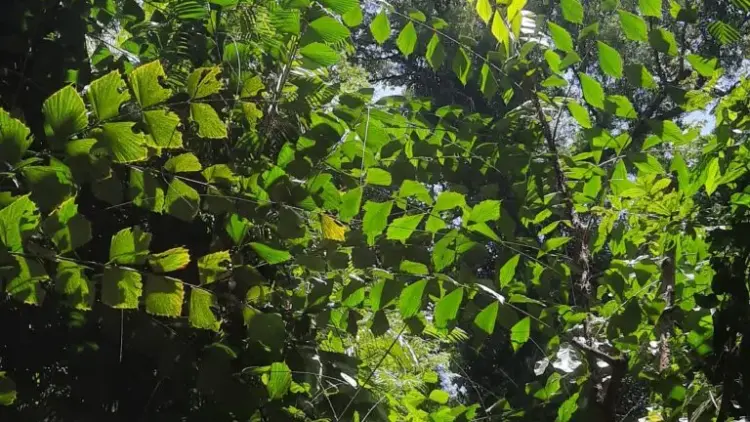
The research focused on Korthalsia laciniosa, a species of rattan or climbing palm. Unlike the iconic, upright palms of tropical postcards, these are "liana-like" plants. They use recursive hooks and sharp spines to latch onto the canopy, winding their way upward through the lowland evergreen forests. Economically, they are the lifeblood of local indigenous and settler communities, used for everything from furniture and basketry to house construction.
Key Findings
- Deep Genetic Divide: There is a "deep genetic break" between populations north and south of the Ten Degree Channel, indicating almost no interbreeding between the two island groups for millennia.
- Ancestral Origins: The Andaman populations likely migrated from the Indo-Burmese region, whereas the Nicobar populations are descendants of Sundaland lineages.
- The "Little Andaman" Anomaly: Even within the Andaman group, Little Andaman showed significant genetic isolation, suggesting that even smaller stretches of water have influenced evolutionary trajectories.
- Private Alleles: The Nicobar populations possess "private alleles"—genetic variants found nowhere else—marking them as a completely unique evolutionary unit.
Chronology: From the Ice Age to the Modern Laboratory
To understand the present-day genetic map of these islands, researchers had to look back 21,000 years to the Last Glacial Maximum (LGM), a period when the Earth’s climate was significantly colder and sea levels were approximately 120 metres lower than they are today.
21,000 Years Ago: The Ice Age Refugia
During the LGM, the geography of the Bay of Bengal was unrecognizable. Lower sea levels meant that many of the current Andaman islands were connected by land bridges, forming a much larger, continuous landmass. However, the Ten Degree Channel was so deep that even with a 120-metre drop in sea level, it remained a formidable water barrier.

The study’s lead author, Sarath Paremmal, formerly of the Kerala Forest Research Institute, explains that as the climate cooled, the climbing palm’s habitat shrank. "The southern Andaman region likely acted as a refugium—a safe haven where the species could survive the harsh conditions of the Ice Age," Paremmal notes.
Post-LGM: The Great Expansion
As the Earth began to warm roughly 10,000 to 15,000 years ago, glaciers melted and sea levels rose. The land bridges vanished, isolating populations on separate islands. However, the warming also allowed the palms to expand out of their southern Andaman refuge, recolonizing the middle and northern islands. This history of "contraction and expansion" created the specific genetic signatures seen in the populations today.
2024–2025: The Research Phase
The modern study involved a rigorous sampling process. Researchers collected leaf samples from 258 individual plants across 13 distinct populations, covering major hubs like Havelock Island, Little Andaman, Great Nicobar, and North Nicobar. By analyzing microsatellites—short, repetitive DNA sequences—they were able to build a high-resolution map of how these plants are related across the archipelago.
Supporting Data: Quantifying Isolation
The strength of the study lies in its use of molecular markers to quantify exactly how "different" these populations are.

| Region | Genetic Affinity | Diversity Levels | Key Characteristic |
|---|---|---|---|
| Andaman Islands | Indo-Burma (Myanmar) | Moderate to High | Expanded from southern refugia post-Ice Age. |
| Little Andaman | Distinct / Isolated | Moderate | Genetically unique even from nearby South Andaman. |
| Nicobar Islands | Sundaland (Sumatra) | Low (within populations) | High number of "private alleles" (unique variants). |
The data showed that genetic difference generally increases with geographic distance, but the Ten Degree Channel represents a "disproportionate jump" in genetic variance. The presence of 14 private alleles in the Great Nicobar samples specifically highlights that this island is not just a subset of the Andamans, but an evolutionary "island" in its own right.
Official Responses and Expert Commentary
The findings have sparked a significant dialogue among the scientific and conservation communities in India, particularly regarding how the islands are managed.
Sarath Paremmal, Lead Author:
"The landscape of the Andamans is fascinating. Over time, the land has changed shape because of sea levels changing. We believe the populations in the Andaman islands derive from Indo-Burmese regions, while the Nicobar regions have a stronger evolutionary connection with the Sumatran region. Our study shows that the Ten Degree Channel is not simply another stretch of water; it marks a deep genetic divide."
G. Ravikanth, Senior Fellow, ATREE Academy:
Ravikanth, who was not involved in the study, emphasizes the "non-substitutability" of these habitats. "The clearest implication from the study is that Great Nicobar belongs to a genetically distinct cluster. In simple words, forest diversion there cannot be offset by stock or habitat elsewhere. We cannot destroy here and create a similar habitat elsewhere."

Ravikanth argues that the current "one-size-fits-all" approach to the archipelago’s forestry management is scientifically flawed. He suggests that the Andaman and Nicobar stocks must be managed as separate ecological units for seed collection, nursery programs, and harvesting rules.
Implications: The Great Nicobar Controversy
While the study is a triumph of biogeographical science, its most urgent application lies in the realm of environmental policy. The timing of the research coincides with one of India’s most controversial infrastructure proposals: the Great Nicobar Island Project.
The Development Push
The Indian government has proposed a massive developmental overhaul for Great Nicobar, including:
- An international container trans-shipment port.
- A greenfield international airport.
- A power plant and a sprawling township.
- The diversion of over 130 square kilometres of pristine forest land.
The Conservation Conflict
The genetic study adds a new layer of complexity to this debate. If the forests of Great Nicobar are genetically unique—hosting variants of species found nowhere else in the world—then the standard practice of "compensatory afforestation" (planting trees elsewhere to make up for those cut down) becomes biologically impossible.

"You can plant a million trees in the Andamans or on the Indian mainland," one researcher noted, "but you cannot recreate the unique genetic heritage of the Nicobar climbing palm or the thousands of other species that likely follow this same pattern of isolation."
A Call for New Management Units
The study suggests three concrete actions for policymakers:
- Separate Management Units: The Nicobar and Andaman islands should be treated as two distinct biological provinces in all environmental laws.
- Refugia Protection: The southern Andaman evergreen forests, identified as Ice Age refugia, must be secured as high-priority conservation zones to ensure the long-term resilience of the species.
- Ex-situ Conservation: Given the development pressures, there is an urgent need to collect and store genetic material (seeds and DNA) from each sub-population to prevent the permanent loss of unique alleles.
Conclusion: A Multi-Layered History
The climbing palm, with its sharp hooks and resilient vines, has become an unlikely witness to the deep history of our planet. Its DNA carries the scars of rising seas and the memories of a time when the world was locked in ice.
The Ten Degree Channel is more than a navigational waypoint for ships; it is a sentinel of evolutionary time. As the Andaman and Nicobar Islands face an era of unprecedented human-led change, this study serves as a reminder that we are not just managing a landscape, but a complex, multi-layered history that, once lost, can never be replanted. Understanding the "Ten Degree Divide" is the first step toward ensuring that the biological treasures of both realms survive for the next 20,000 years.