

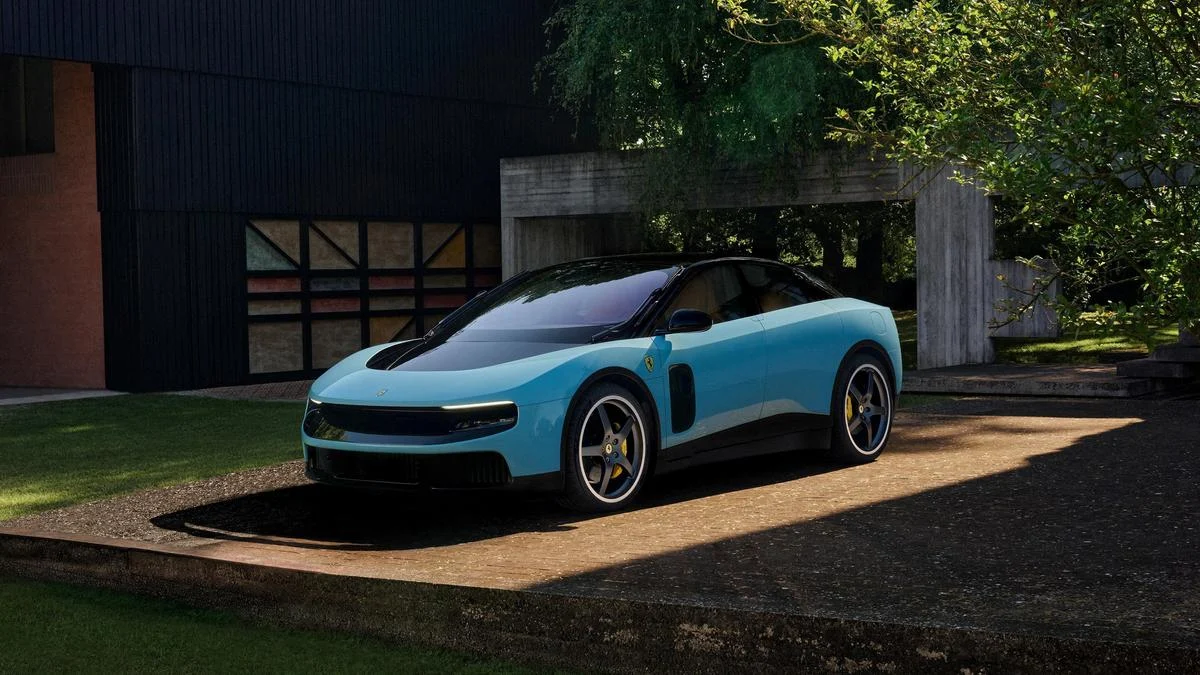
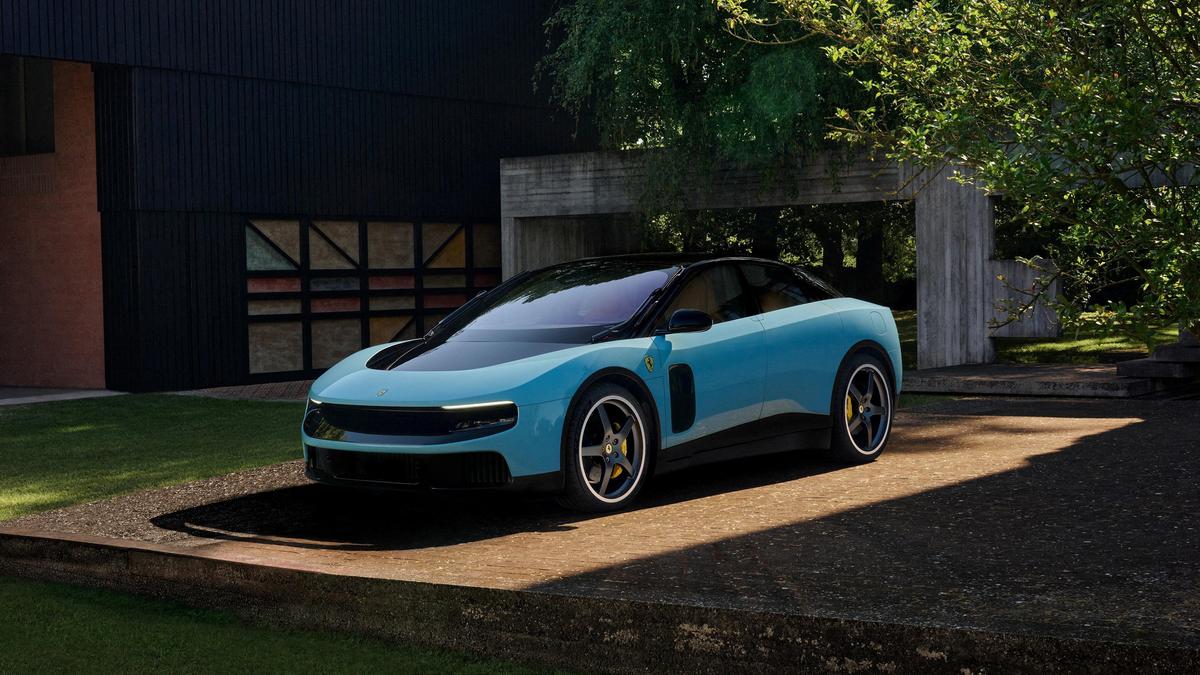
MARANELLO, ITALY — In a move that marks the most significant architectural shift in its 79-year history, Ferrari has officially pulled the silk off its first fully electric vehicle (EV), the Luce. Named after the Italian word for "Light," the Luce represents a paradox of engineering: it is a vehicle designed to carry the brand’s legendary performance into a carbon-neutral future while simultaneously becoming the heaviest and most spacious model ever to wear the Scuderia shield.
The unveiling, held at Ferrari’s newly inaugurated "e-building" in Maranello, signals the end of an era of hesitation for the luxury carmaker. While rivals like Porsche and Lamborghini have already made significant inroads into the electric and hybrid space, Ferrari’s entry is a calculated, high-performance riposte intended to prove that the "soul" of an Italian supercar can survive the transition from internal combustion to high-voltage electrons.
I. Main Facts: Redefining the Ferrari Blueprint
The Ferrari Luce is not merely a battery-powered version of an existing silhouette; it is a ground-up reimagining of what a grand tourer can be. The specifications released late Monday confirm that Ferrari is aiming for the absolute summit of the luxury EV market.
Performance and Powertrain
The Luce is built upon a bespoke electric architecture that integrates a massive 122 kWh battery pack into the floorpan. This powertrain delivers a top speed exceeding 310 kilometres per hour (190 mph), placing it in the upper echelon of electric performance, rivaling the Porsche Taycan Turbo GT and the Lucid Air Sapphire. Perhaps more impressive is its off-the-line urgency: the Luce can sprint from 0 to 100 kph in just 2.5 seconds, a figure that matches the hybrid SF90 Stradale.
Range and Utility
Recognizing that its clients increasingly use their Ferraris for continental touring, the company has equipped the Luce with a range of over 530 kilometres (approximately 330 miles) on a single charge. This is supported by an 800-volt system capable of ultra-fast charging, though specific charging times have yet to be disclosed.
A New Form Factor
The Luce breaks several historical taboos for the Maranello-based firm:
- The Weight Challenge: At 2.26 tonnes, the Luce is officially the heaviest Ferrari ever produced. The weight is a direct consequence of the large battery required to maintain high-speed performance over long distances.
- Four Doors, Five Seats: While the Purosangue introduced four doors to the lineup, it maintained a four-seat "2+2" configuration. The Luce is the first Ferrari in history to offer a five-seater layout, aimed squarely at a younger, more lifestyle-oriented demographic.
II. Chronology: The Road to the "e-building"
The path to the Luce has been one of deliberate, sometimes cautious, evolution. Ferrari has long insisted that it would not produce an electric car until the technology could guarantee "driving emotion" comparable to its V12 and V8 engines.
- 2013 – The Hybrid Seed: Ferrari launched the LaFerrari, its first mild-hybrid hypercar using the HY-KERS system derived from Formula 1. It proved that electrification could enhance, rather than stifle, performance.
- 2019 – Plug-in Integration: The debut of the SF90 Stradale marked Ferrari’s first plug-in hybrid (PHEV), allowing for short bursts of silent, electric-only driving.
- 2021 – Strategic Commitment: CEO Benedetto Vigna joined Ferrari from the semiconductor industry, signaling a shift toward tech-heavy development. He confirmed that a fully electric Ferrari would arrive in 2025/2026.
- 2024 – The Infrastructure: Ferrari completed the "e-building" at its Maranello campus. This state-of-the-art facility was designed specifically to manufacture electric motors, battery packs, and power inverters in-house, ensuring the "Ferrari DNA" remained proprietary.
- May 2026 – The Reveal: The Luce is unveiled to the world, marking the official start of the "Electric Era" for the Prancing Horse.
III. Supporting Data: Market Realities and Technical Benchmarks
The launch of the Luce comes at a volatile moment for the global automotive industry. While the ultra-luxury segment has remained somewhat insulated from the economic headwinds affecting mass-market EVs, the data suggests a cooling of enthusiasm.
The "EV Chasm" and Strategic Pivot
Last year, Ferrari’s leadership made a notable adjustment to their long-term forecasts. Initially, the company projected that electric models would account for 40% of its total sales by 2030. However, in light of shifting consumer sentiment and infrastructure challenges in key markets, that target has been revised downward to 20%.
This 50% reduction in the projected EV mix suggests that Ferrari intends to keep its internal combustion engines (ICE) and hybrid powertrains on life support for as long as regulations allow, likely utilizing carbon-neutral e-fuels to satisfy environmental mandates.
Competitive Landscape
To understand the Luce’s positioning, one must look at the data of its closest competitors:
- Porsche Taycan Turbo GT: 0-100 kph in 2.2 seconds; Top Speed 305 kph.
- Lamborghini Lanzador (Concept): Anticipated 1-megawatt peak power; 2+2 seating.
- Ferrari Luce: 0-100 kph in 2.5 seconds; Top Speed 310+ kph; 5 seats.
By opting for a five-seat configuration and a 310+ kph top speed, Ferrari is positioning the Luce not just as a "track toy," but as a high-speed "Super GT" that occupies a unique space between the traditional supercar and the luxury SUV.
IV. Official Responses: Leadership and Vision
The rhetoric from Maranello during the unveiling was focused on continuity rather than disruption. Ferrari’s leadership is keen to frame the Luce as a natural progression of the brand’s innovative spirit.
John Elkann, President of Ferrari, emphasized the historical weight of the moment:
"Today, we are inaugurating a chapter that turns our vision into reality, strengthening Ferrari’s tradition of anticipating and shaping the future. The Luce is the embodiment of our commitment to innovation without compromise. It is a Ferrari first, and an electric car second."
Benedetto Vigna, CEO, has previously touched upon the "sound" of the vehicle—a major concern for Ferrari purists. While the Luce is silent at low speeds, Ferrari engineers have reportedly spent years developing "acoustic signatures" that amplify the natural frequencies of the electric motors. "The sound of a Ferrari is essential," Vigna noted in earlier briefings. "We have patented technologies to ensure the Luce delivers the visceral thrill our clients expect."
Industry analysts, however, remain cautiously optimistic. "Ferrari is entering the market at a time when the ‘novelty’ of EVs has worn off," says Marco Santino, a lead automotive consultant. "They have to sell the Luce on its ‘Ferrariness,’ not just its battery specs. The 2.26-tonne weight is a hurdle for a brand built on agility."
V. Implications: Brand Identity in the Age of Electrons
The introduction of the Luce carries profound implications for Ferrari’s brand identity and the wider luxury landscape.
1. The Dilution vs. Evolution Debate
For decades, the Ferrari brand has been synonymous with the "screaming" V12 engine. By moving to a silent, heavy, five-seater EV, Ferrari risks alienating its core base of collectors. However, the Luce is also a defensive play. As major cities globally move toward zero-emission zones, a fully electric Ferrari ensures the brand remains relevant in urban centers like London, Shanghai, and Los Angeles.
2. Engineering as a Differentiator
By manufacturing the battery and motors in-house at the "e-building," Ferrari is attempting to avoid the "commodity trap" of EVs. Most electric cars share similar driving characteristics due to the nature of electric torque. Ferrari’s challenge with the Luce will be to prove that its software, thermal management, and torque-vectoring systems can provide a distinct driving experience that justifies a price tag expected to exceed $500,000.
3. The Future of the "Purosangue" Philosophy
The Luce’s four-door, five-seat layout suggests that Ferrari is leaning further into the "lifestyle" segment. The success of the Purosangue (Ferrari’s first four-door utility vehicle) proved that there is massive demand for practical Ferraris. The Luce doubles down on this, suggesting that the future of the brand may lie in versatile, high-performance daily drivers rather than just weekend track cars.
4. Environmental Leadership
While the Luce helps Ferrari lower its fleet emissions, the company remains a vocal proponent of e-fuels. The Luce is part of a "multi-energy" strategy. Ferrari is not putting all its eggs in the electric basket; instead, it is providing a clean-energy alternative for the modern era while fighting to keep the combustion engine alive for the purists.
Conclusion
The Ferrari Luce is a bold, if belated, entry into the electric vanguard. It is a car of superlatives: the fastest, the heaviest, and the most accommodating. Whether the "Light" of the Luce will illuminate a successful new path for the Prancing Horse or be overshadowed by the legacy of its roaring ancestors will depend on how the world’s most discerning drivers react to a Ferrari that hums instead of screams. As the first units prepare to roll out of Maranello, the automotive world watches to see if lightning can truly be bottled in a Ferrari.
