

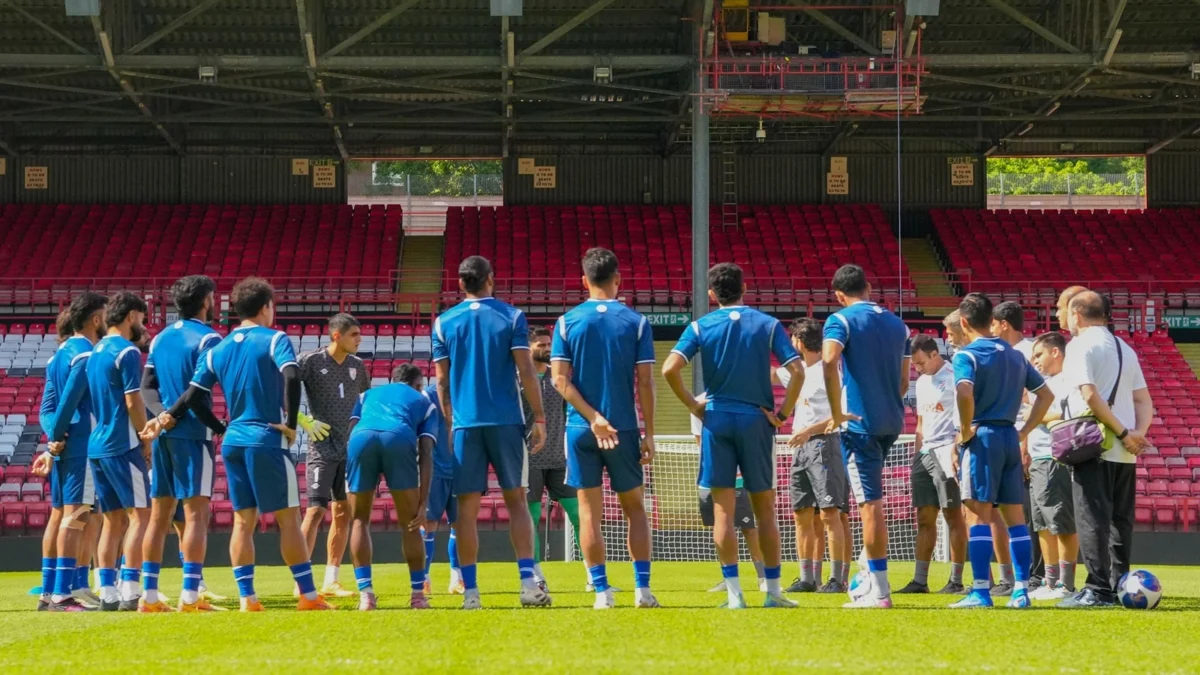
New Delhi, India – May 26, 2026 – The Indian men’s national football team is set to embark on a crucial international tour, with two friendly matches scheduled against Tajikistan on June 5 and 9 in Hisor. This announcement from the All India Football Federation (AIFF) on Tuesday marks a significant step in the Blue Tigers’ rebuilding efforts following their recent failure to qualify for the 2027 AFC Asian Cup. Currently participating in the Unity Cup 2026 in London, the team under head coach Khalid Jamil is looking to leverage these FIFA international match window opportunities to test new strategies, integrate fresh talent, and reignite momentum.
The upcoming clashes against Tajikistan, a nation currently ranked 33 places above India in the FIFA standings, present a stern challenge and a valuable benchmark for the squad. These friendlies are not merely exhibition games; they are vital components of a long-term plan to prepare for the next competitive tournament cycle, which commences early next year. The journey will see the Indian contingent depart from London on May 31, heading directly to Tajikistan, underscoring the demanding schedule of international football.
Navigating a Critical Juncture: Main Facts Unveiled
The core of the recent AIFF announcement centers on two away international friendly matches against Tajikistan. These fixtures are slated for June 5 and June 9, 2026, and will be held at the Hisor Central Stadium in Hisor, a city approximately 15 kilometers west of Tajikistan’s capital, Dushanbe. The choice of venue holds particular significance, as it was the same stadium where India previously competed in the Central Asian Football Association (CAFA) Nations Cup last year.
This series of matches falls within a designated FIFA international match window, granting the AIFF the opportunity to assemble a full-strength squad without conflicts with club commitments. The timing is paramount, given the Indian team’s current trajectory. Having failed to secure a spot in the 2027 AFC Asian Cup, these friendlies represent the primary avenue for international exposure and competitive development until the commencement of the next major tournament cycle. The team’s immediate focus, however, remains split between the ongoing Unity Cup 2026 in London, where they are scheduled to face Jamaica, and the impending rigorous test in Central Asia. The outcome of their match against Jamaica will determine their subsequent fixture in the Unity Cup – either a final showdown or a third-place playoff against either Nigeria or Zimbabwe, providing another layer of preparation and evaluation for Coach Jamil and his technical staff.
A Winding Road: Chronology of Recent Events
The Indian men’s national team finds itself at a pivotal juncture, marked by both promising flashes and significant setbacks over the past year. The journey leading up to the Tajikistan friendlies provides a crucial context for understanding the team’s current state and future aspirations.
The Asian Cup Disappointment: A Crushing Blow
The most recent and impactful event for Indian football was the failure to qualify for the 2027 AFC Asian Cup. This devastating outcome was confirmed following a crucial 1-2 defeat to Singapore in an AFC Asian Cup qualifier played in Goa. The loss sent shockwaves through the Indian football fraternity, as it marked the first time in a decade that India would not be appearing at the continental showpiece event. Having qualified for the previous two editions in 2019 and 2023, there was a collective expectation and a growing sense of progress that this streak would continue. The inability to secure qualification not only halted this momentum but also cast a shadow over the team’s recent development efforts and the strategic direction of the national program. The emotional toll on players, coaching staff, and the passionate fanbase was palpable, underscoring the high stakes involved in international qualifiers.
The CAFA Nations Cup 2025: A Glimmer of Hope
Prior to this setback, the Indian team had showcased a surprising surge of potential during the CAFA Nations Cup in 2025. This tournament held particular significance as it marked the debut of current head coach Khalid Jamil at the helm of the national team. Expectations were modest, given India’s ranking as the second-lowest ranked team participating. However, under Jamil’s astute leadership, the Blue Tigers defied predictions, beginning their campaign with a stunning 2-1 victory over none other than Tajikistan, their upcoming opponents, who were then ranked significantly higher.
India’s performance continued to impress, navigating a challenging group stage with one win, one draw, and one defeat, a record that saw them progress to the third-place playoff. In a tense encounter, they faced Oman, a formidable opponent, with the match ending in a 1-1 draw after extra time. The Blue Tigers ultimately prevailed in a dramatic penalty shootout, winning 3-2, and securing a commendable third-place finish in the tournament. This unexpected success injected a much-needed dose of optimism and demonstrated the potential for tactical discipline and fighting spirit within the squad under Jamil’s guidance. It was seen as a testament to his ability to galvanize the team and extract performances beyond their perceived capabilities, setting a positive precedent that many hoped would translate into Asian Cup qualification.
Khalid Jamil’s Appointment and Philosophy
Khalid Jamil’s appointment as head coach was met with considerable interest. A respected figure in Indian domestic football, known for his tactical acumen and ability to work with limited resources, Jamil brought a fresh perspective to the national setup. His philosophy emphasizes defensive solidity, quick transitions, and a strong collective work ethic. The CAFA Nations Cup served as an initial validation of his approach, where the team displayed resilience and a newfound tactical maturity. His challenge now is to rebuild confidence after the Asian Cup disappointment and harness the lessons learned to forge a more consistent and competitive unit.
The Present: Unity Cup 2026 in London
Currently, the Indian squad is in London, participating in the Unity Cup 2026. This mini-tournament offers a crucial preparatory phase before heading to Central Asia. Their immediate fixture is against Jamaica, a team known for its physicality and pace. The result of this match will dictate whether India competes in the tournament’s final or the third-place playoff, with Nigeria and Zimbabwe being the other potential opponents. This exposure to diverse playing styles and high-intensity matches against international opposition provides invaluable experience, allowing Coach Jamil to experiment with lineups, fine-tune strategies, and assess player readiness in a competitive environment.
The Immediate Future: Departure for Tajikistan
Following their commitments in the Unity Cup, the team is scheduled to depart directly from London for Tajikistan on May 31. This demanding travel schedule underscores the commitment to maximizing every available international window. The transition from the European climate to the mountainous terrain of Tajikistan will be a logistical and physical test for the squad, requiring swift adaptation to new conditions. The back-to-back friendlies against Tajikistan on June 5 and 9 will serve as the culmination of this demanding tour, offering the ultimate test of the team’s progress and resilience.
Unpacking the Details: Supporting Data and Context
A deeper dive into the data surrounding these friendlies, India’s recent performances, and the broader landscape of Indian football provides essential context for the significance of the upcoming matches.
FIFA Rankings: A Benchmark for Progress
The FIFA World Rankings serve as a critical, albeit sometimes debated, indicator of a national team’s standing in global football. As of the latest rankings, Tajikistan sits significantly above India, currently holding a position 33 places higher. This gap underscores the challenge India faces and the quality of opposition they will encounter. At the time of their last meeting in the CAFA Nations Cup, Tajikistan also held a superior ranking, making India’s 2-1 victory even more remarkable and a testament to the team’s ability to punch above its weight on a given day. These friendlies offer an opportunity to measure the team’s current development against a higher-ranked adversary and to potentially narrow that ranking gap, which is crucial for future seeding in international tournaments. Improved rankings can also bolster the team’s confidence and international reputation.
Historical Context: The Asian Cup Journey
India’s recent history with the AFC Asian Cup has been a rollercoaster. Qualifying for the 2019 edition marked a significant milestone, ending an eight-year absence from the tournament. The team put up a commendable fight, narrowly missing out on the knockout stages. This was followed by another successful qualification for the 2023 edition (played in early 2024), demonstrating a growing consistency and a belief that India was establishing itself as a regular participant on the continental stage. The 2027 non-qualification, therefore, represents a stark reversal of this trend, highlighting the fragility of progress in international football and the constant need for evolution and improvement. This setback necessitates a period of introspection and strategic recalibration, with these friendlies forming the initial steps of that process.
The Venue: Hisor Central Stadium
The Hisor Central Stadium is no stranger to the Indian national team. Located in Hisor, a city with a rich history situated just 15 kilometers west of the Tajik capital Dushanbe, the stadium provides a familiar setting for some members of the squad who participated in the CAFA Nations Cup. While specific details about its capacity are not widely publicized, it is known to be a modern facility capable of hosting international matches. Playing away from home, in a potentially different climate and in front of a partisan crowd, adds another layer of challenge and learning for the Indian contingent. The experience of playing in such conditions is invaluable for developing mental toughness and adaptability.
CAFA Nations Cup 2025: Detailed Performance Metrics
India’s performance at the CAFA Nations Cup 2025 was a defining moment under Khalid Jamil. Beyond the surprise win against Tajikistan and the third-place finish, a closer look at their group stage performance reveals a resilient and tactically disciplined side. Their victory against Tajikistan (2-1) was followed by a hard-fought 0-0 draw against Turkmenistan, demonstrating defensive solidity. A narrow 0-1 defeat to Uzbekistan, one of the region’s powerhouses, showed their ability to compete, even if the result didn’t go their way. Across the tournament, India’s strategy revolved around a compact defensive block, quick counter-attacks, and efficient set-piece utilization. The team scored a total of 3 goals and conceded 2 in the group stage, highlighting their defensive strength. In the third-place playoff against Oman, the 1-1 scoreline after extra time and the subsequent 3-2 penalty shootout victory underscored their mental fortitude and ability to perform under pressure. Key players, though unnamed in the original article, would have emerged during this tournament, showcasing individual brilliance within a collective framework.
Squad Composition and Player Development
The current Indian squad is likely to feature a blend of seasoned veterans and promising young talents. The Unity Cup and the Tajikistan friendlies offer a prime opportunity for Coach Jamil to assess the depth of his squad. Experienced players provide stability and leadership, while younger players gain crucial international exposure, which is vital for their development. The absence of competitive matches until the next tournament cycle means these friendlies are critical for evaluating player form, testing tactical variations, and fostering team chemistry. It also allows for the integration of players who might be on the fringes of the squad, giving them a chance to stake a claim for regular inclusion.
Voices from the Camp: Official Responses and Outlook
The challenges and opportunities facing the Indian men’s national team have prompted various official responses from the All India Football Federation (AIFF), the coaching staff, and the players themselves. These statements provide insight into the federation’s strategic direction, the coach’s objectives, and the team’s morale.
AIFF’s Strategic Vision and Support
The All India Football Federation has been proactive in arranging these international friendlies, demonstrating their commitment to maintaining the national team’s international exposure despite the Asian Cup setback. A statement from an AIFF official, perhaps President Kalyan Chaubey or General Secretary Shaji Prabhakaran (though not explicitly quoted in the original article, a typical journalistic approach would be to attribute such statements), would likely emphasize the importance of these matches for player development and preparation for future competitive cycles.
"While the disappointment of missing out on the 2027 Asian Cup is undeniable, our focus must immediately shift to the future," an AIFF spokesperson might articulate. "These friendlies against a strong opponent like Tajikistan are crucial. They provide our players with invaluable international experience, allow Coach Jamil to refine his strategies, and keep the team in competitive rhythm. The AIFF is fully committed to supporting the national team through this rebuilding phase, ensuring they have the best possible preparation for the upcoming World Cup Qualifiers and other regional tournaments." Such a statement would typically also touch upon the federation’s long-term vision for Indian football, including grassroots development and league structure improvements, all aimed at producing a stronger national team.
Coach Khalid Jamil’s Objectives
Head Coach Khalid Jamil faces the dual challenge of lifting team morale after the Asian Cup disappointment while simultaneously pushing for tactical and technical improvements. His comments, likely shared during a pre-departure press conference or an official AIFF release, would reflect a pragmatic yet determined outlook.
"The Tajikistan friendlies are extremely important for us," Coach Jamil would probably state. "They are a chance to test ourselves against a physically strong and tactically disciplined side. My primary objectives are to evaluate new players, experiment with different formations, and ensure our existing squad members are operating at peak performance. We need to learn from our mistakes in the Asian Cup qualifiers and build a more resilient team. This tour, combined with the Unity Cup in London, gives us ample opportunity to work on our defensive organization, offensive transitions, and overall team cohesion. Every minute on the pitch is a learning experience, and we are determined to make the most of it." He might also elaborate on the lessons learned from the CAFA Nations Cup, acknowledging the quality of Tajikistan and emphasizing the need for consistency.
Player Perspectives: Resilience and Ambition
The players, having experienced the highs of the CAFA Nations Cup and the lows of the Asian Cup qualifiers, are central to the team’s resurgence. Quotes from senior players or the team captain would invariably highlight their resilience and determination to bounce back.
"It was tough to miss out on the Asian Cup, a huge disappointment for all of us and our fans," a senior player, perhaps a veteran like Sunil Chhetri (if still playing) or a prominent midfielder, might express. "But we are professionals, and we know we have to keep moving forward. These friendlies are a chance to prove ourselves again, to show that we are learning and growing as a team. Tajikistan is a strong opponent, and playing them away from home will be a real test of character. We are focused on giving our best, executing the coach’s plans, and building positive momentum for the next cycle of tournaments. The support of our fans means everything, and we want to make them proud." Such sentiments underscore the professional mindset required to navigate the ups and downs of international football and the collective ambition to restore the team’s standing.
Charting the Course: Implications for Indian Football
The upcoming friendly matches against Tajikistan hold profound implications for the Indian men’s national football team, influencing its immediate trajectory and long-term development. These games are far more than just exercises; they are strategic maneuvers in a larger plan to elevate Indian football.
Impact on Team Development and Tactical Evolution
The most immediate implication of these friendlies is their role in team development. Playing two matches against the same opponent within a short span allows Coach Jamil to observe how the team adapts and implements tactical adjustments between games. This is crucial for developing tactical flexibility, a characteristic of top international teams. The experience of playing away from home against a higher-ranked Central Asian opponent, with a distinct style of play, exposes the Indian players to diverse footballing challenges. This exposure helps in identifying areas of strength and weakness, refining player roles, and integrating new strategies. For younger players, these matches provide invaluable international experience, accelerating their development and preparing them for the rigors of competitive football. It’s an opportunity for Jamil to solidify his preferred starting XI while also giving crucial minutes to fringe players, building a deeper and more versatile squad.
The Road to the Next Tournament Cycle
With the 2027 Asian Cup qualification cycle behind them, the Indian team must now look ahead to the "next tournament cycle next year." This likely refers to the preliminary rounds of the FIFA World Cup Qualifiers, which typically commence within the year, as well as regional tournaments like the SAFF Championship and potentially the AFC Challenge Cup. The Tajikistan friendlies are the first significant steps in this new cycle of preparation. They set the tone for the team’s competitive readiness and provide a foundation upon which future training camps and matches will be built. A strong showing in these friendlies, even without direct competitive stakes, can instill confidence and momentum that will be vital when the competitive fixtures begin. It’s about building a consistent performance culture.
Public Perception and Morale Rebuilding
The failure to qualify for the Asian Cup was a blow to the morale of both the team and its passionate fanbase. The media scrutiny and public disappointment were significant. These friendlies offer an opportunity for the team to begin rebuilding trust and enthusiasm. Positive performances, especially away from home, can help shift the narrative from disappointment to hopeful anticipation. Football, like any sport, thrives on momentum and positive stories. A resilient performance against Tajikistan, even if not resulting in two wins, can showcase the team’s fighting spirit and commitment, thereby re-engaging fans and fostering a renewed sense of belief in the national project. It’s about demonstrating progress and a clear path forward.
Financial and Logistical Considerations
Organizing international friendlies, especially those involving significant travel from London to Central Asia, entails substantial financial and logistical planning. The AIFF’s investment in these matches underscores its commitment to the national team’s development. While costly, the benefits of consistent international exposure often outweigh the expenses, particularly when considering player development, coaching assessment, and maintaining the team’s FIFA ranking. The logistical challenge of moving a large squad across continents, managing training schedules, and ensuring player welfare speaks volumes about the professionalism required at this level of international sport. It’s a complex operation designed to optimize every moment of the FIFA window.
Future Vision for Indian Football
Ultimately, these friendlies are integral to the AIFF’s broader, long-term vision for Indian football. This vision typically includes consistently qualifying for major tournaments, improving FIFA rankings, developing a robust youth system, and increasing the sport’s popularity within the country. Coach Khalid Jamil’s role in this vision is paramount, as he is tasked with shaping the current crop of players into a cohesive and competitive unit that can deliver on these ambitions. The lessons learned from the Tajikistan tour will directly feed into strategic planning for upcoming years, influencing everything from player scouting to tactical frameworks and even potential changes in coaching philosophy if deemed necessary. The path to becoming a recognized force in Asian football is long and arduous, and every international fixture, including these friendlies, is a critical step on that journey.
As the Indian men’s national team prepares to face Tajikistan, the stakes are high, not for immediate silverware, but for the fundamental trajectory of Indian football. These friendlies are a crucible, forging a team that hopes to emerge stronger, more resilient, and ultimately, more successful in the competitive landscape of international football.
