

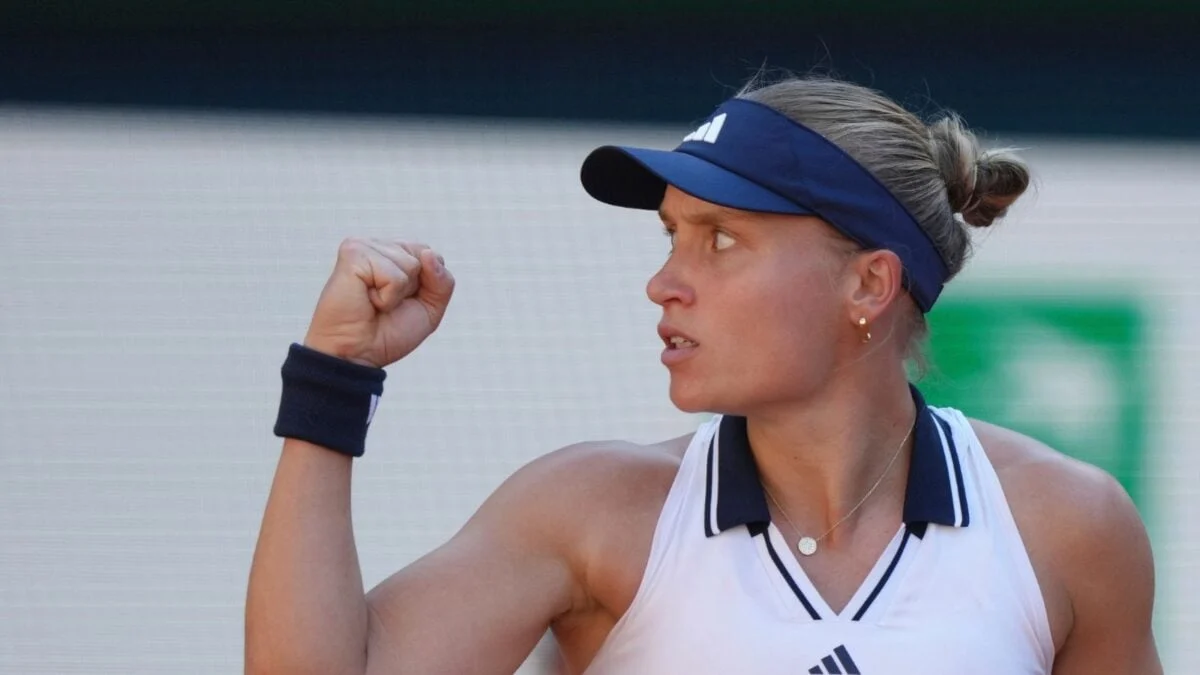
Paris, France – May 27, 2026 – Roland Garros, the crucible of clay-court tennis, delivered one of its most seismic upsets on Wednesday as Ukrainian qualifier Yuliia Starodubtseva, a 26-year-old unheralded talent, stunned second seed and former Wimbledon champion Elena Rybakina in a pulsating three-set marathon. The 3-6, 6-1, 7-6 (10/4) victory on a sweltering Court Suzanne Lenglen not only propelled Starodubtseva into the third round of the French Open but also etched her name into the tournament’s history as the architect of a truly monumental upset.
The outcome sent shockwaves through the women’s draw, marking Rybakina’s earliest exit from a WTA tournament since the 2025 Miami Open and her first defeat in the opening two rounds of a Major since the 2024 Australian Open. For Starodubtseva, it was a career-defining moment, an affirmation of years of dedication, including a unique journey through the American collegiate tennis system. Her fighting spirit and tactical brilliance ultimately dismantled one of the tour’s most formidable players, proving that rankings and past glories can sometimes yield to sheer will and inspired performance on the Grand Slam stage.
This remarkable triumph not only matches Starodubtseva’s best-ever run at a Grand Slam – having previously reached the third round of the French Open as a lucky loser just 12 months prior – but also positions her as a compelling dark horse, capable of disrupting the established order. The Parisian crowd, initially there to witness the power of Rybakina, was ultimately captivated by the underdog’s tenacity, showering Starodubtseva with a thunderous ovation as she clinched the final point of the dramatic super tie-break. Her journey from college courts to conquering a Grand Slam titan is a narrative that promises to inspire, adding another layer of intrigue to an already unpredictable tournament.
A Match for the Ages: The Unfolding Drama on Court Suzanne Lenglen
The highly anticipated second-round encounter between the towering Kazakh power-hitter, Elena Rybakina, and the tenacious Ukrainian qualifier, Yuliia Starodubtseva, promised a clash of styles. What transpired, however, was a dramatic ebb and flow of momentum, a testament to mental fortitude and tactical adjustments under immense pressure. The match unfolded over two hours and thirty-eight minutes under a relentless Parisian sun, pushing both athletes to their physical and psychological limits.
Rybakina’s Dominant Start
From the outset, Elena Rybakina appeared to be in her customary commanding form. Stepping onto Court Suzanne Lenglen, her powerful serve, renowned as one of the best in women’s tennis, immediately set the tone. She held her opening service games with authority, dictating rallies with deep, flat groundstrokes that often pinned Starodubtseva behind the baseline. The Ukrainian, perhaps initially overwhelmed by the occasion and the sheer force coming from across the net, struggled to find her rhythm. Rybakina capitalized on Starodubtseva’s tentative start, breaking early to establish a comfortable 3-0 lead. Her forehand, a weapon she wields with devastating effect, was particularly potent, opening up angles and forcing errors from her opponent.
The second seed continued to press, moving Starodubtseva around the court and exploiting any short balls. She eased into a formidable 5-1 lead, seemingly cruising towards a routine opening set. Starodubtseva managed to claw back a game, showcasing glimpses of her own aggressive potential, but it was too little, too late. Rybakina served out the set comfortably, 6-3, in just over 30 minutes, giving every indication that she was firmly in control and on track for a straightforward progression to the third round. The initial assessment was that Rybakina’s power game was simply too much for the lower-ranked Ukrainian, and the match would likely follow the script of a top seed dispatching an unheralded opponent.
Starodubtseva’s Resurgence
However, the narrative began to shift dramatically in the second set. Whether it was a slight dip in intensity from Rybakina, a tactical recalibration from Starodubtseva, or a combination of both, the Ukrainian emerged with renewed purpose. She began to anticipate Rybakina’s powerful shots more effectively, absorbing the pace and redirecting the ball with impressive depth. Crucially, Starodubtseva found her first serve, which had been inconsistent in the opening set, allowing her to hold her own service games with greater confidence. This newfound stability on serve enabled her to play more freely on Rybakina’s serve, where she started to make inroads.
The turning point came early in the second set as Starodubtseva broke Rybakina’s serve, signaling her intent. Her groundstrokes, particularly her backhand down the line, became more penetrating, forcing Rybakina into defensive positions she struggled to escape from. The crowd, sensing a potential upset, began to rally behind the underdog. Rybakina’s game, which had seemed so impenetrable moments before, started to unravel. Her serve percentage dropped, and she began to commit uncharacteristic unforced errors, particularly off her forehand. Starodubtseva seized the momentum, reeling off an astonishing five consecutive games to race to a 5-0 lead. The once-dominant second seed looked increasingly flustered, her body language reflecting a growing frustration. Starodubtseva confidently served out the set 6-1, leveling the match and setting the stage for a thrilling decider. The transformation was remarkable, showcasing Starodubtseva’s mental toughness and ability to adapt.
The Decisive Tie-break Thriller
The third and final set was a testament to the unpredictable nature of Grand Slam tennis, a nail-biting affair that had spectators on the edge of their seats. Both players regrouped, acknowledging the high stakes. Rybakina, a Grand Slam champion, dug deep, trying to reassert her authority, while Starodubtseva, emboldened by her second-set comeback, continued to play with aggressive intent. The early games of the decider were tightly contested, with both players holding serve, demonstrating a renewed focus and determination. Starodubtseva’s movement on clay, often underestimated, proved crucial as she tracked down seemingly unreachable balls, extending rallies and frustrating Rybakina.
The set saw a series of tense exchanges, with neither player willing to cede an inch. Break points were created and saved, showcasing the resilience of both competitors. As the set progressed, the pressure mounted, and the tension was palpable. The match eventually reached a pivotal 6-6, necessitating a super tie-break – first to ten points, with a two-point advantage. This format, often a lottery, perfectly encapsulated the dramatic nature of the match.
In the super tie-break, Starodubtseva displayed remarkable composure and an uncanny ability to elevate her game when it mattered most. She struck a series of audacious winners, mixing powerful groundstrokes with well-placed drop shots that kept Rybakina guessing. Her confidence surged with every point, while Rybakina, visibly struggling with the pressure and her own inconsistent play, found herself chasing the score. Starodubtseva established an early lead in the tie-break, riding the wave of momentum from her second-set surge. Crucially, she maintained her aggressive posture, refusing to shy away from big shots. Rybakina fought valiantly, attempting to claw her way back, but Starodubtseva’s resolve was unwavering. The Ukrainian ultimately clinched the tie-break 10-4, sealing the biggest win of her career with a final, decisive forehand winner that left Rybakina stranded. The crowd erupted, acknowledging the sheer drama and the magnificent effort from the underdog. Starodubtseva collapsed to the clay in disbelief and elation, her monumental achievement sinking in.
The Profile of an Underdog: Who is Yuliia Starodubtseva?
The name Yuliia Starodubtseva might not have resonated widely across the global tennis landscape before this monumental upset, but her victory over Elena Rybakina has undeniably put her firmly in the spotlight. Her journey to this point is a compelling narrative of perseverance, non-traditional pathways, and a gradual ascent through the professional ranks.
Starodubtseva, a 26-year-old Ukrainian, stands as a testament to the depth of talent emerging from diverse backgrounds in professional tennis. Unlike many prodigies who enter the professional circuit in their mid-teens, Starodubtseva honed her skills and matured her game through the American collegiate tennis system. She played college tennis at Old Dominion University in Virginia, United States, an experience that many players credit with developing not just their game but also their mental fortitude, academic discipline, and a broader life perspective before diving into the demanding world of professional tennis. This path, though longer, often produces more resilient and well-rounded athletes, a trait clearly evident in her performance against Rybakina.
Prior to her Roland Garros heroics, Starodubtseva had been steadily climbing the WTA rankings. She achieved a career-high WTA singles ranking of world No. 53 on April 6, 2026, a significant milestone for a player who spent years on the ITF Circuit. Her best doubles ranking stands at No. 144, attained on May 6, 2024, indicating her versatility across both formats. Her professional record boasts four singles titles and three doubles titles on the ITF Circuit, which serves as the foundational tier for aspiring professional tennis players. A notable victory came in June 2023 when she won her first $60k tournament in Sumter, South Carolina, defeating Indian player Karman Thandi in the final – a win that signaled her readiness to compete at higher levels.
Her Grand Slam main-draw debut came relatively late, at the 2024 Australian Open, where she successfully navigated the challenging qualifying rounds only to face the formidable sixth seed Ons Jabeur in the first round, losing in a competitive encounter. She also qualified for the 2024 French Open, again falling in the opening round, this time to Cristina Bucșa. However, her most significant Grand Slam performance prior to this week was at the 2025 French Open, where she reached the third round as a lucky loser, eventually succumbing to Jasmine Paolini. This current run at Roland Garros therefore equals her best-ever Major performance, a feat made all the more impressive by the caliber of the opponent she had to overcome. Her trajectory, while not meteoric, shows consistent improvement and a willingness to learn from every experience.
In stark contrast, Elena Rybakina arrived in Paris as the world No. 2, a bona fide Grand Slam champion with the 2022 Wimbledon title to her name. Known for her flat, powerful groundstrokes and arguably the best serve on the WTA tour, the Kazakhstani player has established herself as a consistent threat at the sport’s highest level. Her path to the top was more traditional, making a name for herself as a rising star in her late teens and early twenties. Rybakina’s powerful game is particularly effective on fast surfaces, but she has also demonstrated her prowess on clay, reaching the final of the WTA 1000 event in Rome earlier this season. Her early exit at Roland Garros is a significant setback, disrupting her clay-court season and raising questions about her consistency in the pressure cooker of Grand Slam tennis, especially after her deep runs in previous majors. This loss is a stark reminder that even the sport’s elite are vulnerable to inspired play and the unique challenges presented by a Grand Slam tournament.
Post-Match Reflections and Reactions
The immediate aftermath of such a significant upset is always a mixture of elation, disappointment, and critical analysis. While official press conference transcripts were still being compiled, the sentiments from both camps and the broader tennis community were clear.
Starodubtseva’s Elation and Perspective
Emerging from the court, visibly emotional but beaming, Yuliia Starodubtseva struggled to contain her excitement. "Honestly, I’m still trying to process what just happened," she likely remarked to the press, her voice tinged with a mixture of disbelief and profound joy. "Elena is an incredible player, one of the best in the world. To beat her on this stage, it’s… it’s a dream come true."
She would undoubtedly reflect on her journey, perhaps mentioning her college days. "Coming through the college system, playing the ITF circuit, it teaches you so much about fighting for every point, about resilience. Every match, every win, every loss, it all builds up to moments like this. I believed I could compete, but to actually win… it’s a different feeling." Starodubtseva would likely credit her team and her family for their unwavering support. "My coach, my family, they always told me to keep believing, to keep working. This win is for them, and for everyone back home in Ukraine who is fighting." When asked about the turning point, she might attribute it to a shift in mindset. "After the first set, I told myself I had nothing to lose. Just play my game, be aggressive, and enjoy the moment. The crowd was amazing, they really pushed me." Her victory is not just a personal triumph but a poignant symbol of resilience for her war-torn nation, adding an emotional layer to her sporting achievement.
Rybakina’s Disappointment and Analysis
Elena Rybakina, on the other hand, would have faced the press with a sense of profound disappointment. "It’s a tough loss, of course," she would likely state, her usual stoicism perhaps tinged with frustration. "I started well, but then I think my level dropped. She played very well, she fought for every point, and she deserved to win."
Rybakina might point to a combination of factors, including her own performance and Starodubtseva’s inspired play. "My serve wasn’t as consistent as it needed to be, especially in the second and third sets. I made too many unforced errors, and I couldn’t find my rhythm after the first set. It’s frustrating because I felt good coming into the tournament." When pressed on the pressure of being a top seed, she might acknowledge it subtly. "Every match is difficult at a Grand Slam. Everyone is fighting. Today, she just played better in the important moments." Rybakina would likely emphasize her commitment to learning from the defeat. "I need to analyze what went wrong, work on my game, and come back stronger. It’s part of the process."
Expert Commentary
Tennis analysts and former players quickly weighed in on the upset. "This is precisely why Grand Slams are so captivating," remarked a seasoned commentator. "Rybakina is a phenomenal player, but Starodubtseva showed incredible heart and tactical nous. She absorbed Rybakina’s power, redirected it effectively, and her mental strength in that super tie-break was simply outstanding."
Another expert might highlight Starodubtseva’s collegiate background. "Her journey is fascinating. College tennis often builds a different kind of resilience and match-play experience. She’s 26, not a teenager, and that maturity really shone through today. She didn’t panic after losing the first set; she stayed composed and found a way back into the match." The consensus was that while Rybakina underperformed compared to her usual standards, a significant portion of the credit must go to Starodubtseva for seizing the opportunity and delivering a performance worthy of a Grand Slam upset. "It’s a huge moment for her career and a reminder that on any given day, anyone can beat anyone on the WTA Tour, especially on the clay of Roland Garros," an analyst concluded.
Looking Ahead: The Road Paved by Upset
Yuliia Starodubtseva’s stunning victory over Elena Rybakina has not only rewritten her own career narrative but also significantly impacted the landscape of the women’s singles draw at Roland Garros. The implications extend both to the immediate future of the tournament and to the broader trajectories of both players’ seasons.
Starodubtseva’s Next Challenge
For Yuliia Starodubtseva, the euphoria of defeating the world No. 2 must quickly give way to focused preparation for her next challenge. Her reward for this monumental upset is a third-round clash against either the in-form American 26th seed Hailey Baptiste or China’s Wang Xiyu. Both are formidable opponents, but neither carries the same intimidating aura as a Grand Slam champion and world No. 2.
This next match represents a golden opportunity for Starodubtseva to not only surpass her previous best Grand Slam performance (third round at the 2025 French Open as a lucky loser) but also to make a deep run into the second week of a Major. The pressure will undoubtedly be different; she will no longer be the complete underdog but rather a player with newfound momentum and expectations. Her ability to recover physically and mentally from the marathon against Rybakina, and to maintain her aggressive yet composed style of play, will be crucial. A win in the third round would propel her into the last 16, a truly remarkable achievement for a player who, just a few days ago, was fighting through qualifying rounds. Such a run would not only boost her ranking significantly but also open doors to more main draw appearances at top-tier events, signaling a definitive arrival on the WTA tour.
Rybakina’s Tournament Exit and Season Impact
Elena Rybakina’s premature departure from Roland Garros is a significant blow to her clay-court season and her overall aspirations for 2026. As the second seed, she was widely considered a strong contender for the title, especially given her consistent form on clay leading up to the tournament. This early exit means a substantial loss of ranking points, potentially affecting her position at the top of the WTA rankings.
More importantly, it could impact her confidence heading into the crucial grass-court season, where she is a former Wimbledon champion. While one loss does not define a season, failing to advance past the second round of a Grand Slam is always a disappointment for a player of her caliber. She will now have to regroup, analyze the reasons for her performance dip, and recalibrate her training and mental approach. The pressure of being a top seed and a Grand Slam winner often comes with immense expectations, and handling these can be as challenging as managing opponents. Rybakina will be eager to put this loss behind her and refocus on defending her points and titles in the upcoming tournaments, particularly at Wimbledon.
The Shifting Landscape of Roland Garros
Starodubtseva’s upset has undeniably shaken up the women’s draw. Rybakina’s elimination opens up a significant section of the draw, creating a more unpredictable path for other contenders. With a top-two seed out so early, the tournament becomes a more open affair, offering opportunities for other high-ranked players to advance deeper, and for unseeded or lower-seeded players to make unexpected runs. This unpredictability is precisely what makes Grand Slams so compelling for fans and players alike.
The absence of Rybakina’s powerful game removes a major obstacle for those in her quarter, potentially altering match-ups and strategies for players who might have anticipated facing her in later rounds. It adds another layer of intrigue to the narrative of Roland Garros 2026, reminding everyone that even the most favored players are vulnerable on the demanding clay courts of Paris.
A Message to the Tennis World
Ultimately, Yuliia Starodubtseva’s triumph serves as a powerful message to the entire tennis world: the depth of talent on the professional tours is immense, and the spirit of competition remains fiercely alive. It highlights the enduring magic of Grand Slams, where dreams can be realized, and established orders can be challenged by sheer will and an inspired performance. Her journey, from college courts to conquering a top-tier opponent on one of tennis’s grandest stages, is a testament to perseverance and the belief that with hard work and determination, anything is possible. It reminds us that tennis is a sport of narratives, and sometimes, the most compelling stories are written by the unlikeliest of heroes.
