

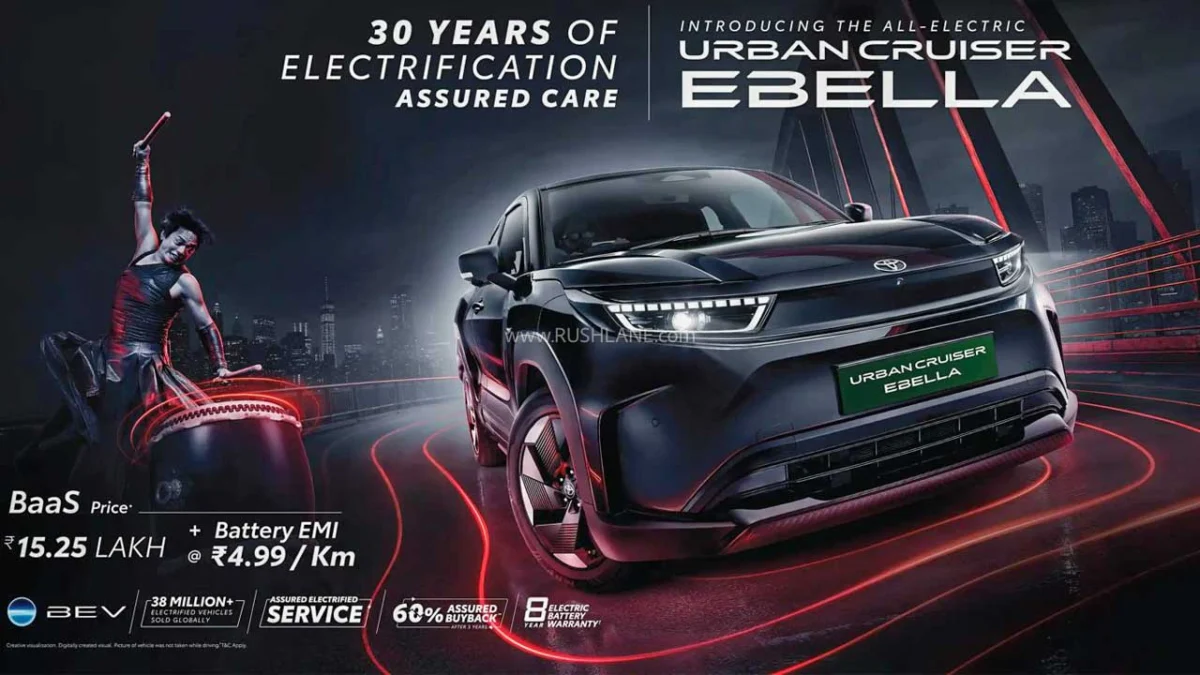
The Indian automotive landscape has witnessed a pivotal shift as Toyota Kirloskar Motor (TKM) officially marked its entry into the mainstream battery electric vehicle (BEV) segment. After months of anticipation, strategic teasers, and industry speculation, the Japanese automaker has launched the Toyota Ebella, its first-ever fully electric SUV for the Indian market.
Positioned as a premium offering in the mid-size electric SUV space, the Ebella is the fruit of the global Toyota-Suzuki alliance. Manufactured at Maruti Suzuki’s state-of-the-art facility in Gujarat, the Ebella is a badge-engineered sibling to the Maruti Suzuki eVitara. However, Toyota has carved out a distinct identity for its contender, focusing on a singular high-spec launch strategy and a sophisticated pricing model that includes the innovative Battery-as-a-Service (BaaS) program.
Main Facts: Pricing, Variants, and the BaaS Model
Toyota has opted for a "top-down" approach for the Ebella’s market introduction. While three trims—E1, E2, and E3—have been conceptualized, the company has initially launched only the top-tier E3 variant.
The Pricing Structure
The Toyota Ebella E3 has been positioned at a premium price point of Rs 23.60 lakh (Ex-showroom). This pricing reflects Toyota’s brand equity and its commitment to offering a "fully-loaded" experience from day one. In a move to make the upfront cost more accessible, Toyota has introduced the Battery-as-a-Service (BaaS) model. Under this scheme, the acquisition cost of the vehicle drops significantly:
- BaaS Upfront Price: Rs 15.25 lakh
- Battery Rental Charge: Rs 4.99 per kilometer
This dual-pricing strategy aims to lower the entry barrier for EV adoption while shifting the battery’s long-term residual value risk away from the consumer. However, a direct comparison with its sibling, the Maruti Suzuki eVitara, reveals a significant price gap. The eVitara’s top-spec Alpha trim is priced at Rs 20.01 lakh (Ex-showroom), making the Toyota Ebella approximately Rs 3.59 lakh more expensive than its Maruti counterpart. In the BaaS ecosystem, Toyota’s offering is Rs 74,000 dearer upfront, with a per-kilometer running cost that is Rs 0.6 higher than the eVitara.

Chronology: From Concept to the Indian Road
The journey of the Toyota Ebella is deeply intertwined with the "Global Strategic Alliance" between Toyota and Suzuki, signed in 2017. The project, initially known under the codename "27PL" (the dedicated EV platform), was designed to create a global electric SUV that could serve multiple markets, including Europe, Japan, and India.
- Concept Stage: The origins trace back to the Maruti Suzuki eVX concept showcased at the 2023 Auto Expo in Delhi. This concept served as the blueprint for both the eVitara and the Ebella.
- Global Unveil: In late 2024 and early 2025, the production-ready Maruti eVitara was unveiled in Milan, Italy, signaling that the platform was ready for mass production.
- Manufacturing Integration: Production was localized at Maruti Suzuki’s Gujarat plant, utilizing a high degree of local sourcing for battery packs and motor components to keep costs competitive.
- The Toyota Reveal: Following the eVitara’s launch, Toyota finalized the "Ebella" branding—a name derived from "Electric" and "Bella" (Italian for beautiful)—emphasizing a blend of sustainable technology and aesthetic appeal.
- Market Launch: The May 2026 launch of the E3 variant marks the official start of Toyota’s electric era in India, with E1 and E2 variants expected to follow within the next fiscal quarter.
Supporting Data: Specifications and Performance
The Toyota Ebella E3 is not merely a cosmetic exercise; it is a technologically dense vehicle designed to tackle the unique challenges of the Indian driving cycle.
Powertrain and Battery Tech
The E3 variant is equipped with a 61 kWh lithium-ion battery pack, utilizing Blade Cell technology known for its thermal stability and longevity.
- Range: The vehicle promises a certified range of 543 km on a single charge (MIDC cycle).
- Performance: The front-mounted permanent magnet synchronous motor produces 172 bhp and 193 Nm of torque, providing a linear yet punchy acceleration characteristic of high-end EVs.
- Charging: Time is a critical factor for EV owners. The Ebella supports high-speed DC fast charging, capable of replenishing the battery from 10% to 80% in just 45 minutes, provided a compatible 60kW+ charger is used.
Premium Features and Interior
Toyota has justified the E3’s premium price tag with an exhaustive list of features:
- Infotainment: A 10.1-inch high-definition touchscreen with wireless Apple CarPlay and Android Auto.
- Instrumentation: A 10.2-inch TFT digital instrument cluster with EV-specific telemetry.
- Comfort: Ventilated front seats (a necessity for Indian summers), a sliding and reclining rear bench with a 40:20:40 split, and dual-zone automatic climate control.
- Audio: A premium JBL sound system specifically tuned for the quiet cabin of an EV.
- Safety: The Ebella comes standard with Level-2 ADAS (Advanced Driver Assistance Systems), including autonomous emergency braking, lane keep assist, and adaptive cruise control. It also features six airbags, all-wheel disc brakes, and a 360-degree camera system.
Official Responses and Market Positioning
While Toyota Kirloskar Motor has not released a detailed breakdown of the pricing discrepancy between the Ebella and the eVitara, industry analysts suggest that the premium is attributed to Toyota’s superior warranty packages, "QDR" (Quality, Durability, and Reliability) standards, and a more premium dealership experience.

A Toyota spokesperson noted during the launch, "The Ebella is more than just an electric vehicle; it is a testament to Toyota’s commitment to ‘Carbon Neutrality for All.’ We have focused on a design language that is ‘Solid-plus-Elegant,’ ensuring that our customers feel the premium nature of the Toyota brand in every kilometer they drive."
The decision to launch the E3 variant first is a calculated move. By establishing the Ebella as a high-end, feature-rich SUV, Toyota avoids the "budget" tag often associated with badge-engineered products. The upcoming E1 and E2 variants will likely cater to fleet operators and value-conscious private buyers, respectively, potentially starting at an ex-showroom price of approximately Rs 18-19 lakh.
Implications: The Impact on the Indian EV Ecosystem
The launch of the Toyota Ebella has several far-reaching implications for the Indian automotive industry:
1. The Normalization of BaaS
With both Maruti Suzuki and Toyota now backing the Battery-as-a-Service model (following the trail blazed by MG Motor with the Windsor EV), BaaS is no longer a fringe experiment. It is becoming a mainstream financial tool. This model could significantly increase the resale value of the car "shell," as the buyer of a used EV would not have to worry about the health of a five-year-old battery; they simply continue the rental agreement or get a replacement through the service provider.
2. Heightened Competition in the Mid-Size Segment
The Ebella enters a crowded arena. It faces direct competition from:

- Tata Nexon EV / Curvv EV: The market leaders in terms of volume.
- Mahindra XUV400: Known for its performance.
- MG ZS EV: A well-established premium contender.
- Hyundai Creta EV (Upcoming): Perhaps the most anticipated rival.
Toyota’s entry forces these competitors to refine their technology and perhaps reconsider their pricing or service models.
3. The "Badge Engineering" Litmus Test
The price difference of Rs 3.59 lakh between the Ebella and the eVitara is one of the highest seen in the Toyota-Suzuki partnership (compared to the Glanza/Baleno or Hyryder/Grand Vitara). This will serve as a litmus test for the Indian consumer’s brand loyalty. Will buyers pay a 15-18% premium for the Toyota badge, a slightly different aesthetic, and Toyota’s service network?
4. Supply Chain and Localization
The production of the Ebella in Gujarat signifies a deepening of the EV supply chain in India. The localization of the 61 kWh battery pack is a massive step toward the government’s "Make in India" goals, potentially leading to lower costs for future models as economies of scale kick in.
Conclusion
The Toyota Ebella is a sophisticated, high-performance entry into the Indian EV market. While its initial pricing may seem steep compared to its Maruti Suzuki twin, its comprehensive feature list, robust battery technology, and the flexibility of the BaaS model make it a compelling choice for the modern, eco-conscious Indian family. As Toyota rolls out the more affordable E1 and E2 trims, the Ebella is poised to become a cornerstone of the brand’s "Green" portfolio, challenging the status quo and accelerating the nation’s transition to electric mobility.
