Kolkata, India – May 30, 2026 – Trinamool Congress (TMC) national general secretary and Member of Parliament, Abhishek Banerjee, was subjected to a violent mob attack on Saturday during his high-profile visit to Sonarpur in West Bengal’s South 24 Parganas district. The incident, which saw stones and eggs hurled at Banerjee’s convoy and person, has ignited a fresh political firestorm in a state already grappling with intense post-electoral friction. Banerjee, visibly defiant after the assault, vehemently accused the Bharatiya Janata Party (BJP) of orchestrating the disruption, a claim the opposition party has swiftly and forcefully rejected.
The attack occurred as Banerjee arrived to meet with families of victims affected by the recent spate of post-poll violence across West Bengal, underscoring the volatile and deeply polarized political landscape of the region. The swift escalation from a protest to a physical assault highlights the persistent challenges to law and order and the deepening animosity between the state’s dominant political forces.
The Attack Unfolds: A Chronology of Violence
Abhishek Banerjee’s visit to Sonarpur was intended as a gesture of solidarity and support for those impacted by the brutal aftermath of the recently concluded elections. His itinerary included meetings with grieving families and an assessment of the ground situation in an area that has historically been a TMC stronghold but has also witnessed sporadic political clashes.
Initial Arrival and Mounting Tension:
According to eyewitnesses and police reports, Banerjee’s motorcade entered Sonarpur around 3:30 PM. Initially, a small group of protesters, bearing BJP flags and placards, had gathered along the route, chanting slogans critical of the TMC and its leadership. While such protests are not uncommon in West Bengal’s charged political atmosphere, the sheer number and palpable anger of this particular crowd hinted at a potential escalation. Local police had a presence, but it was reportedly minimal for a visit by such a high-profile political figure in a known sensitive area. The atmosphere grew increasingly tense as the convoy approached the designated meeting point, with the crowd swelling rapidly, seemingly drawing in more individuals from adjacent lanes and by-lanes.
The Onset of Violence:
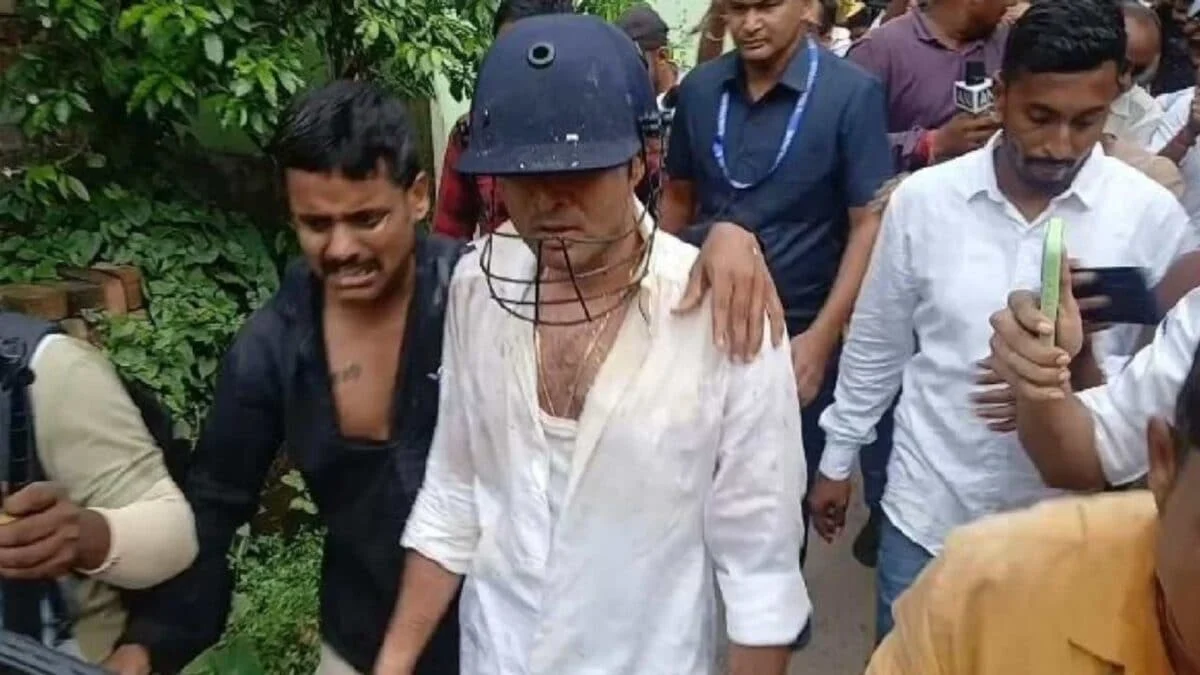
As Banerjee’s vehicle slowed down near the venue, a sudden surge of aggression erupted from the crowd. What began as vocal protests quickly devolved into a full-blown assault. Unidentified individuals from within the agitated mob began pelting stones, eggs, and plastic bottles at the convoy. The projectiles struck the vehicles and, in some instances, landed dangerously close to Banerjee himself. The initial moments of the attack were marked by chaos and confusion. The local police deployment, described by senior officials as "struggling to contain" the sudden outbreak, appeared overwhelmed by the sheer force and spontaneity of the public anger.
Security Scramble and Defiance:
Banerjee’s security detail, comprising personnel from the West Bengal Police and his personal security, immediately sprang into action. They formed a protective cordon around the MP, shielding him from the barrage of objects. Despite the intensity of the attack, Banerjee reportedly refused to retreat immediately, attempting to address the crowd and understand the grievances. However, the cacophony of slogans and the continuous pelting made direct communication impossible. His security team, prioritizing his safety, eventually managed to extricate him from the immediate vicinity of the most intense violence, guiding him to a more secure location before he could address the media. The rapid and uncoordinated nature of the attack prevented any immediate arrests, as the perpetrators quickly dispersed into the crowd.
Aftermath and Reinforcements:
Following the incident, the local police, recognizing the severity of the situation and the intelligence failure that had preceded it, swiftly deployed massive reinforcements. Anti-riot squads, equipped with protective gear and crowd control measures, arrived on the scene. Flag marches were conducted in sensitive pockets of Sonarpur to restore a semblance of order and to deter further violence. The area remained tense for several hours, with a heavy police presence maintained throughout the evening. The incident left a trail of damaged vehicles and heightened anxiety among residents and political workers alike.
Deep-Seated Political Tensions: Supporting Data and Context
The attack on Abhishek Banerjee is not an isolated incident but rather a stark manifestation of the deeply entrenched political violence that has plagued West Bengal, particularly during and after electoral cycles. The state has a long and often bloody history of political clashes, where party affiliations run deep, and rivalries frequently spill over into physical confrontations.
A History of Post-Poll Violence:
West Bengal’s political landscape is characterized by fierce competition, often escalating into violence, especially in the wake of elections. The 2021 assembly elections, for instance, were followed by widespread reports of violence, leading to casualties, displacement, and property destruction. Both the TMC and the BJP have accused each other of instigating and perpetrating such violence. The recent elections, the details of which remain under wraps as per the article’s future date, have evidently left a similar trail of discord, necessitating Banerjee’s visit to console victims. These incidents are often rooted in local power struggles, control over resources, and the desire to assert political dominance at the grassroots level.
The Significance of Sonarpur:
Sonarpur, located in the South 24 Parganas district, is a region with significant political importance. While generally considered a TMC stronghold, pockets within the district have seen the BJP gain traction, leading to increased political competition and, consequently, increased potential for conflict. Banerjee’s visit to an area experiencing post-poll violence underscores the state-wide nature of the problem, indicating that no region is entirely immune from the political friction. The choice of Sonarpur for the visit further highlights the TMC’s efforts to reassure its base and counter any perceived erosion of its authority.
The TMC-BJP Rivalry:
The rivalry between the Trinamool Congress and the Bharatiya Janata Party is arguably the most intense political contest in contemporary Indian politics. The BJP’s aggressive expansion strategy in West Bengal has directly challenged the TMC’s long-standing dominance, leading to a zero-sum political game. This rivalry permeates every level of political activity, from national policy debates to local panchayat elections. Each incident of violence, such as the one in Sonarpur, is quickly politicized, becoming a tool for accusation and counter-accusation, further fueling the cycle of animosity.
Official Responses: Accusations, Denials, and Demands
The aftermath of the Sonarpur attack saw immediate and predictable reactions from both the TMC and BJP, along with a defensive posture from the state’s administrative machinery.
Abhishek Banerjee’s Stinging Indictment:
Addressing the media immediately after being secured, a visibly angry and defiant Abhishek Banerjee minced no words. He unequivocally labeled the disruption a "completely orchestrated assault," leaving no doubt about his conviction that the attack was premeditated and politically motivated. "This is not a spontaneous protest; this is a clear example of the BJP’s version of democracy," Banerjee declared, his voice echoing frustration and contempt. He accused the ruling BJP (at the Centre, implying central involvement or state BJP’s local orchestration) of engineering the unrest, portraying the incident as a deliberate attempt to intimidate him and the TMC.
Banerjee’s criticism extended beyond the political opposition to the state’s administrative and police apparatus. He expressed "deep frustration over the local administrative response," pointing out a glaring "intelligence failure." "It has not been a month since the election cycle concluded, and yet the police were nowhere to be seen during the initial moments of the chaos," he stated, highlighting what he perceived as a severe lapse in security and intelligence gathering for a high-profile visit to a sensitive area. This criticism put the state police force, which falls under the TMC-led government’s purview, in an awkward position, suggesting internal coordination issues or a severe underestimation of the threat.
TMC’s Unified Condemnation and Call to Action:
Following Banerjee’s statements, the Trinamool Congress leadership issued a strong condemnation of the attack. Senior party leaders echoed Banerjee’s accusations, calling the incident a "cowardly act" and a "direct assault on democracy." They demanded an immediate, high-level inquiry into the intelligence failure and the identification and prosecution of those responsible for orchestrating and executing the violence. The party announced plans to "hit the streets in protest against the attack on its national general secretary," signaling a statewide agitation campaign to denounce the incident and rally support. This planned mobilization is expected to further strain the law-and-order machinery and intensify political confrontations across West Bengal.
BJP’s Vehement Denial and Counter-Allegations:
The Bharatiya Janata Party swiftly and vehemently denied Banerjee’s allegations. Senior BJP leaders in West Bengal dismissed the claims as "baseless" and a "desperate attempt to deflect from the TMC’s own failures." A state BJP spokesperson countered that the protests were a "spontaneous manifestation of public anger" against the opposition TMC’s local leadership, particularly concerning their alleged role in instigating post-poll violence against BJP workers and supporters. "The people of Sonarpur are tired of the TMC’s hooliganism and corruption," the spokesperson asserted, "and Mr. Banerjee is simply witnessing the wrath of ordinary citizens who have suffered under their misrule. To blame the BJP for a genuine public outcry is a tactic of a party losing its ground." The BJP accused the TMC of creating a narrative of victimhood to garner sympathy while simultaneously engaging in political intimidation.
Police Response and Investigations:
Local police officials, initially struggling to contain the violence, later confirmed that an investigation into the incident had been launched. While acknowledging the challenges in managing a rapidly escalating crowd, they refrained from commenting on the "intelligence failure" accusations. A senior police officer stated, "We are reviewing all available footage and witness testimonies to identify the perpetrators. Reinforcements were deployed promptly once the situation escalated, and order has been restored." The police emphasized their commitment to maintaining law and order and ensuring the safety of all citizens, including political figures. They also indicated that multiple FIRs (First Information Reports) would likely be lodged based on complaints from both sides.
Broader Implications: A State on Edge
The mob attack on Abhishek Banerjee in Sonarpur carries significant implications for the political future of West Bengal, threatening to further destabilize an already fragile law-and-order situation and deepen the profound political divide across the state.
Escalation of Political Tensions:
The immediate and most obvious implication is a significant escalation of political tensions between the TMC and BJP. The incident, framed by the TMC as a direct assault on its second-in-command and by the BJP as an expression of public dissent, will undoubtedly fuel further animosity. The planned statewide protests by the TMC will inevitably lead to counter-demonstrations and verbal skirmishes, potentially spilling over into physical confrontations, thus creating a perpetual cycle of reaction and retaliation. This heightened tension could make constructive political dialogue virtually impossible, hindering governance and policy implementation.
Challenge to Law and Order:
The incident exposed vulnerabilities in the state’s law-and-order machinery, particularly concerning intelligence gathering and crowd control during high-profile political events. The criticism of "intelligence failure" from within the ruling party highlights a serious concern about the administration’s ability to ensure security. If a prominent MP can be attacked in this manner, it raises questions about the safety of ordinary citizens and political workers, especially in sensitive areas. The need for continuous heavy police deployment and anti-riot squads in Sonarpur and other sensitive pockets indicates a state constantly on edge, diverting resources that could be used elsewhere.
Impact on Political Discourse:
The Sonarpur incident contributes to the erosion of civil political discourse in West Bengal. When political visits are met with violence and accusations of orchestrating attacks become commonplace, it further polarizes public opinion and normalizes aggression as a tool of political expression. This environment makes it difficult for political parties to engage in substantive policy debates or address the genuine concerns of the populace, as attention is constantly diverted to incidents of violence and the blame game that follows.
Security Concerns for Political Figures:
The attack also brings into sharp focus the security challenges faced by political leaders, particularly in states with a history of political violence. It underscores the need for robust security protocols, advanced intelligence gathering, and efficient crowd management strategies. The incident will likely lead to a review of security arrangements for high-profile individuals in West Bengal, potentially increasing the distance between leaders and the public, which could be detrimental to democratic engagement.
Precedent for Future Interactions:
The manner in which this incident is investigated and the subsequent actions taken by both political parties and the police will set a crucial precedent. If perpetrators are not swiftly identified and punished, it could embolden others to resort to similar tactics. Conversely, a fair and thorough investigation, followed by decisive action, could send a strong message against political violence. However, given the deep-seated mistrust, achieving such an outcome will be a formidable challenge.
In conclusion, the violent mob attack on Abhishek Banerjee in Sonarpur is more than just an isolated incident; it is a potent symbol of West Bengal’s enduring political volatility. It serves as a stark reminder of the challenges in fostering a peaceful democratic environment amidst fierce political rivalry and a history of post-electoral unrest. As the Trinamool Congress vows to intensify its protests and the BJP maintains its denial, the confrontation is set to further strain the state’s social fabric and deepen the political chasm, leaving West Bengal on a perilous trajectory.