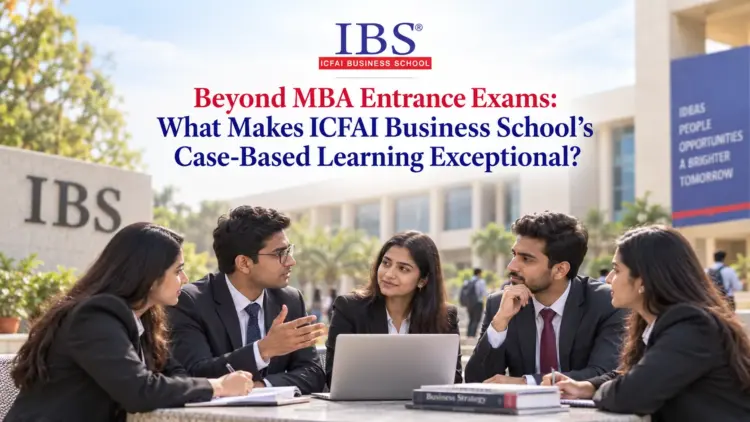
New Delhi, India – September 25, 2024 – In the competitive landscape of Indian management education, where entrance exam scores often take center stage, a crucial aspect of leadership development can be overlooked: the practical, real-world preparedness of future business leaders. While standardized tests offer a benchmark, the true measure of a business school’s efficacy lies in its ability to equip students with the nuanced skills, critical thinking, and adaptive strategies necessary to navigate the complexities of the global corporate arena. ICFAI Business School (IBS) is charting a distinct path, moving beyond the sole reliance on traditional metrics to anchor its management curriculum in a deeply immersive, world-class case-based learning methodology.
At the core of this distinctive academic philosophy is the ICFAI Business School Case Research Center (IBS CRC). This center has garnered international acclaim, securing a remarkable third position globally in case research. This ranking places IBS CRC in esteemed company, alongside venerable institutions such as Harvard Business Publishing and INSEAD, underscoring the significant international teaching impact of the cases it produces. These meticulously crafted cases are not merely academic exercises; they form the very operational fabric of the two-year full-time MBA and PGPM programs offered across all nine IBS campuses nationwide. This integrated approach ensures that every student benefits from direct exposure to authentic business challenges, mirroring the pedagogical approach adopted by leading global business schools.
The Transformative Power of Case-Based Pedagogy: Sharpening Executive Acumen
The case-based teaching methodology employed by IBS serves as a powerful conduit, bridging the gap between theoretical management principles and the pragmatic realities of executive decision-making. This approach immerses students in intricate and often ambiguous business scenarios, compelling them to move beyond rote memorization. Instead, learners are challenged to meticulously analyze incomplete data, pinpoint critical operational dilemmas, and devise strategic solutions within defined constraints. This is not a passive learning experience; it is an active engagement. Students are encouraged to participate in robust classroom debates and collaborative group discussions, where they must articulate, substantiate, and rigorously defend their proposed frameworks against the critical scrutiny of their peers.
This dynamic process is instrumental in cultivating a suite of essential executive capabilities. It significantly enhances critical thinking, enabling students to dissect complex problems from multiple angles. Quantitative analysis skills are honed as students grapple with financial data, market trends, and operational metrics. The ability to synthesize disparate pieces of information into coherent strategic insights is developed through the iterative process of case analysis. Furthermore, students learn the vital skill of strategic alignment – ensuring that proposed solutions are in sync with overarching organizational goals. Beyond these analytical proficiencies, the case-based method also sharpens crucial soft skills. Active listening becomes paramount in understanding diverse perspectives. Persuasive communication is refined as students learn to articulate their ideas compellingly. Perhaps most importantly, the pressure of real-time decision-making within the case study context builds resilience and sharpens the ability to make high-stakes choices under duress – qualities that are indispensable for effectively managing real-world corporate challenges.
The efficacy of this pedagogical approach is vividly illustrated in a series of videos available on the IBS India website. These testimonials from respective IBS campuses showcase how the institution leverages real-world business scenarios within its curriculum to systematically sharpen students’ analytical prowess and decision-making capabilities. By engaging with these authentic narratives, prospective students and educators can gain a deeper appreciation for the practical application of IBS’s innovative teaching methods.
A Streamlined Pathway to Excellence: IBSAT 2026 Admissions
For aspiring management professionals who are meticulously evaluating their options for advanced business education, the IBS Admission Test (IBSAT) 2026 presents a clear and accessible pathway into one of India’s most respected and robust business school networks. The IBSAT is not merely an entrance examination; it is designed to identify candidates who possess the intellectual curiosity, analytical aptitude, and potential for leadership that are foundational to success in IBS’s demanding academic environment.
The admissions process for the MBA and PGPM programs for the 2027-2029 batch is structured to be transparent and efficient. Prospective candidates are encouraged to familiarize themselves with the eligibility criteria, application procedures, and important dates as outlined by IBS. Early preparation and a thorough understanding of the examination format are key to maximizing one’s chances of success. The IBSAT, while a rigorous test, is carefully calibrated to assess the core competencies that the case-based learning methodology will further develop.
Connecting with the IBS Community: Insights from Alumni and Current Students
Understanding the student experience and the impact of the IBS curriculum is invaluable for prospective applicants. To facilitate this, IBS actively encourages engagement with its vibrant community of alumni and current students. These individuals offer firsthand accounts of their academic journeys, the challenges they’ve overcome, and the skills they’ve acquired. Their perspectives provide a unique and authentic glimpse into the culture, pedagogy, and career outcomes associated with an IBS education.
Prospective candidates are invited to join dedicated online forums and discussion groups, such as the "[Official] IBSAT 2026 | ICFAI Business School (IBS) | MBA/PGP Admissions 2027-29 | PaGaLGuY" on platforms like PaGaLGuY. These platforms serve as crucial hubs for information exchange, allowing individuals to connect with peers, ask questions, and gain insights from those who have navigated the admission process and are currently immersed in the IBS academic ecosystem. Such interactions are instrumental in making informed decisions about one’s future educational pursuits.
The IBS Advantage: A Commitment to Global Standards and Practical Application
The sustained success and international recognition of ICFAI Business School can be attributed to its unwavering commitment to a pedagogical model that prioritizes real-world application and the development of holistic leadership capabilities. The case-based learning approach, supported by the globally ranked IBS CRC, ensures that students are not just prepared for examinations, but are equipped to excel in their chosen careers.
By integrating authentic business challenges into the curriculum, IBS cultivates graduates who are not only knowledgeable but also adaptable, analytical, and confident in their ability to contribute meaningfully from day one. This focus on practical preparedness, coupled with a rigorous academic framework, positions IBS as a premier institution for those seeking a transformative management education that transcends the limitations of conventional assessment methods and truly prepares them for the dynamic world of business leadership. The IBSAT 2026 offers a gateway to this distinctive learning environment, inviting a new cohort of ambitious individuals to embark on a journey of intellectual growth and professional development.