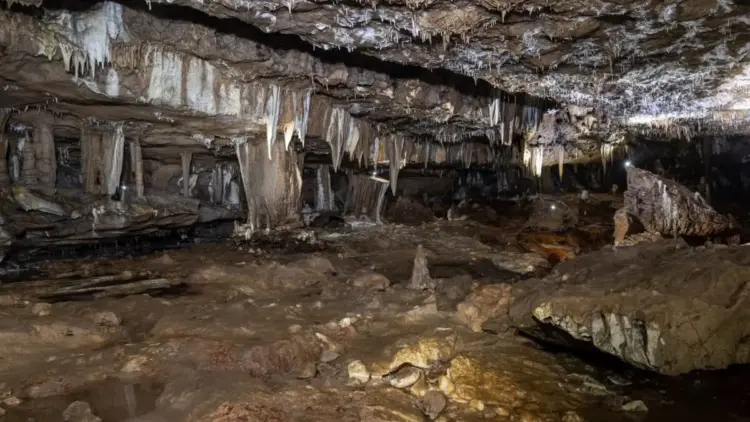
In the rain-drenched hills of Meghalaya, a silent, stony archive is being written drop by drop. Deep beneath the surface of the Cherrapunji plateau, the Mawmluh Cave holds secrets of the Earth’s climatic past spanning thousands of years. However, this "subterranean library" is currently facing an existential crisis. A combination of erratic climate shifts and unregulated industrial activity—specifically limestone and coal mining—threatens to erase these geological records before they can be fully read.
As scientists sound the alarm, a grassroots movement led by local indigenous communities is emerging. By pivoting from extractive industries to managed ecotourism, they hope to preserve a heritage that has become a global benchmark for geological time.
I. Main Facts: A Global Geological Benchmark
Meghalaya, often called the "Abode of Clouds," is home to one of the most extensive cave systems in the world. To date, over 1,700 caves have been documented, with many more remaining unexplored. These are not merely hollow spaces in the earth; they are highly sensitive ecosystems and invaluable scientific repositories.

The Meghalayan Age
The most significant scientific contribution of these caves is the definition of the "Meghalayan Age." In 2018, the International Commission on Stratigraphy formally recognized the current stage of the Holocene Epoch as the Meghalayan Age. This distinction was based on a stalagmite found in Mawmluh Cave, which provided evidence of a massive, 200-year-long global drought that began approximately 4,200 years ago. This climatic event led to the collapse of several major civilizations, including the Old Kingdom in Egypt, the Akkadian Empire in Mesopotamia, and the Indus Valley Civilization.
The Double Threat
Despite their global importance, the caves face two primary pressures:
- Anthropogenic Climate Change: Shifting monsoon patterns are altering the hydrology of the caves. Instead of the steady, mineral-rich "drip-drip" required for stalagmite growth, the caves are experiencing either prolonged dry spells or sudden, violent flooding that washes away delicate formations.
- Unregulated Extraction: Meghalaya sits on vast reserves of high-grade limestone and coal. Limestone is the primary raw material for cement, and its extraction often involves blasting that can collapse cave ceilings and disrupt the subterranean water tables essential for cave life.
Community Stewardship
In response to the lack of formal government protection—largely due to complex land-tenure systems—the Meghalaya Adventures’ Association (MAA) and local village councils have begun training youth as cave guides. This initiative seeks to create a sustainable economic alternative to mining while instilling a conservationist ethos in the next generation.

II. Chronology: From Discovery to Crisis
The history of Meghalaya’s caves is a timeline of gradual discovery followed by a rapid escalation of industrial threats.
- Pre-1990s: Most caves were known only to local villagers, who occasionally entered the entrances for shelter or to collect water. Scientific documentation was minimal.
- 1990: Brian D. Kharpran founded the Meghalaya Adventures’ Association (MAA). This marked the beginning of systematic exploration and documentation of the state’s subterranean world.
- 2007: Concerned by the rapid expansion of the cement industry, Kharpran filed a Public Interest Litigation (PIL) in the Supreme Court of India. The petition sought protection for the caves from limestone quarrying and coal mining.
- 2008: The Supreme Court dismissed the PIL without a detailed explanation, a move critics attribute to the strong economic and political influence of the mining lobby.
- 2014: The National Green Tribunal (NGT) imposed a ban on "rat-hole" coal mining in Meghalaya, citing environmental degradation and the high risk to human life. Despite the ban, illegal mining persisted.
- 2018: The International Union of Geological Sciences (IUGS) officially designated the "Meghalayan Age," putting Mawmluh Cave on the global scientific map.
- 2019: Researchers discovered Neolissochilus pnar in the Jaintia Hills. Measuring nearly 1.5 feet, it is recognized as the world’s largest known subterranean fish, highlighting the biological importance of these caves.
- 2024: A tragic explosion at an illegal mine in East Jaintia Hills killed 27 workers, underscoring the continued failure of mining regulations and the ongoing threat to the region’s geography.
III. Supporting Data: The Science of Speleothems and Biodiversity
To understand why scientists are frantic about the preservation of these caves, one must look at the data trapped within "speleothems"—the collective term for stalactites and stalagmites.
The Chemical Archive
Stalagmites grow as mineral-rich water drips from the cave ceiling. Each layer acts like a tree ring, capturing a chemical snapshot of the environment at that moment.

- Uranium-Thorium Dating: This technique allows scientists to date cave formations with incredible precision, often down to a few decades, over a span of hundreds of thousands of years.
- Oxygen Isotopes: By analyzing the ratio of oxygen isotopes in the calcite layers, paleoclimatologists can reconstruct past rainfall patterns. This data is crucial for predicting how the Indian Summer Monsoon—the lifeblood of South Asia’s agriculture—might behave in a warming world.
Subterranean Biodiversity
The caves are far from being "dead" rocks. They host a unique array of life forms that have evolved in total darkness:
- Troglobites: Species like transparent freshwater shrimp, white crabs, and blind fish have lost their pigmentation and eyesight, relying instead on heightened tactile and chemical senses.
- The Mega-Fish: The discovery of Neolissochilus pnar challenged previous biological assumptions that cave environments could not support large-bodied vertebrates due to limited nutrient availability.
- The Fragility of the Food Chain: These ecosystems depend on a stable influx of organic matter from the surface. When mining or deforestation occurs above a cave, this delicate balance is shattered, leading to localized extinctions.
IV. Official Responses and Legal Complexity
The governance of Meghalaya’s natural resources is uniquely complicated by the Sixth Schedule of the Indian Constitution. Unlike most of India, where the state owns sub-surface minerals, much of the land in Meghalaya is owned by private individuals or community clans.
The Enforcement Gap
While the National Green Tribunal (NGT) and the Supreme Court have issued various bans and guidelines, enforcement on the ground remains weak.

- Illegal Rat-Hole Mining: Since the 2014 ban, the state government has registered over 1,000 cases of illegal mining. However, the remote terrain and the economic desperation of local communities make policing difficult.
- The Cement Lobby: Large-scale limestone quarrying for cement plants is often technically "legal" under state permits, even when it occurs in close proximity to sensitive cave systems. Scientists like Dr. Sebastian Breitenbach have noted the sound of industrial blasting echoing inside Mawmluh Cave, a stark reminder of the lack of "buffer zones."
The Call for Scientific Buffer Zones
Geologists such as Jaishree Sanwal Bhatt argue that conservation cannot be "one-size-fits-all." They advocate for:
- Mapping and Zoning: Identifying "High-Value" caves for total protection while allowing regulated activity in less sensitive areas.
- Hydrological Monitoring: Ensuring that industrial activity does not divert the groundwater that feeds the cave systems.
- Policy Integration: Moving beyond simple bans toward a "Scientific Mining" framework that requires rigorous environmental impact assessments specifically for subterranean landscapes.
V. Implications: Ecotourism as the Last Line of Defense
As the state struggles with regulation, the burden of protection has shifted to the people who live above the caves. The transition from "miner" to "guide" represents a profound cultural and economic shift.
The Mawmluh Model
At Mawmluh, the community has opted for a "low-impact, high-value" tourism model.

- Natural Integrity: There are no permanent electric lights or paved walkways. Visitors must use headlamps, ensuring the cave’s natural rhythm remains undisturbed.
- Visitor Caps: To prevent the degradation of air quality (CO2 buildup) and physical damage to formations, only 25 visitors are allowed per day.
- Economic Incentive: For young people like Milton Marak, 27, the cave is a source of pride and a steady income. "If we install lights, it becomes a showroom," Marak says. "The real experience is the darkness."
The Future of the "Meghalayan Age"
The stakes extend far beyond the borders of India. If the Mawmluh Cave is destroyed or its hydrology permanently altered, the "type section" for the Meghalayan Age—the physical record that defines our current geological time—could be lost.
The story of Meghalaya’s caves is a microcosm of the global struggle between immediate economic gain and long-term environmental preservation. For the village guides, the scientists, and the MAA, the goal is clear: to ensure that the "books" in this subterranean library remain open for future generations to read. As Milton Marak leads his group back out into the autumn morning, he leaves the darkness behind, hoping that the ancient records within will still be there when the next torchlight flickers against the walls.