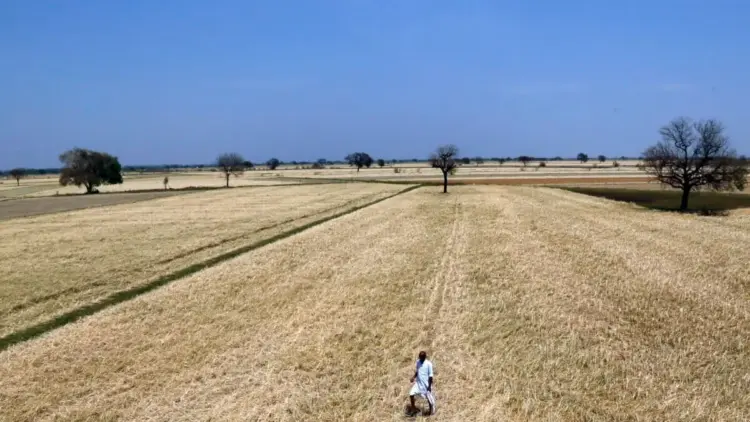
In the high-stakes theater of Indian agriculture, the El Niño Southern Oscillation (ENSO) is a protagonist that often brings tragedy. Historically, an El Niño year—characterized by the warming of surface waters in the eastern Pacific Ocean—has been a harbinger of a weakened monsoon for the Indian subcontinent. While this relationship is a statistical tendency rather than an absolute rule, the odds are heavily stacked against the Indian farmer when the Pacific warms.
In 2026, the signal was not merely a whisper; it was a roar. By the time the monsoon clouds were meant to gather over the Indian Ocean, the scientific community was in near-unanimous agreement. The India Meteorological Department (IMD) placed the probability of El Niño developing during the monsoon at a staggering 92%. Across the ocean, the United States National Oceanic and Atmospheric Administration (NOAA) went further, predicting a 96% chance of the phenomenon persisting through the winter. This was "Super El Niño" territory, drawing comparisons to the devastating 2015 season.
Yet, as the dust settles on a year of parched fields and depleted reservoirs, a troubling paradox has emerged. The science of forecasting performed exceptionally well, but the system of dissemination—the "last mile" delivery of life-altering information—stumbled. For many farmers in regions like Rajasthan, the forecast was an academic success but a practical failure.
Main Facts: A Season of Deficits and Disconnect
The 2026 monsoon season was defined by a widening chasm between meteorological prediction and agricultural protection. The IMD’s seasonal outlook had initially projected rainfall at 90% of the Long Period Average (LPA), with a 60% likelihood of a deficit. The reality on the ground mirrored these grim projections with clinical precision.

By early September 2026, Rajasthan, a state where drought is a recurring visitor rather than a stranger, was reeling from a 21% rainfall deficit. Out of its districts, 21 were classified as deficient, while only two reported a surplus. Nationally, the situation was equally dire; cumulative rainfall remained approximately 15% below the LPA through September.
The agricultural impact was immediate. Kharif sowing, the backbone of India’s summer crop cycle, lagged by 16% as of early July. While sowing figures recovered slightly in August due to desperate late-season planting, the rains never followed suit. This "sowing-rain gap" resulted in widespread crop failure. In Maharashtra, the crisis reached a tipping point where the government was forced to declare drought in 265 of its 358 talukas (administrative blocks).
The central issue, however, was not a lack of data. It was the disparity in how that data was consumed. An investigation into the experiences of farmers in Rajasthan reveals a stark divide: those connected to institutional networks adapted and survived, while those on the fringes were left to "rely on God" and misinformation.
Chronology: From Early Signals to Field-Level Crisis
The trajectory of the 2026 crisis began nearly half a year before the first raindrop was expected.

- January – March 2026: Global climate models begin picking up strong anomalies in the Pacific. The "Super El Niño" narrative starts to take shape in scientific circles.
- April – May 2026: The IMD issues its first Long Range Forecasts. The 92% probability of El Niño is made public. Agromet Field Units begin synthesizing this into state-level advisories.
- June 2026: The monsoon arrives with a whimper. Early sowing begins in parts of Northern India, but the intensity is low. Institutionalized farmers receive warnings to "hold back sowing" or "switch to short-duration crops."
- July 10, 2026: National data reveals a massive lag in Kharif sowing—53.12 million hectares against 63.27 million in the previous year. The deficit in paddy-growing regions along the Ganga becomes critical.
- August 2026: A brief "break-monsoon" period turns into a prolonged dry spell. Farmers who lacked early warnings find their soybean and rice crops wilting.
- September 2026: Rajasthan reports a 21% deficit. Formal drought declarations begin in Maharashtra and parts of Karnataka. The disconnect between the "accurate forecast" and "failed harvest" becomes the central theme of agricultural discourse.
Supporting Data: The Evolution of India’s Forecasting Machinery
To understand why the system failed in 2026, one must look at the infrastructure India has built over the last five decades. The country’s drought early warning system is anchored by the Agromet Advisory Services (AAS), established in 1977.
Initially, these services relied on All India Radio and newspapers—the only tools available to reach a rural audience. In 2008, the system was localized to the district level under the Gramin Krishi Mausam Sewa (GKMS). By 2018, in partnership with the Indian Council of Agricultural Research (ICAR), the service was extended to the block level. Today, more than 130 Agromet Field Units and a network of District Agromet Units housed at Krishi Vigyan Kendras (KVKs) generate these advisories.
The Digital Shift and the Precision Problem
The transition from radio to digital (SMS, WhatsApp, and apps like Meghdoot) was intended to make warnings "targeted and immediate." However, data from the 2026 season suggests this shift created new vulnerabilities.
- The Scale Gap: While a forecast might be 100% accurate at the block level (covering dozens of villages), it often fails to account for the micro-climate of an individual plot. Farmers noted that "block-level" rain often missed their specific fields entirely.
- The Authority Collapse: On a smartphone, a government advisory from the IMD looks identical to a speculative forward on a WhatsApp group. In 2026, many farmers reported deleting genuine warnings because they couldn’t distinguish them from "fake news."
- The Language Barrier: Despite the push for localization, many digital advisories remained steeped in technical jargon or were written in non-regional dialects, rendering them useless to the average farmer.
Official Responses and the "Two-Tier" Farmer Reality
The official response to the 2026 El Niño was a testament to scientific progress. The government utilized the Multi-Model Ensemble (MME) and statistical forecasting to give a six-month lead time. However, the "last mile" investigation in Rajasthan highlighted a deep sociological rift in how this information was utilized.

Group A: The Institutionalized Farmer
Farmers with sustained contact with their local KVKs were the success stories of 2026. For them, the system worked exactly as designed. In Sri Ganganagar, farmers like Rampal used the El Niño warning to stagger their paddy sowing, committing only small portions of land at a time to mitigate risk. In Baran and Pratapgarh, others swapped thirsty crops like soybean and rice for drought-resistant varieties like bajra (pearl millet) and guar. These farmers made "deliberate calculations," sowing only what their tube wells could support if the rains failed.
Group B: The Marginalized Farmer
For those outside the KVK network, the 2026 season was a disaster. Lacking institutional links, these farmers relied on traditional knowledge or social media. In Jodhpur and Jaisalmer, many were misled by viral WhatsApp messages claiming the monsoon would be "excellent." They invested their life savings into seeds and fertilizers, only to watch their crops wither under a relentless sun. For this group, the government’s sophisticated forecasting might as well not have existed.
Implications: Livelihood Security vs. Aggregate Production
The 2026 El Niño serves as a stark reminder that national food security and individual farmer livelihood are not the same thing. In the aggregate, India’s food production may remain stable because enough large-scale, "connected" farmers receive and act on warnings. However, the system is failing the very people it is meant to protect: the smallholder and marginal farmers who are furthest from the institutional machinery.
The Path Forward: Humanizing the Tech
If India is to meet its commitments under the Sendai Framework Target G—to substantially increase access to multi-hazard early warning systems by 2030—several systemic changes are required:

- Inter-Agency Convergence: Currently, responsibilities are fragmented between the IMD, the Ministry of Agriculture, the National Disaster Management Authority (NDMA), and ISRO. There is no single agency held accountable for whether a farmer actually understands and acts on a warning.
- The "Varuna Mitra" Model: Policy experts point to Karnataka’s "Varuna Mitra" service as a gold standard. It allows farmers to call and speak directly with an agrometeorologist. This human-to-human connection restores the "sense of authority" that is lost in a crowded WhatsApp inbox.
- Hyper-Local Precision: To make forecasts usable at the plot level, India needs a much denser network of automated weather stations. A forecast that is "correct for the block" is no longer enough in an era of climate volatility.
- Inclusive Dissemination: Outreach must move beyond the smartphone. For farmers in "media-dark" zones, voice-response systems in local dialects and physical outreach through village-level workers must be prioritized over flashy apps.
The 2026 season proved that India can see a drought coming from six months away. The challenge for 2027 and beyond is ensuring that when the scientists see the danger, the farmer on the furthest field has the tools, the trust, and the time to step out of its way. The forecast was the same for everyone; the tragedy is that the warning was not.