BENGALURU – Once celebrated as India’s "Garden City," Bengaluru is currently the site of an escalating conflict between rapid urban infrastructure expansion and the preservation of its dwindling green cover. As the state government pushes forward with a multi-billion-rupee plan for elevated corridors and underground tunnels to solve the city’s chronic traffic congestion, a burgeoning movement of "citizen scientists" is challenging the official narrative.
Through independent tree mapping and legal petitions, residents are exposing significant discrepancies in official environmental reports, raising fundamental questions about how the city accounts for its ecological wealth.
Main Facts: A Mandate Ignored and a Citizenry Awakened
The crux of the current dispute lies in a 2019 Karnataka High Court mandate. Under the Karnataka Preservation of Trees Act, 1976, the court ordered the Bruhat Bengaluru Mahanagara Palike (BBMP) and the Forest Department to conduct a comprehensive tree census. The exercise was given a three-year deadline. However, seven years later, the census remains incomplete, leaving a data vacuum that the state is filling with infrastructure projects.
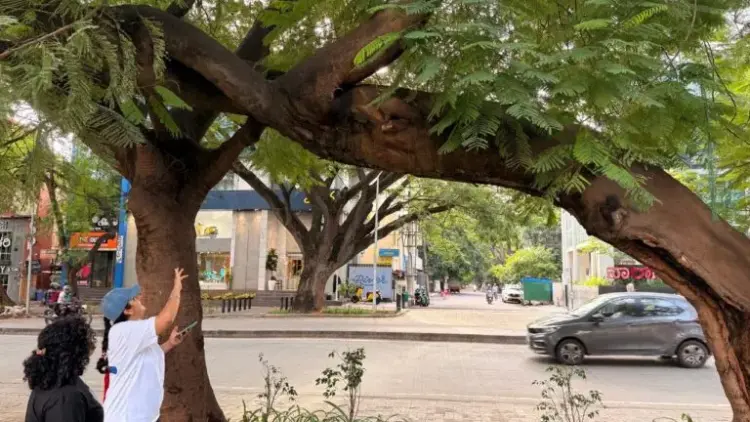
In the absence of official data, resident welfare associations (RWAs) have taken up the mantle. The most prominent example is in Indiranagar, where the group I Change Indiranagar conducted its own survey along the route of a proposed 13-km flyover. While the government’s Detailed Project Report (DPR) estimated that only 235 trees would be affected by the construction width across the entire 13-km stretch, the residents’ survey of just a 3.5-km section found a staggering 1,001 trees.
This discrepancy—a nearly four-fold difference in a fraction of the distance—has become a rallying cry for activists who argue that the government is systematically undervaluing the city’s green assets to fast-track construction.

Chronology: From Garden City to Concrete Corridor
The erosion of Bengaluru’s greenery is not a new phenomenon, but the pace has accelerated sharply in the last decade.
- 1976: The Karnataka Preservation of Trees Act is passed, intended to regulate the felling of trees and mandate compensatory afforestation.
- 2014: A landmark study by the Indian Institute of Science (IISc) reveals that Bengaluru has only 1.47 million trees for a population of 9.5 million—roughly one tree for every seven people.
- August 2019: The Karnataka High Court mandates a city-wide tree census to be completed within three years.
- 2022-2024: Multiple large-scale projects are announced, including 11 elevated corridors spanning 75.6 km and the ambitious Hebbal tunnel project.
- September 2024: Residents of Hebbal file over 1,600 objections following a public notice regarding the removal of 1,128 trees for a 2.2-km tunnel.
- October 16, 2024: The National Green Tribunal (NGT) intervenes, ordering a stay on tree felling for the Hebbal project until the case is decided.
- Present Day: Independent mapping by I Change Indiranagar and the "Dear Dr DK, Flyover Yaake?" campaign continue to challenge the validity of government DPRs in court.
Supporting Data: The High Cost of "Selective Counting"
Experts suggest that the discrepancies in tree counts are rarely accidental. Dr. Harini Nagendra, Director of the School of Climate Change and Sustainability at Azim Premji University, notes that DPRs often employ "selective counting."
"Smaller trees are frequently left out of official tallies, which undervalues the future canopy," Dr. Nagendra explains. "Conversely, ‘overmature’ trees are often excluded under the assumption they will die soon, yet these are the very trees providing the maximum carbon sequestration and cooling."
The Urban Heat Island Effect
The loss of vegetation has measurable climatic consequences. A 2025 IISc study documented a 1,078% increase in Bengaluru’s built-up area between 1973 and 2025. In the same period, vegetation cover plummeted by 88%. This has created a "wicked cluster" of urban heat islands.
Data from the IISc study indicates:

- Built-up areas: Land surface temperatures frequently reach 40°C.
- Dense vegetation/Water cover: Temperatures remain as low as 31°C.
- Threshold for comfort: Researchers estimate a city needs at least 30% vegetation cover to maintain a comfortable microclimate. Bengaluru’s current green cover is estimated at less than 4%.
Carbon Sequestration Deficit
T.V. Ramachandra, head of the Centre for Ecological Sciences at IISc, points out that the current tree-to-human ratio is insufficient to even offset the carbon dioxide residents produce through breathing (estimated at 540-980g per person per day), let alone the emissions from the city’s millions of vehicles.
Official Responses: Balancing Growth and Ecology
The agencies responsible for these projects—primarily Bengaluru Smart Infrastructure Limited (B-SMILE) and the BBMP—maintain that infrastructure is essential for the city’s survival as a global tech hub.
Regarding the Indiranagar controversy, Balaji M.T., an official with B-SMILE, stated that the agency is willing to be flexible. Following a writ petition by residents, the agency has already dropped one stretch of the proposed flyover. "There was a writ petition, so we did not want to hurry. We will abide by the court decision," he said.
However, the government’s primary strategy for mitigation remains "compensatory planting" and "transplantation." The Indiranagar DPR, for instance, allocates ₹4.26 crore to plant 2,350 saplings.
Critics argue this is an ecological "shell game." Most compensatory plantings happen on the city’s outskirts, providing zero relief to the heat-stressed urban core. Furthermore, transplantation—the process of moving mature trees—has a notoriously low success rate. "Transplantation is largely limited to trees younger than 25 years," says Vijay Nishanth of the Vruksha Foundation. "Mature trees often suffer such severe shock that they rarely recover their full ecological function."

Implications: Biodiversity and the Future of Urban Mobility
The battle over Bengaluru’s trees extends beyond mere numbers; it is a fight for the city’s biological soul. Official DPRs almost entirely ignore the impact of fragmentation on urban wildlife.
The Invisible Inhabitants
The Hebbal tunnel project serves as a case study in ecological oversight. While the tree survey lists girth and species, it fails to mention that the project area—including Hebbal Lake and the Veterinary College campus—is home to nearly 280 bird species.
"Insects, butterflies, and birds require unfragmented habitats to move," says Dr. Nagendra. "When we cut a line of avenue trees for a flyover, we aren’t just removing wood; we are destroying a corridor for parakeets, barbets, and pollinators."
The "Induced Demand" Trap
The citizen-led "Dear Dr DK" campaign is also challenging the fundamental logic of flyovers. Organizers like Asadullah M.A. Ansari point to the Silk Board-Ragigudda double-decker flyover as evidence that these structures do not solve traffic; they merely "shift the choke point" to the next junction.
The campaign urges the government to redirect the ₹13,000 crore earmarked for elevated corridors into robust public transport, such as expanded bus fleets and faster Metro completion. They argue that a city designed for cars will always be a city without trees, whereas a city designed for people can afford to be green.
Conclusion: A City at a Crossroads
Bengaluru stands at a critical juncture. The failure of the state to complete a court-mandated tree census has eroded public trust, leading to a situation where citizens feel they must act as the city’s ecological accountants.

As the Karnataka High Court and the National Green Tribunal weigh the evidence, the outcome will likely set a precedent for urban development across India. Will the "Garden City" successfully transition into a sustainable "Silicon Valley," or will it become a cautionary tale of how infrastructure, when pursued without ecological integrity, can ultimately degrade the very quality of life it seeks to improve?
For the residents of Indiranagar and Hebbal, the answer is found not in the engineering blueprints of the DPRs, but in the shade of the ancient rain trees they have spent their weekends mapping—one tree at a time.