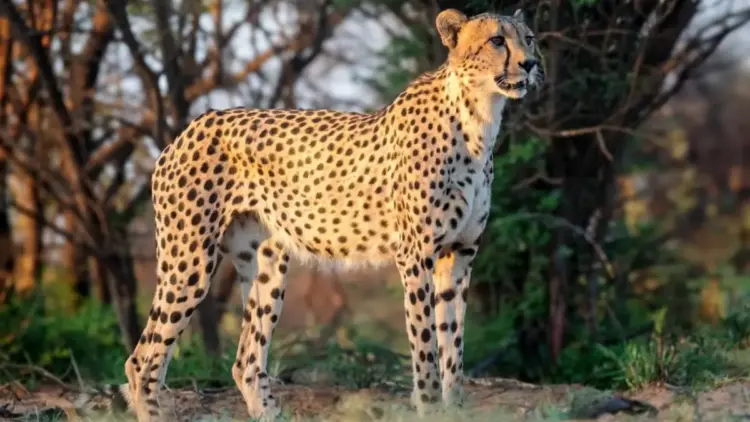
The ambitious and often controversial effort to reestablish a self-sustaining population of cheetahs in India faced its most harrowing setback to date on October 27, 2024. A 19-month-old male cheetah, identified as KNG22, died at a specialized veterinary facility in Jabalpur after failing to recover from severe injuries caused by firearm pellets.
KNG22 was not just any cheetah; he was a symbol of the project’s nascent success, having been born on Indian soil to Nirva, a South African cheetah brought to the country as part of the world’s first intercontinental large carnivore translocation project. His death, resulting from human-induced trauma rather than natural causes or inter-species conflict, has sent shockwaves through the conservation community and prompted a high-level federal investigation into potential poaching or retaliatory violence.
The Incident: A Fatal Discovery in Morena
The tragedy began to unfold on October 25, 2024, when forest officials patrolling the territorial forests of the Morena district—an area situated outside the heavily monitored boundaries of Kuno National Park—discovered the young male in a state of visible distress. KNG22 was found in Compartment No. 748 of the Sheopur Territorial Forest Division.
Unlike previous fatalities in the project, which were largely attributed to renal failure, cardiac arrest, or injuries sustained during mating or hunting, the physical condition of KNG22 immediately suggested external foul play. The cub was rushed to a veterinary facility in Jabalpur, where a multidisciplinary team of experts was assembled to attempt a life-saving intervention.
Medical Findings and the Struggle for Survival
Upon arrival at the Department of Veterinary Surgery and Radiology at Nanaji Deshmukh Veterinary Science University (NDVSU), Jabalpur, the cheetah underwent a series of diagnostic tests. Initial X-rays and a subsequent high-resolution CT scan revealed a grim internal landscape.
The scans identified multiple "foreign bodies" lodged deep within the animal’s anatomy. During emergency surgery, veterinarians recovered five firearm pellets. The trajectory of these pellets had caused catastrophic damage to:
- The Musculoskeletal System: Fractures and soft tissue tearing that inhibited movement.
- The Nervous System: Potential spinal or peripheral nerve damage that led to paralysis or severe neurological shock.
- Internal Organs: Hemorrhaging and perforation of vital systems, leading to systemic failure.
Despite intensive veterinary care and the best efforts of the surgical team, the damage was too extensive. On the morning of October 27, the Principal Chief Conservator of Forests and Chief Wildlife Warden of Madhya Pradesh, Sameeta Rajora, officially confirmed the cheetah’s passing.
Chronology of Project Cheetah and KNG22’s Life
To understand the weight of this loss, one must look at the timeline of India’s reintroduction efforts and the brief life of KNG22.
- September 2022: Prime Minister Narendra Modi releases the first batch of eight Namibian cheetahs into Kuno National Park, marking the species’ return to India 70 years after being declared extinct in 1952.
- February 2023: A second batch of 12 cheetahs arrives from South Africa, including Nirva, the mother of KNG22.
- March 2023: The first litter of cubs is born in India, though several succumb to extreme heat and dehydration shortly after.
- Early 2023: Nirva gives birth to KNG22. As an India-born cub, KNG22 represented the "F1 generation"—the first generation of cheetahs that would ideally grow up adapted to the Indian climate, prey base, and landscape.
- 2024: As the cubs matured, they began to exhibit natural dispersal behaviors. KNG22, like other young males, started exploring the fringes of the protected areas, moving into territorial forests and closer to human settlements.
- October 25, 2024: KNG22 is found wounded in Morena.
- October 27, 2024: KNG22 is pronounced dead in Jabalpur.
Official Responses and the Launch of a Federal Probe
The nature of KNG22’s death—caused by firearms—has elevated the incident from a conservation loss to a criminal investigation. The Union government has signaled the gravity of the situation by bypassing standard regional protocols and deploying a high-powered federal team to the ground.
The Federal Investigation Team
The Ministry of Environment, Forest and Climate Change has deputed a specialized unit to investigate the "ground truth" of the incident. This team includes:
- The Inspector General of Forests from the National Tiger Conservation Authority (NTCA).
- The Additional Director of the Wildlife Crime Control Bureau (WCCB).
- The Regional Deputy Director of the WCCB.
The involvement of the WCCB is particularly significant. It suggests that the government is looking into the possibility of an organized poaching attempt or a coordinated retaliatory strike by local communities.
State-Level Action
Simultaneously, the Madhya Pradesh government has constituted a Special Task Force (STF). This task force is unique in its composition, featuring both senior forest officials and high-ranking police officers. Their mandate is to sweep the villages surrounding the Sheopur and Morena territorial forests, conduct forensic ballistics tests on any recovered firearms in the area, and interrogate suspects who may have been involved in the shooting.
Supporting Data: The Current State of India’s Cheetah Population
The death of KNG22 reduces the total number of cheetahs in India to 58. While the project started with just 20 imported adults, the birth of several litters has helped maintain the numbers despite adult mortality. According to the latest press notes from the Madhya Pradesh Forest Department, the population is currently distributed as follows:

| Location | Number of Cheetahs |
|---|---|
| Kuno National Park (KNP) | 52 |
| Gandhi Sagar Wildlife Sanctuary | 4 |
| Veerangana Durgavati Tiger Reserve (VDTR) | 2 |
| Total | 58 |
While 58 remains a promising number compared to the initial 20, the loss of a 19-month-old male is a biological blow. Males of this age are the future "coalition" leaders who help defend territories and ensure genetic diversity in the next breeding cycle.
Implications: The Rising Challenge of Human-Wildlife Conflict
The death of KNG22 cannot be viewed in isolation. It is a symptom of the "landscape-level" challenges that Project Cheetah faces as it moves from the "enclosure phase" to the "free-roaming phase."
The "Panic" Factor
On the very same day KNG22 was found injured (October 25), reports emerged from Bamori village in the Sheopur district. Two other cheetahs had reportedly entered a cattle shed in the early hours of the morning. They killed two calves while the owners slept only a few meters away.
This incident highlights a growing friction. While the "Cheetah Mitras" (Friends of the Cheetah) program was designed to educate villagers, the reality of losing livestock—and the perceived threat to human life—creates a volatile environment. If KNG22 was shot by a villager, it may have been an act of "defensive" poaching, where locals take the law into their own hands to protect their livelihoods.
Territorial Overreach
Cheetahs are wide-ranging carnivores. A single male can require a territory of over 100 square kilometers. Kuno National Park, while vast, is surrounded by a "porous" landscape of territorial forests, agricultural fields, and villages. As young males like KNG22 explore these boundaries, they inevitably cross paths with humans.
The fact that KNG22 was found in the "territorial forests" of Morena—outside the core protected zone—proves that the cheetahs are attempting to establish home ranges in areas where forest protection is less intensive and human presence is higher.
The Path Forward: Conservation or Conflict?
The death of KNG22 by pellet wounds is a turning point for Project Cheetah. It forces a shift in focus from biological adaptation to social engineering and law enforcement.
1. Strengthening the Legal Deterrent
If the investigation finds that KNG22 was intentionally targeted, the state must pursue a conviction under the Wildlife Protection Act of 1972, which carries stringent penalties for hunting Schedule I animals. Without a clear legal deterrent, the "free-roaming" stage of the project may be doomed by small-scale retaliatory killings.
2. Redefining Compensation
To prevent villagers from reaching for firearms, the compensation process for livestock loss must be instantaneous and fair. If a farmer loses a calf to a cheetah, the bureaucratic delay in receiving payment often fuels the anger that leads to incidents like the one in Morena.
3. Fencing and Corridors
There is an ongoing debate among experts regarding whether India should adopt the South African model of fenced reserves or the "open landscape" model. The death of KNG22 provides ammunition for those arguing that, in a country as densely populated as India, completely open landscapes may be too dangerous for a species that lacks the "street smarts" to avoid humans.
Conclusion
KNG22 was a beacon of hope for the "Make in India" aspect of wildlife conservation—a cub born of a South African mother but raised on the sights, sounds, and prey of the Indian scrubland. His death is a sobering reminder that the greatest threat to the cheetah’s return is not the climate, the habitat, or the prey base, but the complex and often violent interface between wild animals and human civilization.
As the NTCA and WCCB conduct their investigation, the eyes of the global conservation community remain on Madhya Pradesh. The success of Project Cheetah now depends not just on the survival of the remaining 58 cats, but on the ability of the Indian government to foster a landscape where a cheetah can roam outside a park boundary without facing a barrage of pellets.