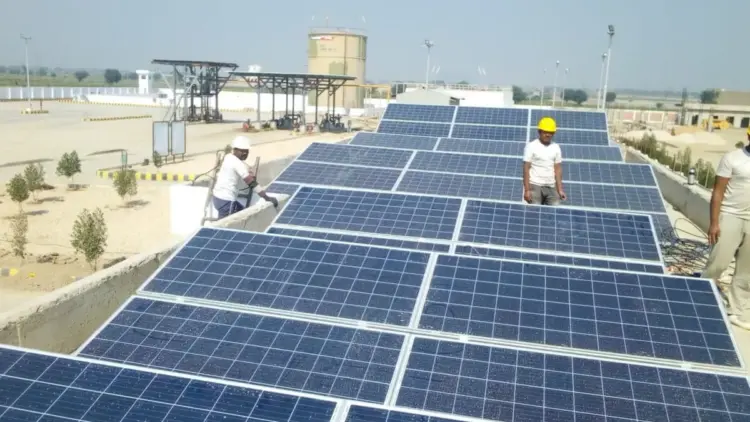
NEW DELHI – For over two decades, India’s trajectory of greenhouse gas emissions has been a subject of global concern, characterized by rapid, seemingly inexorable growth tied to its burgeoning economy. However, 2025 has emerged as a potential watershed year. According to the United Nations Environment Programme’s (UNEP) Emissions Gap Report 2026: The Point of Return, released on October 21, India’s emission trends have undergone a significant pivot, moving away from a path of steep acceleration toward a slight, yet historic, decline.
This shift, while influenced by transient weather patterns, suggests that structural changes in India’s energy architecture—specifically the aggressive expansion of renewable energy—are finally beginning to decouple economic growth from carbon output.
Main Facts: A Departure from the Growth Paradigm
The UNEP report highlights a rare consensus among major tracking agencies, even if their specific figures vary slightly. The Emissions Database for Global Atmospheric Research (EDGAR) and the International Energy Agency (IEA) both reported a slight decline in India’s total emissions for 2025. Conversely, the Energy Institute estimated a marginal increase. Despite these discrepancies, all three major data sources agree on a singular point: 2025 represented a dramatic departure from India’s historical pattern of high-velocity emissions growth.
India remains the world’s third-largest greenhouse gas emitter, trailing only China and the United States. In 2025, the nation’s total emissions reached approximately 4.5 billion tonnes of carbon dioxide equivalent (CO₂e), excluding land use and forestry. However, the narrative of India as a "polluter" is often balanced by its per capita metrics. At 3.1 tonnes of CO₂e per person, India’s individual footprint remains less than half the global average of 6.4 tonnes, and significantly lower than those of developed Western nations.

A parallel analysis by the Centre for Research on Energy and Clean Air (CREA), published via Carbon Brief, adds weight to this "cooling" trend. CREA estimated that CO₂ emissions specifically from fossil fuels and cement rose by a mere 0.7% in 2025. Excluding the anomalous pandemic year of 2020, this represents the slowest growth rate India has seen since 2001.
Chronology: The Road to the 2025 Plateau
To understand the significance of 2025, one must look at the preceding decades. Since the early 2000s, India’s emissions have largely mirrored its GDP growth, driven by an immense reliance on coal to power its industrialization.
- 2001–2019: A period of sustained, high-growth emissions, often exceeding 5% to 7% annually.
- 2020: The COVID-19 pandemic caused a temporary, forced contraction in emissions due to nationwide lockdowns.
- 2021–2024: A "revenge" surge in emissions as the economy reopened, with 2024 recording a 6.2% growth in electricity demand, largely met by coal.
- 2025: The "Pivot Year." Electricity demand growth slowed to 2.4%, and for the first time, renewable energy capacity additions were sufficient not just to meet new demand, but to actively displace coal generation.
Minal Pathak, a researcher at Ahmedabad University and a lead author for the UNEP report, characterized the 2025 data as "very encouraging," noting that the shift was a combination of structural energy transitions and favorable climatic conditions.
Supporting Data: The Rise of Renewables and the Retreat of Coal
The most compelling evidence for a structural shift lies in the power sector. According to Ember’s Global Electricity Review 2026, India’s renewable electricity generation surged by approximately 98 terawatt-hours (TWh) in 2025.
The Clean Energy Surge
The breakdown of this 98 TWh increase reveals a diversified green portfolio:

- Solar Power: The star performer, increasing by 53 TWh (a 37% jump).
- Wind Power: Contributed an additional 22 TWh.
- Hydropower: Added approximately 21 TWh, aided by a robust monsoon.
In a landmark milestone, solar energy overtook hydropower in 2025 to become India’s largest individual source of clean electricity. Combined, solar and wind now account for 14% of the nation’s total generation. When including nuclear and other renewables, clean sources provided 27% of India’s electricity in 2025, up from 22% just a year prior.
The Decline of Coal
As green energy surged, coal-fired generation felt the squeeze. Coal output declined by 44 TWh (2.9%) in 2025. Consequently, coal’s share of the total electricity mix fell from 75% in 2024 to 71% in 2025. This reduction directly impacted the atmosphere: electricity-sector emissions fell by 2.9%, dropping from 1,437 million tonnes of CO₂e to 1,395 million tonnes.
The Weather Factor: A Helping Hand from Nature
While structural shifts are promising, experts caution that 2025 benefited from a "perfect storm" of favorable weather. The India Meteorological Department (IMD) reported that the average temperature in 2025 was 0.28°C above the 1991–2020 average. While this still ranked as the eighth warmest year since 1901, it was significantly milder than 2024, which saw an anomaly of 0.65°C.
The relatively cooler summer significantly dampened the demand for air conditioning—a major driver of peak power loads in India. Ember estimates that this reduced cooling demand saved approximately 32 TWh of electricity consumption. Furthermore, India received 110% of its long-period average rainfall, boosting hydropower reservoirs and further reducing the need for coal-fired "peaker" plants.
Industrial Realities: The Steel and Cement Challenge
While the power sector showed signs of decarbonization, India’s industrial engine continued to roar. Steel production grew by 8% and cement by 10% in 2025. These two sectors alone account for roughly 21% of India’s CO₂ emissions from fossil fuels and industrial processes.

The growth in these "hard-to-abate" sectors partially offset the gains made in the power sector. However, there were silver linings even here: natural gas demand fell by 4%, and the consumption of petroleum coke and naphtha weakened, suggesting that even industry is beginning to experiment with fuel switching and efficiency measures.
Official Responses: Optimism Tempered by Caution
The reaction from the scientific and policy community is one of "cautious celebration."
Vaibhav Chaturvedi, a researcher at the Council on Energy, Environment and Water (CEEW), emphasized that while the displacement of coal by renewables is an "important change," it is not yet guaranteed to be permanent. "Adding clean energy capacity alone will not sustain it unless the power sector can store, transmit, and use clean electricity when and where it is needed," he noted.
Chaturvedi identified three urgent priorities for the Indian government:
- Flexibility and Storage: Massive investment in battery storage and pumped hydro to manage the intermittency of solar and wind.
- Pricing Reform: Implementing "Time of Day" tariffs to encourage consumers to use power when solar and wind output is highest.
- Integrated Planning: Aligning the power grid with the rapid electrification of transport (EVs) and buildings.
Minal Pathak added that demand management is the "missing piece" of the puzzle. She argued that lifestyle changes, urban planning, and better building designs in India’s rapidly growing cities could drastically reduce the baseline energy need before a single watt is generated.

Implications: National Targets vs. Global Reality
The UNEP report suggests that India is well on its way to meeting its 2030 and 2035 Nationally Determined Contributions (NDCs). Under current policies, India aims to reduce its emissions intensity (emissions per unit of GDP) by 47% relative to 2005 levels by 2035.
However, a critical distinction remains: meeting an intensity target does not mean absolute emissions will stop rising. Because India’s economy is expected to continue growing robustly, the UNEP estimates that India’s absolute emissions in 2035 could still be 1,254 million tonnes of CO₂e higher than its 2030 levels, even while meeting its intensity goals.
The Global Gap
On a global scale, the report paints a grimmer picture. Total global emissions reached 58.4 billion tonnes of CO₂e in 2025. Under current policies, the world is on track for 2.8°C of warming by the end of the century—well above the 1.5°C goal of the Paris Agreement.
To keep the 1.5°C target alive, global emissions must plummet by 45% by 2035. For India, this creates a diplomatic and economic tightrope. As the third-largest emitter, India will face increasing pressure to move from "emissions intensity" targets to "absolute peak" targets.
Conclusion: A Fragile Turning Point
The 2025 data offers a glimpse of a future where India’s growth is no longer synonymous with environmental degradation. The fact that clean energy generation is now growing faster than electricity demand is a milestone that few predicted a decade ago.

Yet, as both Pathak and Chaturvedi warned, one year does not make a trend. The "pivot" of 2025 was assisted by a mild summer and heavy rains—luxuries that climate change itself may soon make rare. For India to turn this slight decline into a sustained downward slope, the next five years will require an unprecedented scale of investment in grid modernization and industrial decarbonization.
The "Point of Return" has been identified; whether India—and the world—has the political will to cross it remains the defining question of the decade.