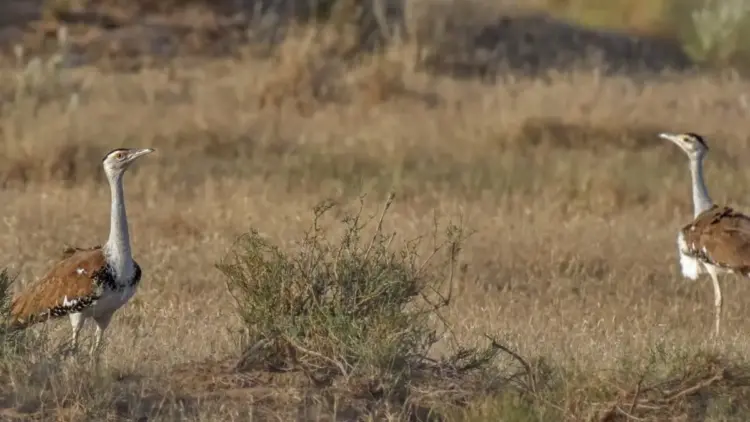
The Great Indian Bustard (Ardeotis nigriceps), a majestic bird once found across the dry plains of the Indian subcontinent, currently stands on the precipice of extinction. With fewer than 150 individuals remaining in the wild, every single bird represents a significant percentage of the global population. In October, a landmark effort to bolster these numbers saw the first release of captive-bred bustards into the wild—a move hailed as a "milestone" for Project Great Indian Bustard. However, the subsequent death of one of these birds has ignited a complex debate regarding the transparency of conservation efforts, the ethics of predator management, and the brutal realities of rewilding a species that has forgotten how to live in the wild.
Main Facts: A Milestone Marred by Mortality
In early October, four captive-bred Great Indian Bustards (GIBs) were released into the Desert National Park (DNP) in Rajasthan. This was the culmination of nearly a decade of intensive conservation breeding efforts led by the Wildlife Institute of India (WII) and the Rajasthan Forest Department. The goal was simple but ambitious: to transition birds raised in a controlled environment into the harsh, unpredictable landscape of the Thar Desert.
By October 17, however, the celebratory mood was dampened. One of the four released birds was found dead. Preliminary investigations and evidence at the site suggested that the bird had been predated upon by a desert fox (Vulpes vulpes pusilla) just a day earlier.
The incident has highlighted the "trial by fire" nature of rewilding programs. While the loss of a critically endangered animal is always a blow, project leads have been quick to frame the event not as a failure, but as an expected outcome of a high-risk biological experiment. The incident raises critical questions about the readiness of captive-bred birds to face natural predators and the adequacy of the "predator-proof" enclosures designed to protect them during their transition.
Chronology of the Conservation Effort
To understand the weight of this recent release, one must look at the timeline of Project Great Indian Bustard, which has evolved through several phases of desperation and innovation.

- 2010–2018: The Founder Population: Recognizing that wild populations were crashing due to habitat loss and power line collisions, the WII and forest departments established a conservation breeding program. Eggs were collected from wild nests in the Thar Desert and transported to specialized centers in Sam and Ramdevra, Jaisalmer. These eggs formed a "founder population" of 40 birds, raised entirely by humans using "puppet brooding" techniques to prevent the birds from imprinting on people.
- March 2024: The Gujarat "Jumpstart": In a bid to revive the GIB population in Gujarat—a former stronghold where only a few females remain—the "Jumpstart Approach" was initiated. A fertilized egg from the Rajasthan breeding center was transported to Kutch, Gujarat. It was placed in the nest of a wild female bustard to be incubated and reared naturally.
- April 2024: A Setback in Kutch: The chick from the Jumpstart program successfully hatched but went missing just weeks later. Despite exhaustive searches by forest officials, no remains were found. Predation was suspected, leading the Gujarat government to announce stricter habitat protection and predator-management measures.
- Early October 2024: The First Rajasthan Release: With the captive population nearing 100 birds, authorities decided to move to the rewilding phase ahead of the original 15-year schedule. Four birds were released into the DNP.
- October 17, 2024: The discovery of the predated bird in Rajasthan.
- Late 2024: Plans remain in place to release six more birds in November and December, provided they meet health and behavioral fitness criteria.
Supporting Data: The Mathematics of Survival
The success of the GIB breeding program is often viewed through the lens of survival statistics, which vary wildly between the laboratory and the field.
Captivity vs. The Wild
Sutirtha Dutta, a lead scientist with the WII, notes that the project has achieved remarkable success in its breeding phase. While international bustard conservation programs typically see a 48% survival rate for captive-reared birds, the Indian program has recorded an 80% survival rate. This efficiency allowed the team to begin rewilding in just eight years, nearly half the time originally projected.
However, the wild is a much harsher environment. In nature, a GIB egg has only an 18% chance of surviving to adulthood. The primary threats include predation by foxes, monitor lizards, and feral dogs, as well as trampling by livestock.
The Rewilding Benchmark
Experts warn that the public must calibrate its expectations for the rewilding phase. "Typically, in bustard breeding and release programmes, the survival rates of captive-bred and released bustards is 30% at best," says Dutta.
The strategy is a numbers game. If the project can release 30 birds annually and achieve a 30% survival rate, it would add 10 surviving adults to the wild population each year. Given that the current wild population in Desert National Park is estimated at only 40 individuals, an influx of 10 birds per year would represent a massive 25% increase in the local population, potentially pulling the species back from the brink of a "genetic bottleneck."
Official Responses: Defense and Strategy
The response from the scientific community and the government has been one of cautious pragmatism. They argue that the death of one bird should not overshadow the achievement of the release itself.

The Scientist’s Perspective
Sutirtha Dutta maintains that mortality is an inherent part of rewilding. The birds must learn to forage, find water, and avoid predators—skills that cannot be fully replicated in a captive environment. The "soft release" method, where birds are kept in large enclosures within their natural habitat before full release, is intended to mitigate these risks, but it cannot eliminate them.
The Predator Management Controversy
Following the death of the bird in October, reports surfaced suggesting a proposal to destroy fox dens and relocate desert foxes from the area. This sparked immediate backlash from environmentalists who argued that the desert fox is also a protected species under Schedule I of the Wildlife (Protection) Act, 1972.
Dutta clarified that large-scale removal of foxes was never on the table. Instead, he described a "scientifically-informed practice" of strategic translocation. This involves removing foxes from the specific 20-square-kilometer breeding enclosures within the 3,100-square-kilometer park. "Almost 50% of wild GIB eggs get predated, mostly by foxes whose numbers are very high inside these breeding enclosures," Dutta explained. He noted that this practice is directed by the Supreme Court and affects less than 1% of the total park area, ensuring that the wider ecosystem remains balanced.
Implications and Criticisms: The Transparency Gap
Despite the scientific defenses, the project faces significant criticism from independent biologists and conservationists regarding how information is shared and how the landscape is managed.
Calls for Transparency
Sumit Dookia, a wildlife biologist and associate professor at GGS Indraprastha University, has been a vocal critic of the program’s perceived secrecy. He argues that as a project of national importance funded by public money, the successes and failures should be documented and shared openly with the scientific community.
"It’s the world’s first experiment breeding the Great Indian Bustard species. Both successes and failures need to be discussed as part of the learning process," Dookia says. He points out that very little information has been made public regarding the specific circumstances of the predation. If the fox entered a "predator-proof" enclosure, it suggests a technical failure in the infrastructure that needs to be addressed before more birds are released.

The Ecological Dilemma
The GIB is an "umbrella species" for the grassland ecosystem. Protecting it should, in theory, protect everything else in that habitat. However, the focus on "predator management" raises an ethical dilemma: can you save one endangered species by suppressing another native species?
Dookia warns against viewing the desert fox as a "villain." The fox is an integral part of the Thar Desert’s food web. If the released bustards cannot learn to coexist with natural predators, the rewilding program may create a population of "zoo birds" that are permanently dependent on human intervention and fenced-off, fox-free zones.
The Infrastructure Threat
While predation is the immediate concern for these four birds, the "elephant in the room" for GIB conservation remains high-voltage power lines. Over the last decade, collisions with overhead wires have been the leading cause of adult GIB mortality. While the Supreme Court of India has ordered the undergrounding of many of these lines, progress has been slow due to technical and financial hurdles cited by power companies. Conservationists argue that unless the "sky is cleared" of these wires, rewilding efforts—no matter how successful the breeding—will ultimately lead the birds into a deathtrap.
Conclusion: The Long Road to Recovery
The death of a captive-bred Great Indian Bustard in the Desert National Park is a somber reminder of how difficult it is to undo the damage of habitat loss and species decline. However, in the cold calculus of conservation biology, the fact that three other birds are still navigating the Thar Desert is a sign of hope.
The coming months will be critical. As the WII prepares to release more birds in November and December, the focus will shift to refining the "soft release" process and ensuring that the lessons learned from the October predation are applied. The path to saving the Great Indian Bustard is not a straight line; it is a zig-zag of scientific breakthroughs, tragic losses, and the persistent hope that a species on the edge can eventually find its footing in the wild once more. For now, the eyes of the global conservation community remain on the sands of Jaisalmer, waiting to see if the "King of the Grasslands" can truly return to its throne.