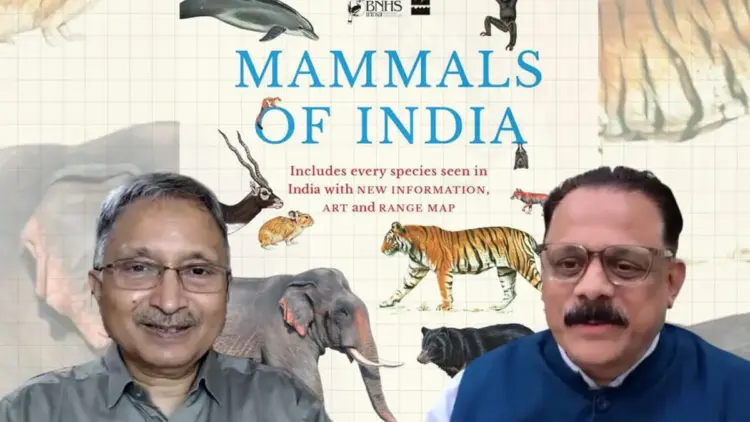
In a landmark collaboration between the Bombay Natural History Society (BNHS) and HarperCollins Publishers India, the newly released "Mammals of India" serves as both a comprehensive scientific record and a poignant tribute to one of the country’s greatest wildlife pioneers.
The Indian subcontinent, a landmass defined by its dramatic geological birth and its subsequent role as a "biotic ferry," holds a mammalian diversity that is as complex as its history. This intricate tapestry of life has now been meticulously documented in a new volume titled Mammals of India. Authored by two of the nation’s most distinguished wildlife researchers—the late Dr. A.J.T. Johnsingh and Dr. P.O. Nameer—the book represents a bridge between rigorous academic inquiry and public conservation awareness.
However, the publication is marked by a somber milestone. Dr. A.J.T. Johnsingh, a legendary figure in Indian wildlife biology often referred to as the "father of modern field biology" in the country, passed away in 2024. He did not live to see the final printed copies of the work he spent years refining. In a recent dialogue, his co-author, Dr. P.O. Nameer, Dean of the College of Forestry at Kerala Agricultural University, reflected on the book’s journey and the profound geological forces that shaped the animals inhabiting the Indian landscape today.
I. Main Facts: A Definitive Compendium for a Biodiversity Hotspot
The publication of Mammals of India comes at a critical juncture for Indian conservation. As habitat fragmentation and climate change threaten various species, the need for an accessible yet scientifically accurate database has never been higher.
A Collaboration of Giants
The book is the result of a strategic partnership between the Bombay Natural History Society (BNHS)—India’s oldest conservation NGO—and HarperCollins Publishers India. By combining the institutional knowledge of BNHS with the reach of a global publisher, the authors aimed to ensure that the secrets of India’s jungles, mountains, and deserts reached more than just the desks of researchers.
The Scope of the Work
The volume covers the vast array of mammals found within Indian borders, ranging from the charismatic megafauna like the Bengal tiger and the Asian elephant to the elusive and often overlooked small mammals, such as shrews, bats, and rodents. The book is designed to serve as a primary reference for:
- Wildlife researchers and taxonomists.
- Forest department officials and policy makers.
- Naturalists, students, and the general public interested in India’s natural heritage.
II. Chronology: The Journey from Conception to Publication (2018–2024)
The development of Mammals of India was not a rapid endeavor but a meticulous six-year process of compilation, verification, and synthesis.
2018: The Vision Takes Shape
The project was officially initiated in 2018. Dr. Johnsingh and Dr. Nameer identified a significant gap in the existing literature: while there were numerous field guides and highly technical academic papers, there was a lack of a comprehensive, updated volume that synthesized the latest taxonomic changes and ecological data into a format readable by the layperson.
2019–2022: Research and Drafting
During these years, the authors worked through a mountain of data. This period involved reconciling various taxonomic disputes—deciding, for instance, which subspecies should be recognized as distinct species based on the latest genetic research. Dr. Nameer’s expertise in taxonomy and his location in the Western Ghats (a biodiversity hotspot) complemented Dr. Johnsingh’s vast field experience across the Indian landscape.
2023: Finalizing the Manuscript
As the manuscript neared completion, the focus shifted to ensuring the narrative captured the "why" behind India’s diversity. This included the deep-time geological history that Nameer emphasizes as the foundation of the book.
2024: A Bittersweet Launch
Tragedy struck the Indian scientific community in mid-2024 with the passing of Dr. Johnsingh. His death occurred just as the book was entering its final production stages. The subsequent release of the book has become a tribute to his five-decade-long career, ensuring his knowledge continues to educate future generations of conservationists.
III. Supporting Data: The Geological Engine of Diversity
To understand why India has such a unique mammalian profile, the authors look back millions of years. The book explains that India’s biodiversity is not an accident of geography, but a result of its "cataclysmic" geological past.
The Biotic Ferry Theory
Around 100 million years ago, the Indian plate broke away from the supercontinent of Gondwana (which included present-day Africa, Antarctica, and South America). For nearly 50 million years, India was an island continent, drifting northward across the Tethys Ocean. This "island phase" allowed for the evolution of unique lineages.
The Collision and the Rise of the Himalayas
Around 50 million years ago, the Indian plate collided with the Eurasian plate. This was not a single event but a staggered process.

- The Uplift: The collision forced the earth’s crust upward, creating the Himalayan range.
- The Land Bridge: As the plates fused, a land bridge was created, allowing for a massive exchange of species. African and European lineages migrated into India, while some "native" Indian species moved into Asia.
The Monsoon System
The sheer height of the Himalayas fundamentally altered the climate of South Asia. By blocking the cold winds from Central Asia and trapping the moisture-laden winds from the Indian Ocean, the mountain range gave birth to the Indian Monsoon. This seasonal rainfall created the diverse ecosystems—from the rainforests of the Northeast to the deciduous forests of Central India—that support such a high density of mammalian life.
IV. Official Responses: Insights from Dr. P.O. Nameer
In discussions following the book’s release, Dr. P.O. Nameer highlighted the dual purpose of the publication. He notes that while the book celebrates what we know, it also highlights the gaps in our understanding of the natural world.
On the Legacy of A.J.T. Johnsingh
"Working with Dr. Johnsingh was a masterclass in field biology," Nameer reflected. "He was adamant that this book should not just stay in libraries. He wanted the forest guard in the field and the student in the classroom to be able to identify a species and understand its role in the ecosystem."
On the Importance of Small Mammals
Dr. Nameer has often emphasized that while tigers and elephants get the headlines, the health of an ecosystem is often dictated by its smaller inhabitants. "The book gives significant weight to the ‘lesser’ mammals. Bats, for example, are crucial for pollination and pest control, yet they are often misunderstood. We wanted to change that narrative."
On the Human Impact
Nameer explains that much of the Indian peninsula was once a continuous stretch of forest. The "cataclysmic changes" mentioned in the book aren’t just geological; they are anthropogenic. The conversion of forests into agricultural land and urban centers has created "islands" of habitat, making the documentation of what remains even more urgent.
V. Implications: The Future of Conservation in India
The release of Mammals of India carries significant implications for the future of wildlife management and environmental policy in the region.
1. Standardizing Taxonomy
In the world of conservation, you cannot protect what you cannot name. By providing a standardized, updated list of species, the book helps researchers and the government align their conservation priorities. This is particularly important for endangered species that may have been recently reclassified.
2. Promoting Citizen Science
By making the language accessible, BNHS and the authors are encouraging a new generation of "citizen scientists." When trekkers and nature enthusiasts can accurately identify mammals, the volume of data available for researchers increases exponentially through platforms like iNaturalist or India Biodiversity Portal.
3. A Call for Habitat Connectivity
The geological history detailed in the book proves that species survival is linked to movement. The "connections and disconnections" of the past were natural; today’s disconnections are man-made. The book serves as a scientific argument for the creation of wildlife corridors, allowing mammals to move between protected areas to maintain genetic diversity.
4. Educational Foundation
As a definitive text, Mammals of India is expected to become a staple in Indian universities. For students at institutions like the College of Forestry, it provides a localized context that international textbooks often lack.
Conclusion: A Living Record
Mammals of India is more than just a catalogue of animals; it is a biography of a subcontinent. It tells the story of a landmass that traveled across oceans, crashed into a continent, grew the world’s tallest mountains, and birthed a unique weather system—all of which resulted in the magnificent creatures we see today.
As Dr. P.O. Nameer continues his work in Thrissur and the BNHS continues its mission across India, this book stands as a testament to the vision of Dr. A.J.T. Johnsingh. It challenges the reader to look at a langur in a canopy or a squirrel in a backyard not just as an animal, but as a survivor of a 50-million-year journey. In the face of a changing climate and shrinking wild spaces, this record may prove to be one of the most vital tools in the fight to preserve India’s natural soul.
Publication Details:
- Mammals of India
- Authors: A.J.T. Johnsingh and P.O. Nameer
- Publisher: BNHS and HarperCollins Publishers India
- Release Year: 2024