
New Delhi: A palpable buzz has swept through the CAT aspirant community, fueled by the latest registration figures for CAT 2026. With a reported drop of approximately 11,000 candidates compared to the previous year, a narrative of "falling cutoffs" and "easier entry" has begun to circulate rapidly across social media platforms and online forums. However, a closer examination of historical data and the intricate mechanics of CAT percentile calculation reveals a more nuanced reality, suggesting that this registration dip, while statistically significant, is unlikely to dramatically alter the competitive landscape for the majority of serious contenders.
The prevailing sentiment, amplified by social media forwards, suggests that fewer registrations automatically translate to lower percentile requirements for admission into the coveted Indian Institutes of Management (IIMs). This seemingly optimistic outlook offers a glimmer of hope amidst the intense preparation pressure, with the CAT 2026 exam just 38 days away. Yet, as seasoned aspirants know, the CAT demands a rigorous approach to data and a keen eye for detail. This analysis delves into the numbers, dissects the trends, and offers a data-driven perspective, separating the hype from the hard facts.
The Headline Figure: A Dip, But Not a Dramatic Shift
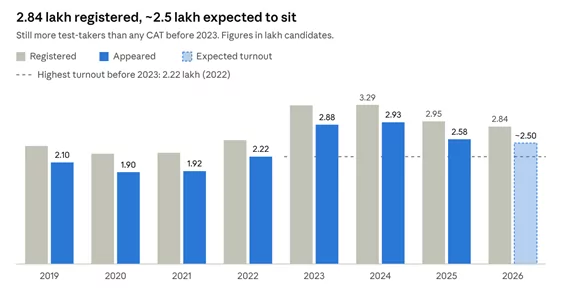
CAT 2026 has recorded approximately 2.84 lakh registrations, a decrease of about 11,000 (or 3.7%) from the 2.95 lakh registrations seen in CAT 2025. This marks the second consecutive year of decline, following the peak of 3.29 lakh registrations in CAT 2024. While this downward trend is undeniable, zooming out to observe a longer historical perspective reveals that the 2024 surge was an outlier rather than the new norm. Even with the current reduction, the CAT 2026 applicant pool remains larger than any year prior to 2023, a period when achieving high percentiles and securing IIM admissions was still a formidable challenge.
The perceived "boom" in 2024, often cited as the benchmark for comparison, might have created an inflated expectation of sustained high registration numbers. The current figures, when viewed against a broader historical canvas, suggest a recalibration rather than a collapse of the applicant base. This is a critical distinction for aspirants to grasp, as it reframes the intensity of the competition.
Beyond Registration: The Real Competition is in the Hall
The critical differentiator, often overlooked in the clamor surrounding registration numbers, is the actual number of candidates who appear for the examination. Historically, the turnout rate has been between 11% and 17% lower than the registered numbers since 2019. In CAT 2025, for instance, out of 2.95 lakh registrations, approximately 2.58 lakh candidates actually sat for the exam. For CAT 2026, the projected turnout is estimated to be around 2.5 lakh.
This gap between registered and appearing candidates is populated by individuals who, for various reasons, do not make it to the examination hall. These can include students who registered "just to see" or as a backup, final-year students who secure campus placements before the exam, or working professionals whose appraisal cycles interfere with their preparation. These individuals, while contributing to the registration count, were likely never serious contenders for the top percentiles. Therefore, the reduction in the actual competition pool is considerably smaller than the headline registration dip suggests. The narrative of a significantly diluted competition, therefore, requires a substantial dose of skepticism.
Percentile: A Share of the Pie, Not a Headcount
The fundamental definition of a percentile remains unchanged regardless of the total number of test-takers. A 99th percentile signifies that a candidate has scored better than 99% of the individuals who took the exam. When the total number of candidates decreases, the absolute number of individuals within each percentile band also shrinks proportionally.

For example, with approximately 2.58 lakh appearing candidates in CAT 2025, the 99th percentile represented the top roughly 2,580 candidates. With an estimated 2.5 lakh appearing candidates for CAT 2026, this number would be around the top 2,500 candidates. While the absolute count is marginally lower, the proportion remains the same. A smaller applicant pool does not automatically grant a higher percentile; it merely makes each percentile band slightly less crowded in terms of absolute numbers. The crucial takeaway here is that the percentile itself is a measure of relative performance within the appearing cohort, not an absolute score tied to the total registration figure.
The True Deciding Factor: The CAT Paper Itself
The single most significant determinant of percentile, far outweighing the fluctuations in registration numbers, is the difficulty and pattern of the CAT examination itself. Historical data starkly illustrates this point. Over the past five years, the marks required to achieve the 99th percentile have fluctuated between 76 and 98. This considerable swing cannot be explained by the changes in the applicant pool alone.
A compelling example is the transition from CAT 2023 to CAT 2024. Despite a negligible change in the number of test-takers, the score required for the 99th percentile surged by a significant 19 marks. This jump was directly attributable to CAT 2024 being a more accessible paper. Conversely, between CAT 2021 and CAT 2022, an additional 30,000 candidates appeared for the exam, yet the 99th percentile score decreased by 14 marks.
These instances underscore a fundamental truth: the difficulty of the Verbal Ability and Reading Comprehension (VARC), Data Interpretation and Logical Reasoning (DILR), and Quantitative Aptitude (QA) sections, and how the entire cohort navigates these challenges, are the primary drivers of score-to-percentile conversion. A challenging DILR section, for instance, can dramatically alter the marks needed for a specific percentile, rendering the marginal decrease in registrations a secondary concern. Aspiring candidates are therefore advised to focus their energy on mastering the exam’s content and strategy rather than banking on a demographic shift.
Where the Smaller Pool Offers a Modest Advantage
While the impact on top percentiles is negligible, a smaller applicant pool can offer a slight, albeit marginal, advantage for candidates aiming for mid-tier calls. IIMs, when shortlisting candidates for interviews, aim to fill a fixed number of seats. If the total number of appearing candidates decreases, the institutes might need to dip slightly deeper into the percentile list to achieve their desired interview call numbers.
Consider an illustrative scenario with hypothetical shortlist sizes:
| If an institute calls… | ~2.93 lakh appear (CAT 2024) | ~2.58 lakh appear (CAT 2025) | ~2.5 lakh appear (CAT 2026, expected) |
|---|---|---|---|
| 3,000 candidates (top IIM) | 98.98 %ile | 98.84 %ile | 98.80 %ile |
| 15,000 candidates (mid-tier IIM) | 94.88 %ile | 94.19 %ile | 94.00 %ile |
As the table suggests, at the higher end (e.g., 3,000 calls), the percentile threshold shifts by a mere 0.18 to 0.2 percentile points, which is often within the margin of error for a single question’s scoring. However, in the 94-95 percentile band (e.g., 15,000 calls), the shift is more noticeable, around 0.8 to 0.9 percentile points. This represents a modest tailwind for candidates targeting calls from mid-tier IIMs.
It is crucial to acknowledge two significant caveats to this observation. Firstly, IIMs officially publish minimum percentile cutoffs as part of their admission policy, and these are generally not revised downwards due to a dip in applicant numbers. Secondly, the shortlisting process is a composite one, taking into account academic scores (Class 10, 12, graduation), work experience, and diversity factors. Therefore, an aspirant cannot solely rely on a slight shift in percentile due to a smaller pool. A comprehensive understanding of each target IIM’s specific shortlisting criteria, available through various official and unofficial guides, remains paramount.
Identifying the Departing Aspirants: A Profile
While official data on who didn’t register is unavailable, informed reasoning suggests that the departing aspirants are likely not those fiercely competing for the top percentiles. Several factors likely contribute to this trend:
- Robust Job Market for Graduates: A strong job market for fresh graduates offers alternative career paths, reducing the urgency for immediate MBA admissions.
- Exorbitant IIM Fees: The fee structure for flagship IIM programs has now reached approximately ₹21 lakh, a significant financial commitment that might deter some aspirants.
- Crowded Entrance Exam Calendar: The proximity of other major MBA entrance exams like NMAT, SNAP, and XAT creates a scheduling challenge and may lead some to prioritize those.
- Admissions Uncertainty: Last year’s admission cycles, marked by revoked offers and revised result lists, may have created an environment of uncertainty, causing some casual aspirants to defer their plans.
These pressures disproportionately affect the "undecided" aspirant – the one who might have registered on a whim or without a concrete preparation strategy. Candidates who have dedicated significant time to mock tests, accuracy tracking, and strategic planning are less likely to be deterred by these factors. Consequently, the CAT 2026 applicant pool is likely to be composed of a more serious and committed cohort, not a less competitive one. This reality should not induce panic but rather serve as a strong impetus to intensify preparation and avoid complacency.
Optimizing the Final 38 Days: Focus on Controllables
Given that the registration numbers have a limited impact on individual percentiles, the focus for the remaining 38 days should be on aspects that are directly controllable by the aspirant. The data strongly suggests prioritizing efforts in the following areas:
- Mock Test Analysis: Beyond just taking mocks, dissecting performance with granular detail is crucial. Identify weak areas, recurring error patterns, and the time management strategies that proved effective or ineffective.
- Targeted Practice: Based on mock analysis, dedicate focused practice to specific topics or question types that consistently pose a challenge. This ensures efficient use of study time.
- VARC Mastery: The Verbal Ability and Reading Comprehension section often presents unique challenges. Consistent reading of diverse material and practicing comprehension passages are vital for improvement.
- DILR Strategy Refinement: The Data Interpretation and Logical Reasoning section demands both analytical skills and efficient problem-solving approaches. Practicing various set types and developing a systematic approach to tackling them is key.
- QA Concept Clarity: While QA might seem straightforward, conceptual clarity and speed are paramount. Revisiting fundamental concepts and practicing timed problem-solving can significantly boost scores.
- Past Paper Review: A thorough review of previous CAT papers provides invaluable insights into the exam’s evolution, question patterns, and difficulty levels, helping to refine preparation strategies.
A More Constructive Message for the Community
Instead of perpetuating the "cutoffs will fall" narrative, aspirants are encouraged to share a more grounded and actionable message within their preparation groups. A more constructive approach would be to disseminate the following key points:
- Focus on the Exam, Not the Numbers: The CAT exam’s difficulty and your performance are the primary determinants of your percentile, not the total number of registrations.
- Actual Competition is Smaller: The number of candidates who actually appear for the exam is significantly less than the registered count.
- Percentile is Relative: A smaller pool means a smaller absolute number of candidates within each percentile band, but the relative standing remains the same.
- Paper Difficulty is King: Historically, the CAT paper’s difficulty has had a far greater impact on score-to-percentile conversion than registration numbers.
- Marginal Gains at Lower Tiers: While a smaller pool might offer a slight advantage in lower percentile bands for mid-tier IIM calls, this effect is minimal and overshadowed by other shortlisting criteria.
The core message remains consistent: the upcoming CAT 2026 examination will test your preparation, your strategy, and your resilience. The number of participants may fluctuate, but the anxiety, the rigor, and the ultimate goal remain the same. With 38 days left until November 29th, the focus must be on diligent preparation and a clear understanding of the factors that truly influence success. The "other side" of the CAT 2026 exam awaits, and it will be conquered by those who are prepared, not by those who are merely hopeful.