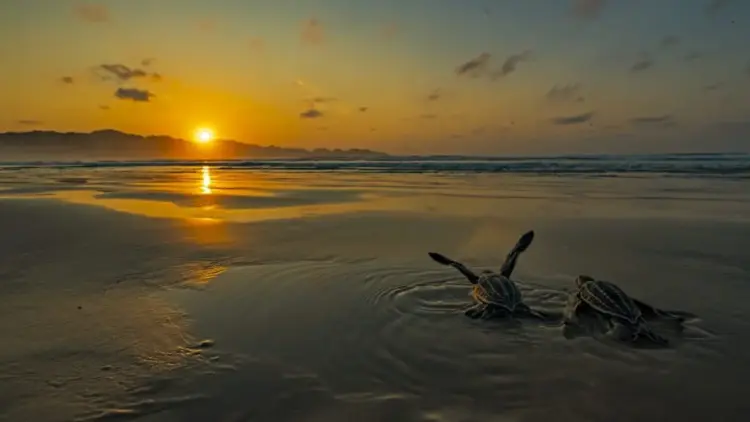
The pristine shores of Great Nicobar Island have long served as a silent witness to one of nature’s most ancient rituals. Last winter, under the cover of darkness, female leatherback turtles (Dermochelys coriacea)—creatures often described as living dinosaurs—heaved their massive, barrel-like frames onto the sands bordering Galathea Bay. According to data from the Andaman and Nicobar Forest Department, obtained through a Right to Information (RTI) Act request, these giants dug and laid eggs in 869 nests during the nesting season that concluded in March.
This figure represents the highest number of leatherback nests recorded on any single beach in the Indian Ocean this year. While the data suggests a population that is currently thriving, it also highlights a growing tension between biological conservation and national industrial ambition. As Galathea Bay emerges as the undisputed "stronghold" of the Northeastern Indian Ocean leatherback, a massive development project looms on the horizon, threatening to dismantle the very sanctuary that has allowed this ancient lineage to endure.
Main Facts: A Stronghold Under Observation
The recent nesting data provides a rare glimpse into the health of a species that is notoriously difficult to monitor. Beyond the record-breaking numbers at Galathea Bay, the Andaman and Nicobar Islands are seeing a broader trend of recovery. Data indicates that nesting numbers are also rising on the South Bay and West Bay beaches of Little Andaman Island.
Experts suggest that the population in this region is not merely stable but "likely overflowing." A researcher, speaking on the condition of anonymity, noted that the population, when left undisturbed, has begun to colonize neighboring beaches, expanding its footprint across the archipelago. Hiltrud Cordes of the Turtle Foundation, an organization dedicated to protecting marine turtles in Indonesia, describes Galathea as the "epicenter" of this nesting population.

Current estimates suggest that Galathea Bay alone hosts approximately 175 or more nesting mothers per year. To put this in perspective, this single beach likely supports more nesting activity than all of Sumatra or the other islands in the Andaman chain combined. This concentration of reproductive activity makes Galathea not just a local treasure, but a site of global ecological significance.
Chronology: Mariners from Deep Time
To understand the weight of the current conservation crisis, one must look back millions of years. The lineage of the leatherback turtle, the family Dermochelydae, has cruised the world’s oceans for over 100 million years. They shared the planet with the Tyrannosaurus rex and survived the cataclysmic extinction event 66 million years ago that wiped out the other dinosaurs.
The Evolutionary Timeline
- 5 Million Years Ago: The primordial mother of all modern leatherbacks is estimated to have lived in the Pacific Ocean.
- 3 Million Years Ago: Descendants of this lineage spread into the Indian Ocean.
- 2.8 Million to 700,000 Years Ago: During the Ice Ages, most leatherback species perished. Only Dermochelys coriacea survived, likely by finding refuge in the "Sundaland" biodiversity hotspot, which includes the Great Nicobar Island.
- 1 Million Years Ago: The population underwent a genetic "bottleneck," resulting in the relatively low genetic diversity seen in modern leatherbacks compared to other marine species.
- 2001-2002: Marine biologists Kartik Shanker and B.C. Choudhury conducted the first major genetic baseline study at Galathea Bay, identifying high diversity relative to other global populations.
- 2004: The Indian Ocean Tsunami devastated the nesting beaches of Great Nicobar, temporarily halting research and monitoring.
- 2021-2024: Nesting numbers show a robust recovery, but the announcement of the Great Nicobar Development Project introduces a new, anthropogenic threat.
The leatherback’s survival through the millennia is a testament to its specialized biology. Unlike other sea turtles, they do not have a hard, bony shell; instead, their backs are covered by a thick, leathery skin embedded with tiny osteoderms. This allows them to dive to depths of over 1,200 meters—depths where the pressure would crush a human—and to regulate their body temperature in near-freezing waters. However, their evolutionary "Achilles’ heel" remains their absolute dependence on specific terrestrial beaches for reproduction.
Supporting Data: The Genetic Reservoir
The significance of Galathea Bay is rooted deeply in the genetic material of the turtles that nest there. In the winter of 2001-2002, Kartik Shanker and B.C. Choudhury, then with the Wildlife Institute of India, collected blood and tissue samples from over 100 nesting females. Working with the Centre for Cellular and Molecular Biology (CCMB) in Hyderabad, they examined mitochondrial DNA (mtDNA), which is passed down exclusively through the maternal line.

The study identified four distinct haplotypes—A, D, E, and I. At the time, this level of genetic diversity was among the highest ever recorded globally, matched only by the now-extinct population in Terengganu, Malaysia.
Why Genetic Diversity Matters
Genetic diversity is the "raw material" for evolution. For a species facing the rapid onset of climate change, higher diversity provides a broader range of traits that may allow the population to adapt to rising sea levels, changing sand temperatures (which determine the sex of hatchlings), and shifting ocean currents.
"If you have two populations to conserve, and you could only pick one, you want to pick the one with greater diversity," says Shanker, now at the Indian Institute of Science. "That diversity is the foundation for the long-term resilience of the lineage."
Recent studies have ignited a debate among scientists regarding the connectivity between the Great Nicobar turtles and those in Sumatra. While some researchers, like Maslim As-singkily of Wageningen University, argue that Sumatran populations show even higher diversity (eight haplotypes), Shanker contends that this is a result of more modern sequencing techniques that examine longer segments of DNA. Regardless of the technical debate, the data confirms that the Northeastern Indian Ocean remains a critical genetic reservoir for the species.

Official Responses and Bureaucratic Hurdles
Despite the clear ecological importance of the region, research in the Andaman and Nicobar Islands has become increasingly difficult. Leatherback turtles are listed under Schedule I of the Indian Wild Life (Protection) Act, 1972, granting them the highest level of legal protection. Paradoxically, this protection has created a "bureaucratic black hole" for scientists.
B.C. Choudhury notes that the process of obtaining permits to collect tissue samples is so arduous that many research grants expire before the paperwork is finalized. "Sometimes the permitted sample size is so low—perhaps only five individuals—that it isn’t even worth the effort to conduct the study," he explains.
Furthermore, there is a growing concern regarding the transparency of environmental data. The recent nesting figures were not released through official scientific publications but had to be extracted via the Right to Information Act. Since the announcement of the Great Nicobar Development Project, almost all research on the island has been restricted to government-affiliated agencies, leading to what some call a "secrecy shroud" over the island’s wildlife status.
Implications: The "Million-Dollar Question"
The most pressing threat to the leatherback stronghold is the proposed International Container Transshipment Terminal (ICTT) at Galathea Bay. This massive infrastructure project is part of a broader development plan that includes an international airport, a power plant, and a greenfield city.

The Impact of Development
The transformation of Galathea Bay from a secluded nesting sanctuary into a bustling industrial port carries several catastrophic risks for the leatherback population:
- Habitat Loss: The construction of berths and breakwaters will physically alter the beach structure, potentially making it impossible for turtles to haul themselves ashore.
- Light Pollution: Hatchlings navigate toward the ocean by following the brightest horizon (traditionally the moon over the water). Artificial lights from a port can disorient them, leading them toward the land where they perish from exhaustion or predation.
- Ship Strikes and Noise: Increased vessel traffic in the bay increases the risk of fatal collisions and creates acoustic interference that may disrupt the turtles’ migratory cues.
- Population Pressure: The project is expected to bring approximately 325,000 new residents to Great Nicobar. This influx increases the likelihood of poaching, accidental entanglement in fishing nets, and general disturbance of the nesting environment.
The tragedy of Terengganu, Malaysia, serves as a grim warning. Once a site where thousands of leatherbacks nested, it was decimated by egg collection, industrial fishing, and poor hatchery management. Today, nesting in Malaysia is virtually non-existent.
As the development of Great Nicobar moves forward, scientists and conservationists are left asking a haunting question. "What happens when that stronghold breaks?" asked a researcher. "Leatherbacks have survived the extinction of the dinosaurs and the freezing of the oceans, but they have never had to survive a container terminal on their primary nesting beach."
The record-breaking 869 nests found last winter are a sign of a species at its peak, but in the context of the coming industrial expansion, they may also represent a final, silent protest from a primordial mariner whose time is running out. The "million-dollar question" remains: Can India achieve its maritime ambitions without extinguishing one of the oldest lineages on Earth? The answer will be written in the sands of Galathea Bay over the coming decade.