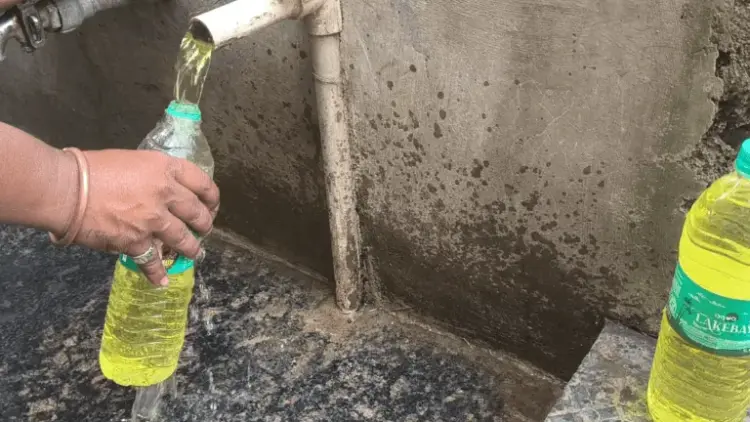
For 55-year-old Gangubai Laxmigan Shivale, the simple act of cooking a meal for her family has become a painful impossibility. A resident of Dattanagar—a working-class neighborhood nestled against the Ambad industrial estate on the outskirts of Nashik, Maharashtra—Shivale is a living testament to an environmental catastrophe. For two months, her hands have been covered in weeping rashes and chemical ulcers.
“There is constant itching, and blood pours out if I scratch the rashes, so I can’t cook,” she explains. Her family of four now survives on a diet of samosas and vada pav purchased from street vendors. Her story is not an isolated case of misfortune; it is a symptom of a systemic collapse in industrial regulation that has turned the region’s groundwater into a toxic, yellow broth.
Main Facts: A Neighborhood Under Siege
Dattanagar is currently the epicenter of a severe public health crisis. Approximately 400 residents have reported debilitating skin ailments, including black lesions, swollen lymph nodes, and deep chemical ulcers. The common denominator among these victims is their reliance on borewell water, which has turned a vivid, alarming shade of bright yellow.
The culprit is Hexavalent Chromium (Cr VI), a heavy metal used extensively in electroplating—the process that gives jewelry, automotive parts, and plumbing fixtures their metallic sheen. In Dattanagar, this industrial byproduct has leached into the aquifer at levels that defy belief.

The Toxicity Profile
Laboratory analyses have confirmed the residents’ worst fears. A test commissioned by the South Asia Network on Dams, Rivers and People (SANDRP) and conducted by Ashwamedh Engineers and Consultants revealed:
- Total Chromium: 50.5 milligrams per litre (mg/L).
- Hexavalent Chromium: 50.3 mg/L.
- The Limit: The Bureau of Indian Standards (BIS) permissible limit for chromium in drinking water is a mere 0.05 mg/L.
In simpler terms, the water being drawn by the residents of Dattanagar contains chromium at more than 1,000 times the legal safety limit. A parallel study by the Maharashtra Pollution Control Board (MPCB) corroborated these findings, detecting levels 900 times the permissible limit in various dug wells and borewells across a half-kilometer stretch.
Chronology: Fourteen Years of Warnings Ignored
The current crisis in Dattanagar is not a sudden accident but the climax of over a decade of regulatory negligence and legal battles.
- 2012: Activist Rajesh Pandit files a Public Interest Litigation (PIL) in the Bombay High Court. The petition highlights that the Satpur and Ambad Industrial Estates (MIDC) lack a Common Effluent Treatment Plant (CETP), leading to the direct discharge of untreated waste into the Nandini and Godavari rivers.
- The High Court Mandate: The court directs the Maharashtra Industrial Development Corporation (MIDC) to establish CETPs in both industrial areas and take strict action against units violating environmental norms.
- 2013–2022: A decade of missed deadlines. While industrial output in Nashik grows, the infrastructure to manage its toxic waste remains on paper. Small-scale industries, lacking their own treatment facilities, allegedly resort to using "soak pits"—digging holes to dump untreated effluent directly into the ground, bypassing surface monitoring but poisoning the aquifer.
- 2023: Pandit files a contempt petition, alleging that the MIDC has failed to comply with the court’s 2012 orders. MIDC submits an affidavit promising the CETP will be operational by September 2024.
- June–August 2024: Residents of Dattanagar begin noticing yellow water and experiencing "mystery" skin rashes.
- October 2024: The crisis explodes into the national consciousness. The National Green Tribunal (NGT) and the National Human Rights Commission (NHRC) take cognizance of the situation.
- October 31, 2024: Amidst the crisis, the flag-hoisting ceremony for the Simhastha Kumbh Mela is scheduled, highlighting the proximity of the pollution to a site of global religious significance.
Supporting Data: The High Cost of Contamination
The impact of the chromium leak extends beyond physical pain; it is a financial and social wrecking ball for the working-class families of Dattanagar.

The Economic Drain
For families earning modest wages in the nearby factories, the medical burden is unsustainable. Kunti Balu Sarkate, a local resident, notes that medical expenses for a single person can range from ₹5,000 to ₹6,000 per month. "As long as we take medicines, we find some relief. The moment we stop, the itching comes back," she says.
The financial desperation has led to extreme measures. Preeti Shah, another resident, has been forced to rent a second home in a different locality just to access clean water for bathing and washing clothes. This "water rent" costs her family an additional ₹5,000 to ₹6,000 a month—effectively a "pollution tax" levied on the victims by the failure of the state.
The Scale of the Survey
Following the public outcry, the Nashik Municipal Corporation (NMC) conducted a massive health and infrastructure survey:
- Households Covered: 8,887
- Residents Surveyed: 34,399
- Borewells Mapped: 229
- Contaminated Borewells: 45 (yielding bright yellow water)
Official Responses: Denial and Damage Control
The response from authorities has been a mix of urgent intervention and puzzling denial.

The Regulatory Crackdown
Vidyasagar Killedar, Regional Officer of the MPCB, reported that the board has finally begun to crack down on the suspected sources. In late October 2024, 22 industrial units were ordered to close. Another 16 units were served with show-cause notices or directions. The MPCB is also exploring "bioremediation" techniques to neutralize the chromium already present in the groundwater, though experts warn this is a long and complex process.
The Political Contradiction
Perhaps the most controversial aspect of the official response came from Girish Mahajan, Maharashtra’s Minister and Nashik’s Guardian Minister. Despite international consensus, Mahajan claimed to the press that the yellow chemical detected in the water was "not carcinogenic."
This statement stands in direct opposition to the classification by the International Agency for Research on Cancer (IARC) and the World Health Organization (WHO), which categorize Hexavalent Chromium as a Group 1 Carcinogen. Exposure is known to cause lung cancer, liver damage, reproductive issues, and severe abdominal pain, in addition to the visible skin lesions seen in Dattanagar.
Implications: A Threat to the Holy Godavari
While the immediate suffering is concentrated in Dattanagar, the environmental implications are far more reaching. Activists argue that the contaminated groundwater does not remain static; it leaches into the nallahs (streams) that feed the Nandini River, which in turn flows into the Godavari.

The Kumbh Mela Factor
Nashik is one of the four sites of the Kumbh Mela, one of the world’s largest religious gatherings. Millions of pilgrims are expected to bathe in the Godavari during the main events in 2027. If the chromium plume is not contained, the "holy dip" could become a mass exposure event to a known carcinogen.
The NHRC has expressed grave concern over reports that doctors in the area have advised women to avoid pregnancy due to the potential for birth defects linked to heavy metal poisoning. Furthermore, the social stigma associated with the visible wounds has led to children being barred from schools and residents being shunned on public transport—a secondary crisis of social isolation.
The Systemic Failure
The Dattanagar crisis exposes a critical flaw in India’s industrial growth model: the "pollute now, pay later" approach. The absence of a Common Effluent Treatment Plant for 14 years, despite court orders, suggests a profound lack of accountability within the MIDC and MPCB.
The "soak pit" phenomenon—where industries hide their waste underground—represents a form of environmental "guerrilla warfare" against public health. Because groundwater moves slowly, the damage done today may take decades to remediate, and the true toll on the health of Nashik’s citizens may not be fully known for a generation.

Conclusion: Beyond Tanker Water
The Nashik Municipal Corporation has begun supplying water via tankers and has sealed the contaminated borewells. However, for the residents of Dattanagar, these are "band-aid" solutions for a gaping wound.
The permanent solution requires more than just clean water; it requires the immediate completion of the CETPs, a transparent audit of every industrial unit in the Ambad and Satpur belts, and a comprehensive health registry for the victims. Until the "golden poison" is purged from the earth and the regulators are held as accountable as the polluters, the residents of Dattanagar remain prisoners of an industrial nightmare they did nothing to create.