New Delhi, November 2, 2026 – The Indian automotive landscape witnessed a historic milestone this past month as the electric two-wheeler (E2W) segment shattered all previous records. October 2026 has officially become the highest-selling month in the history of electric mobility in India, with total registrations peaking at 2,24,064 units. This surge not only underscores a tectonic shift in consumer preference but also highlights the maturing of the electric vehicle (EV) ecosystem in the world’s largest two-wheeler market.
The Headline Numbers: A Market in Full Bloom
The data for October 2026 reveals a market experiencing exponential growth. The total of 2,24,064 units represents a staggering 48.49% year-on-year (YoY) increase compared to the 1,50,890 units registered in October 2025. In absolute volume terms, the industry added over 73,174 units compared to the same period last year.
The momentum was not limited to yearly comparisons. On a month-on-month (MoM) basis, the industry grew by 8.08%, climbing from 2,07,314 units in September 2026. This sequential growth suggests that the festive season, which traditionally peaks in October with Dussehra and Diwali, acted as a powerful catalyst, driving first-time buyers and upgraders toward electric alternatives.
Chronology of a Record-Breaking Month
The road to 2.24 lakh units was paved by a series of strategic maneuvers by legacy manufacturers and the continued expansion of charging infrastructure across Tier-II and Tier-III cities.
Early October: The Festive Kick-off
The month began with aggressive promotional campaigns. Manufacturers like TVS and Bajaj Auto launched "Festive Editions" and limited-time battery warranty extensions. These moves addressed the two primary concerns of Indian buyers: resale value and long-term reliability.
Mid-October: The Supply Chain Resilience
Unlike previous years, where supply chain bottlenecks for lithium-ion cells hampered deliveries, October 2026 saw a streamlined flow of components. Localized battery assembly plants, incentivized under the government’s advanced chemistry cell (ACC) PLI scheme, reached peak utilization, ensuring that showrooms were well-stocked to meet the festive rush.

Late October: The Registration Peak
In the final ten days of the month, coinciding with the auspicious days of the Hindu calendar, daily registrations surged. Regional Transport Offices (RTOs) across Maharashtra, Karnataka, and Tamil Nadu reported record numbers, with electric scooters accounting for nearly 45% of all new two-wheeler registrations in urban pockets.
Market Share Analysis: The Rise of the Legacy Giants
The most significant takeaway from the October 2026 data is the consolidation of power by India’s traditional automotive giants. TVS Motor Company and Bajaj Auto have effectively transitioned from "defensive" players to market leaders, collectively controlling nearly half of the entire E2W market.
TVS Motor Company: The Undisputed Leader
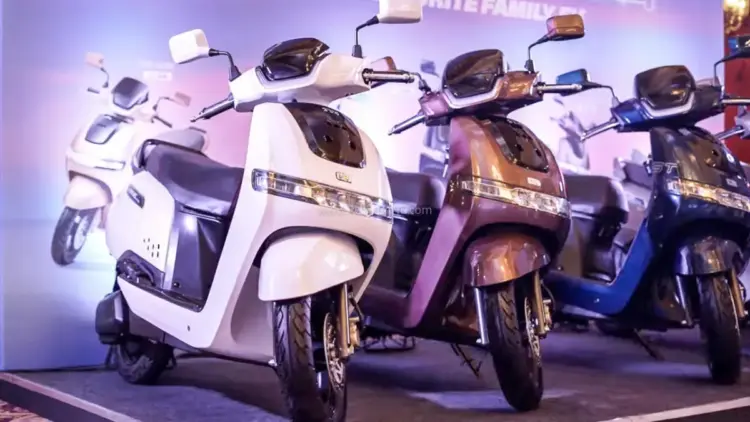
TVS Motor retained its crown, clocking 60,490 units. This performance represents a phenomenal 94.66% YoY growth. The TVS iQube, now available in five distinct variants ranging from a budget-friendly 2.2 kWh version to a long-range 5.1 kWh ST variant, has become the "Gold Standard" for family-oriented electric scooters. Their MoM growth of 11.94% indicates that their production ramp-up is successfully keeping pace with demand.
Bajaj Auto: The Chetak’s Triumph
Securing the second spot, Bajaj Auto registered 49,156 units. With a market share of 21.9%, the Chetak brand has seen a renaissance. By expanding its network through dedicated "Chetak Hubs" and leveraging its existing KTM/Husqvarna service points, Bajaj has built a reputation for premium build quality and reliability. Their YoY growth of 51.33% reflects a successful strategy of positioning the Chetak as a lifestyle choice rather than just a utility vehicle.
The Battle of the Innovators: Ather and Hero MotoCorp
Ather Energy continues to hold its ground with 31,833 units. While its YoY growth of 5.25% appears modest compared to the legacy giants, Ather remains the leader in the "performance" and "connected" segments. The launch of the Ather Rizta (the family-focused scooter) has broadened their appeal beyond tech enthusiasts.
Hero MotoCorp, under its "Vida" brand, has emerged as a formidable force. Selling 29,923 units in October, Hero saw an 81.36% YoY increase. Their massive distribution network—the largest in the country—is finally being leveraged to push electric models into rural and semi-urban markets.
The Ola Electric Crisis: A Warning Sign
In stark contrast to the industry’s overall health, the former market leader, Ola Electric, continues to struggle. Registrations for Ola plummeted to 12,098 units, a 26.41% YoY decline. More concerning is the 10.06% MoM drop.

Industry analysts attribute this decline to persistent service-related issues and a "trust deficit" among consumers. While Ola was the first to scale, the entry of TVS and Bajaj with superior service footprints has lured away potential customers. Ola’s struggle highlights a critical lesson for the EV industry: sales are driven by products, but market share is sustained by service.
The "Dark Horses": Greaves, River, and BGauss
The October data also highlights the rise of specialized players:
- River Mobility: The Bengaluru-based startup reported a jaw-dropping 273.94% YoY growth, selling 6,817 units. Their "Indie" scooter, marketed as the "SUV of Scooters," has carved out a niche for its utility and ruggedness.
- Greaves Electric: With 10,839 units and a 39.98% YoY growth, Greaves remains a strong contender in the value-for-money segment, particularly in non-metro markets.
- BGauss: Recording 5,556 units (80.57% YoY growth), BGauss has benefited from a sleek design language and competitive pricing that appeals to younger commuters.
Official Responses and Industry Sentiment
The Society of Manufacturers of Electric Vehicles (SMEV) hailed the October numbers as a "point of no return" for internal combustion engine (ICE) scooters.
A spokesperson for the Ministry of Heavy Industries commented:
"The 2.24 lakh registrations in a single month are a testament to the success of the PM E-Drive scheme. We are seeing the results of stable policy, localized manufacturing, and increased consumer confidence. The government remains committed to ensuring that by 2030, 80% of two-wheeler sales in India are electric."
V.N. Sahay, an independent Senior Auto Analyst, noted:
"What we are seeing is a ‘flight to quality.’ In 2023 and 2024, consumers were willing to experiment with new startups. In 2026, the Indian buyer is looking for reliability. This is why TVS and Bajaj are dominating. They offer the peace of mind of a 50-year-old brand combined with 21st-century technology."
Supporting Data: A Snapshot of October 2026
| Manufacturer | Oct 2026 Sales | Oct 2025 Sales | YoY Growth (%) |
|---|---|---|---|
| TVS Motor | 60,490 | 31,075 | +94.66% |
| Bajaj Auto | 49,156 | 32,462 | +51.33% |
| Ather Energy | 31,833 | 30,246 | +5.25% |
| Hero MotoCorp | 29,923 | 16,439 | +81.36% |
| Ola Electric | 12,098 | 16,439 | -26.41% |
| Greaves Electric | 10,839 | 7,743 | +39.98% |
| River Mobility | 6,817 | 1,823 | +273.94% |
| BGauss | 5,556 | 3,076 | +80.57% |
| Others | 17,382 | 11,525 | +50.81% |
| Total | 2,24,064 | 1,50,890 | +48.49% |
Implications for the Future
The record-breaking performance in October 2026 has several long-term implications for the Indian economy and the environment:
- The Decline of the ICE Scooter: With electric scooters now consistently crossing the 2-lakh-unit monthly mark, the sales of traditional 110cc and 125cc petrol scooters are under severe pressure. Many dealers are reporting that for every three petrol scooters sold, two electric units are now leaving the showroom.
- Infrastructure Acceleration: The sheer volume of EVs on the road is forcing a rapid expansion of public charging stations. Oil marketing companies (IOCL, BPCL) are now converting parts of their petrol pumps into fast-charging hubs at a rate of 500 stations per month.
- Secondary Market Development: 2026 marks the year where the first generation of high-volume electric scooters (sold in 2021-22) are entering the used-vehicle market. The strong performance of brands like TVS and Bajaj is helping stabilize the resale value of EVs, which was previously a major hurdle for adoption.
- Environmental Impact: At 2.24 lakh units a month, the displacement of petrol consumption is significant. Preliminary estimates suggest these vehicles will collectively save over 45 million liters of fuel annually, contributing to India’s Net Zero targets.
Conclusion
October 2026 will be remembered as the month the "Electric Dream" became a mainstream reality in India. As TVS and Bajaj continue to scale, and as startups like River bring fresh innovation to the table, the competition is no longer about whether people will buy electric, but which electric vehicle they will choose. For the Indian commuter, the choice has never been more diverse, more reliable, or more sustainable. The 2.24 lakh milestone is not just a number; it is a signal that the era of the internal combustion engine in the two-wheeler segment is rapidly drawing to a close.