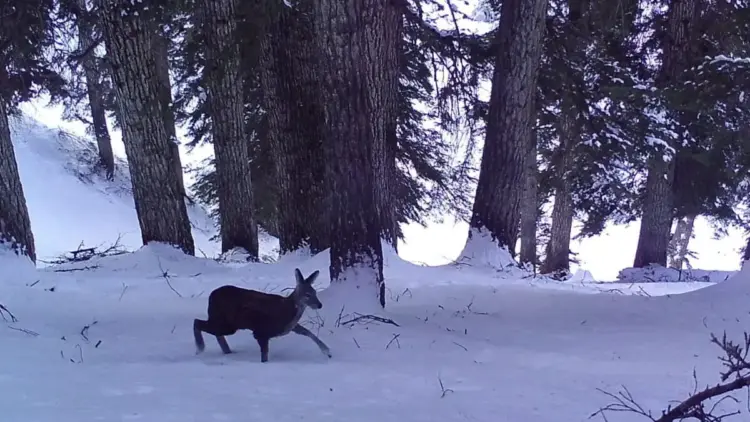
The high-altitude forests of the Western Himalaya are home to one of the world’s most elusive and evolutionarily distinct mammals: the Kashmir musk deer (Moschus cupreus). Small, solitary, and famously antlerless, this "vampire deer"—so named for the elongated, saber-like canines of the males—is currently standing at an ecological crossroads. While the species has long battled the twin threats of poaching and habitat fragmentation, a comprehensive new study from the Kashmir Himalaya warns that a third, more pervasive enemy is looming: anthropogenic climate change.
According to research recently published by scientists at Aligarh Muslim University (AMU), the shifting climate is projected to not only decimate the deer’s suitable habitat but also sever the vital corridors that allow populations to migrate, breed, and maintain genetic diversity. The study suggests that under the most severe emissions scenarios, the species could lose more than 80% of its viable range by the end of the century, pushing an already endangered animal toward the brink of extinction.
Main Facts: An Endangered Icon of the High Peaks
The Kashmir musk deer is a primitive ruminant that occupies a unique niche in the subalpine and alpine ecosystems of Afghanistan, India, and Pakistan. Unlike the more common cervids, such as the elk or the white-tailed deer, the musk deer does not grow antlers. Instead, males develop long, downward-pointing tusks used for territorial disputes and securing mates.
Beyond its striking appearance, the musk deer is an ecological linchpin. As selective herbivores, they influence the composition of Himalayan plant communities and contribute significantly to nutrient cycling in nutrient-poor high-altitude soils. They also serve as a critical prey base for top predators, most notably the Persian leopard and the snow leopard.
However, the deer’s most famous characteristic is also its greatest curse. The male possesses a musk gland that produces a secretion highly prized in the international perfume industry and traditional medicine. Despite being classified as "Endangered" on the IUCN Red List and protected under various national laws, the deer remains a prime target for illegal poaching. This pressure, combined with the encroachment of human settlements and livestock grazing, has left the species confined to increasingly small, isolated pockets of the Himalaya.
The AMU study highlights a sobering reality: even if poaching were eliminated tomorrow, the deer’s future remains uncertain. The research indicates that the very geography of the Kashmir Valley—the deer’s primary stronghold—is being reshaped by rising temperatures and altered precipitation patterns, threatening to leave the species with nowhere to run.

Chronology: From Camera Traps to Climate Projections
The effort to map the future of the Kashmir musk deer was a multi-year undertaking that required researchers to navigate some of the most rugged and inaccessible terrain on Earth. The study, led by Mohsin Javid of the Department of Wildlife Sciences at Aligarh Muslim University, was designed to bridge a significant gap in conservation knowledge: the intersection of habitat suitability and landscape connectivity.
Phase 1: Field Surveys and Detection (2020–2023)
The research team initiated an extensive field survey across five distinct landscapes within the Kashmir Valley. Utilizing state-of-the-art camera-trap technology, the team established 184 stations. The results were telling; musk deer were detected at 90 of these stations, yielding more than 1,500 independent detection events. This provided the researchers with a robust baseline of where the deer currently reside and what environmental factors—such as canopy cover, ruggedness, and elevation—define their preferred habitat.
Phase 2: Establishing the Baseline (1981–2010)
To understand how the climate will change, the researchers first had to define the "normal" parameters of the deer’s environment. They used the period between 1981 and 2010 as a climatic baseline. During this period, the model identified approximately 5,003 square kilometers of suitable habitat across the study area. Crucially, only 22.4% of this habitat fell within the boundaries of existing protected areas.
Phase 3: Future Modeling (2011–2100)
The team then projected habitat availability across three distinct future timeframes:
- Near-term: 2011–2040
- Mid-century: 2041–2070
- Late-century: 2071–2100
These projections were run against three different "Shared Socioeconomic Pathways" (SSPs), which represent different global responses to greenhouse gas emissions, ranging from aggressive sustainability (SSP1-2.6) to a "business-as-usual" high-emissions scenario (SSP5-8.5).
Supporting Data: A Drastic Shrinkage of Viable Range
The data generated by the AMU study paints a complex and often dire picture of the deer’s future. The impact of climate change is not a simple linear decline; rather, it is a process of "squeezing" the species into higher, more remote mountainous interiors.

The Impact of Emissions Scenarios
- SSP1-2.6 (Low Emissions): Under the most optimistic scenario, where global emissions are drastically reduced, the deer’s habitat remains relatively stable, mirroring the baseline conditions.
- SSP3-7.0 (High Emissions): This scenario shows a deceptive initial expansion of habitat to 6,606 sq. km. by 2040 as some higher altitudes become warmer and more habitable. However, this is followed by a sharp crash, falling to 3,701 sq. km. by the end of the century.
- SSP5-8.5 (Very High Emissions): This represents the worst-case scenario. The model projects a catastrophic reduction in habitat. By the period of 2071–2100, suitable habitat is predicted to plummet to just 871 sq. km.—an 82.6% loss compared to the baseline.
The Connectivity Crisis
Habitat loss is only one side of the coin. The researchers used "Circuit Theory"—a method that treats the landscape as an electrical circuit where "resistance" is created by human disturbance and unsuitable terrain—to model how the deer move between patches.
- Corridor Loss: Under baseline conditions, potential movement corridors covered 3,366 sq. km. By the end of the century under the SSP5-8.5 scenario, this falls to 1,653 sq. km., a 50.9% reduction.
- Isolation: The model analyzed 171 pairs of protected areas. In the worst-case scenario, movement becomes significantly more difficult between 161 of those pairs, effectively "islanding" populations and preventing the gene flow necessary for long-term survival.
Official Responses: Insights from the Research Team
The authors of the study emphasize that their findings should serve as a wake-up call for regional policymakers and international conservation bodies. Mohsin Javid, the study’s corresponding author, notes that the musk deer’s survival is tied to more than just temperature.
“The Kashmir musk deer is not controlled by climate alone,” Javid explains. “It is a forest-associated mountain species whose distribution is also shaped by elevation, ruggedness, forest structure, and human disturbance. Our goal was to ask not only where suitable habitat may persist but whether those areas will remain connected enough to support dispersal, gene flow, and recolonization.”
Professor Orus Ilyas, a co-author of the study and a leading expert at AMU, highlights the biological danger of isolation. “Biologically, this means that dispersal between populations becomes harder, and recolonization after a local loss becomes less likely. Populations may still persist in individual refugial patches but become increasingly isolated. Habitat persistence inside a reserve therefore does not guarantee long-term connectivity.”
The researchers also point out a significant policy gap. Their data shows that the majority of "climate refugia"—areas that will remain suitable even under the worst climate scenarios—currently lie outside the boundaries of protected parks. “Because 79% of robust refugia lie outside protected areas, conservation cannot rely on reserve boundaries alone,” Javid warns.
Implications: Rethinking Conservation in the Himalaya
The findings of this study have profound implications for the management of the Himalayan landscape. If the Kashmir musk deer is to survive the 21st century, the traditional "fortress conservation" model—relying solely on fenced-off national parks—must evolve into a more dynamic, landscape-level approach.

The Importance of Climate Refugia
The study identified specific areas, such as Overa-Aru and Thajwas-Baltal, as critical future refuges. While these areas currently have strong protections, they will shrink significantly. Meanwhile, areas like Kazinag were identified not for their size, but for their role as "stepping stones" or corridors. Protecting these bottlenecks is just as vital as protecting the core habitats themselves.
Strategic Recommendations for the Future
Based on the study’s data, several key strategies emerge for the conservation of the species:
- Trans-Boundary Cooperation: Since the deer’s range spans India, Pakistan, and Afghanistan, climate-driven movement will likely ignore national borders. International cooperation is essential for maintaining corridors.
- Permeable Landscapes: Rather than just creating new parks, planners must ensure that the "matrix" of land between parks remains permeable. This means limiting infrastructure development (roads, dams, and settlements) in identified corridor bottlenecks.
- Community-Led Stewardship: Since much of the future habitat lies outside reserves, local communities must be incentivized to protect the deer. This includes regulating livestock grazing in high-altitude meadows and strengthening anti-poaching networks through community surveillance.
- Restoration Ecology: Actively restoring forest cover in areas identified as future corridors could help mitigate the "resistance" the deer face when trying to move between mountain peaks.
In conclusion, the Kashmir musk deer is more than just a biological curiosity; it is a sentinel for the health of the entire Himalayan ecosystem. The AMU study makes it clear that while the climate is changing, our conservation strategies must change even faster. Protecting this ancient, "fanged" deer requires a holistic vision that sees the Himalaya not as a collection of isolated parks, but as a single, interconnected, and breathing landscape. Without such a vision, the "Ghost of the Himalaya" may truly become a spirit of the past.