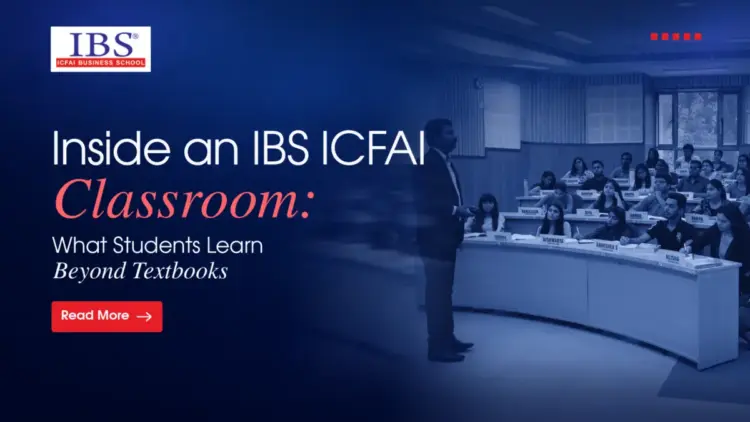
Mumbai, India – While placement reports offer a quantifiable snapshot of where MBA graduates land their first professional roles, they often fail to capture the profound and multifaceted transformation that occurs within students during their academic journey. The true value of an MBA program lies not just in the destination, but in the crucible of experiences that forge critical thinking, enhance communication prowess, and cultivate collaborative spirit. This article delves into the qualitative shifts experienced by students at ICFAI Business School (IBS), exploring how pedagogical approaches beyond traditional textbook learning equip them for the complexities of the business world.
The transition from an admitted student to a job-ready professional is a journey marked by significant personal and intellectual growth. For MBA aspirants scrutinizing potential institutions, understanding this developmental arc – the evolution from admission day to the first professional interview – is paramount. At IBS, this transformative process is actively cultivated through a robust curriculum centered on case discussions, presentations, group assignments, and internships. These elements are not mere academic exercises; they are carefully orchestrated opportunities designed to hone the invaluable skill of not just acquiring knowledge, but of applying it decisively and articulating the rationale behind those decisions with conviction.
The Power of Case-Based Learning: Cultivating Critical Decision-Making
The traditional academic model often follows a predictable pattern: read, understand, recall. Business education, however, demands a more dynamic and interactive approach. The case-based learning methodology employed at IBS fundamentally disrupts this passive consumption of information. It immerses students in real-world business scenarios, forcing them to grapple with ambiguity, analyze complex problems, and formulate actionable solutions.
Consider a hypothetical business facing declining sales. A simplistic approach might be to immediately advocate for a price reduction. However, within the framework of a case discussion, this recommendation is immediately challenged. Questions arise about profit margins, the potential impact on brand perception, and whether the core issue lies in the product itself. This dynamic exchange, where every proposed solution is met with scrutiny regarding its potential consequences, is the very essence of IBS’s case-based approach. Students are not merely memorizing theories; they are actively engaging with them, dissecting business situations, identifying underlying problems, and weighing diverse, often conflicting, potential responses.
This process demands more than a superficial understanding of management jargon. It requires students to discern which data points are relevant, to unearth implicit assumptions, and to meticulously evaluate a spectrum of alternatives. Arshneet Singh, a member of the IBS Gurgaon 2022-24 batch, vividly recalls how marketing classes, particularly under the guidance of Dr. Vibha Arora, transformed case studies into vibrant platforms for spirited debate among classmates. His initial semester, a whirlwind of assignments, quizzes, and presentations, underscored the active participation required. The true takeaway, as Arshneet highlights, is that contributing meaningfully to a case discussion necessitates more than just recognizing a chapter from a textbook; it demands a well-formed opinion, backed by thorough preparation and the confidence to articulate it.
Furthermore, this pedagogical method instills a crucial, yet often overlooked, professional trait: the willingness to adapt and revise one’s perspective. In the heat of a case discussion, if a classmate identifies a flaw in an argument, defending it more vehemently will not strengthen its foundation. Learning to gracefully retract or modify a recommendation when presented with compelling counter-evidence is an invaluable skill that directly translates to effective management in the professional arena. This iterative process of proposing, defending, and refining ideas fosters intellectual humility and a commitment to data-driven decision-making.
Sharpening the Edge: Building Essential Communication and Presentation Skills
For many students, the prospect of public speaking can evoke a sense of trepidation. The ability to formulate a compelling idea is distinct from the skill of conveying it effectively to an audience. Some students may excel in quantitative analysis, comfortable with spreadsheets and data, yet find themselves hesitant during verbal discourse. Conversely, others might possess eloquent speaking abilities but struggle to distill their thoughts into concise, impactful messages. IBS recognizes that both these scenarios represent opportunities for development.
The MBA program at IBS places a significant emphasis on honing soft skills, encompassing communication and interpersonal abilities. The Bengaluru MBA curriculum, for instance, explicitly identifies spoken and written English proficiency, presentation skills, teamwork, and leadership as key learning outcomes. These areas provide students with structured avenues to refine how they articulate their acquired knowledge.
The true value of this focus lies in the consistent practice and constructive feedback provided. Can a student explain a complex recommendation without simply reading verbatim from a slide? Can they directly address the question posed, rather than deflecting or providing tangential information? Can they engage in constructive disagreement, maintaining a productive and respectful dialogue even when opinions diverge? These seemingly ordinary classroom interactions are, in reality, microcosms of the professional workplace, equipping students with the essential tools to navigate diverse communication challenges. The ability to articulate a clear, concise, and persuasive argument, whether in a boardroom or a team meeting, is a direct byproduct of the emphasis IBS places on these fundamental communication skills.
The Collective Intelligence: Learning Through Teamwork and Peer Collaboration
The collaborative nature of business problems often necessitates diverse perspectives for effective resolution. A challenge that appears straightforward to an individual with a finance background might present a different facet to someone with a marketing or operations perspective. Productive discussions within a cohort allow these varied viewpoints to surface, enriching the collective understanding of a problem.
Shikha Rani, another student from the IBS Gurgaon 2022-24 batch, highlighted the rich diversity of her classmates. She recalled a particularly impactful group assignment that required her team to develop a comprehensive startup business plan and present it to a panel of simulated investors. This exercise effectively bridged the gap between theoretical classroom concepts and the practical demands of making a business idea compelling to external stakeholders.
The learning process, however, extends far beyond the presentation itself. Before a single slide is created, the group must collaboratively establish its core assumptions, meticulously divide the workload, and ensure that the financial projections robustly support the proposed strategic direction. Even individually strong contributions must be seamlessly integrated to form a cohesive and convincing whole.
Anyone who has participated in a significant group project will recognize the inherent challenges. One’s individual section might be flawlessly executed, yet the team’s overarching recommendation could remain unclear or underdeveloped. Learning to identify these gaps and actively contribute to bridging them is an integral part of developing reliability and fostering a sense of collective responsibility – qualities indispensable in any professional setting. This emphasis on peer learning not only enhances problem-solving capabilities but also cultivates essential interpersonal skills like negotiation, conflict resolution, and consensus-building, all of which are critical for navigating the complexities of team-based work environments.
Bridging Theory and Practice: Industry Exposure Through Internships
The internship experience serves as a crucial bridge, transporting the theoretical knowledge and honed skills from the classroom into a professional environment where the work has a tangible audience beyond academic peers and faculty. It provides students with invaluable real-world exposure and the opportunity to apply their learning in a practical context.
Vaibhav Vinchurkar, an MBA student at IBS Mumbai, offers a compelling illustration of this. During a rigorous three-month finance internship at HDFC Life, he was deeply involved in equity research and analysis. His account highlights the comprehensive support he received, beginning with the placement office’s assistance during the selection process, followed by dedicated guidance from both a faculty mentor and an industry mentor within the organization.
Vaibhav’s key takeaways from this experience were multifaceted. He reported a significant enhancement in his analytical and financial acumen, a notable boost in his self-confidence, and a more profound understanding of the nuances of professional working life. His testimonial is particularly valuable because it underscores the substantial effort that underpins such learning: the dedication to research, the meticulousness of analysis, and the immersive experience of operating within the established structures of a corporate organization.
For MBA aspirants specializing in finance, such detailed insights are precisely what they should be seeking. Questions about the specific scope of projects, the actual application of their analyses, and the feedback they received provide a far richer understanding than simply noting the name of the company on an internship certificate. These discussions also furnish students with concrete material for future interviews. Articulating the details of a project, detailing one’s specific contributions, and clearly outlining the resultant outcomes allows for a demonstration of both technical competence and reflective capability. Even the ability to discuss what they would approach differently showcases a student’s capacity for critical self-assessment and continuous improvement, qualities highly prized by employers.
Expanding Horizons: Learning Beyond the Classroom through Events and Industry Interactions
The learning landscape at IBS extends well beyond the confines of traditional classrooms. The institution actively curates a range of extracurricular activities, including seminars, guest lectures, publications, and inter-business school competitions, all designed to broaden students’ perspectives and deepen their engagement with the business world.
Taking on responsibility for organizing or participating in campus events offers practical lessons in coordination and project management. These experiences underscore the necessity of clear instructions, the importance of assigning ownership for deadlines, and the adaptability required to navigate unforeseen challenges and adjust plans accordingly. An event that appears seamless to its audience often represents a complex undertaking for its organizers, providing them with invaluable insights into meticulous planning and execution.
Neha Maggu, a member of the IBS Bangalore batch of 2014, credits her positive experience to several factors. She specifically mentioned the accessibility of faculty, the enriching interactions with industry professionals, and her active participation in management and cultural events. These experiences, she noted, were instrumental in helping her identify her personal interests and fostering a significant growth in her self-assurance. Neha’s narrative adds a crucial dimension to the classroom-centric view of education: by embracing unfamiliar responsibilities and stepping outside their comfort zones, students can discover hidden talents and passions they might not have otherwise explored. This holistic approach to development, encompassing both academic rigor and experiential learning, is a hallmark of a well-rounded MBA program.
The Aspirant’s Compass: What to Look for When Choosing a B-School
The individual experiences shared from various IBS campuses, each with its unique contextual nuances, converge on a central theme: the profound relationship between active student participation and tangible learning outcomes. Whether it involves diligently dissecting a case study, actively soliciting feedback, contributing meaningfully to group endeavors, or treating internships with utmost seriousness, each of these actions demands a deliberate and energetic commitment from the student.
For prospective MBA candidates meticulously building their shortlist of institutions, this insight offers a valuable framework for their next campus visit or interaction with current students and alumni. Beyond the standard inquiries about fees, specialized programs, and placement statistics, a crucial line of questioning should focus on the actual work students engage in.
In conversations with students, aspiring candidates should probe deeper: "Which specific case discussion genuinely challenged your initial assumptions and led you to reconsider your perspective?" "Can you recall a presentation where you identified a personal weakness in your delivery, and how did you subsequently work to improve it?" "Which internship assignment proved particularly insightful in helping you understand a potential career path and its demands?"
A truly impactful management education should empower students to provide increasingly thoughtful and nuanced answers to these kinds of questions. The collective IBS experiences detailed here offer a compelling illustration of what this transformation can look like: the development of clearer, more logical arguments; the formulation of more considered and well-reasoned decisions; a tangible increase in self-confidence and professional presence; and a deeper, more nuanced understanding of how to collaborate effectively with diverse individuals and teams.
The textbook provides the foundational concepts, the theoretical framework upon which business acumen is built. However, the true measure of progress in management education becomes unequivocally visible when a student can demonstrably translate that theoretical knowledge into practical application, effectively putting it to work in solving real-world business challenges. This is the transformative journey that distinguishes a reputable MBA program, and it is this journey that prospective students should diligently seek to understand.