

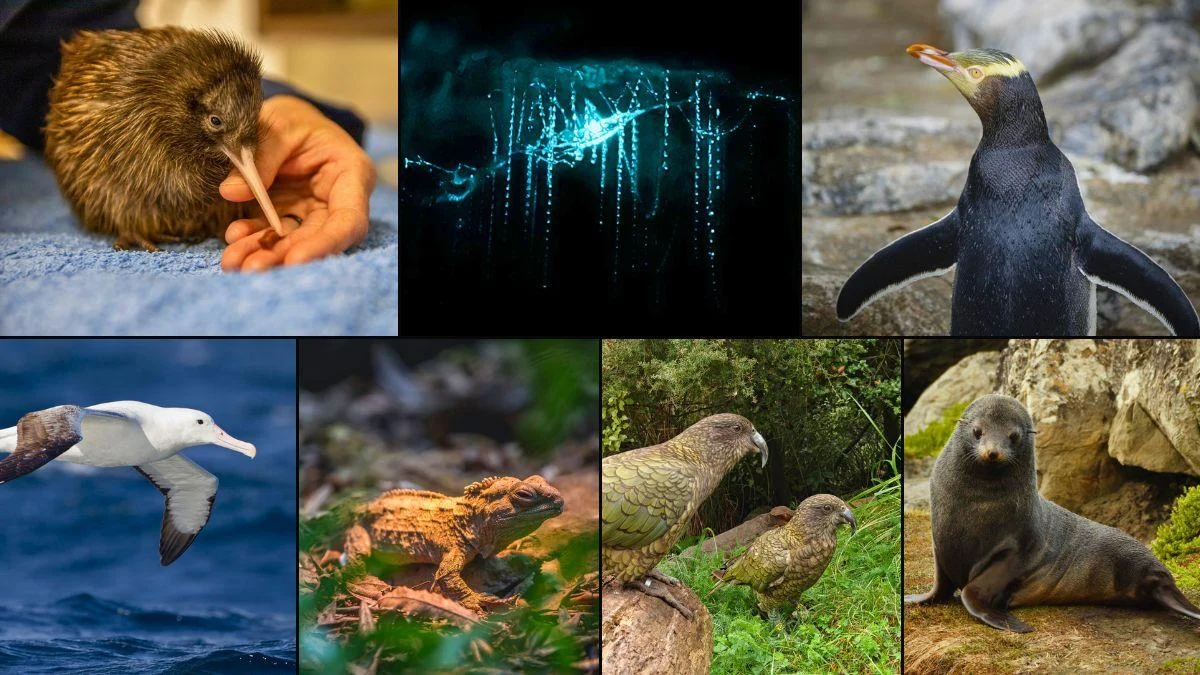
Main Facts: The Evolutionary Sanctuary of Aotearoa
New Zealand, or Aotearoa, represents one of the world’s most unique biological experiments. Having evolved in isolation for roughly 85 million years following the fragmentation of the ancient supercontinent Gondwana, the archipelago remained a land without terrestrial mammals. In the absence of mammalian predators and grazers, birds, reptiles, and insects filled ecological niches that elsewhere belonged to wolves, deer, and rodents.

Today, this evolutionary legacy is under siege, surviving primarily in managed fragments and high-tech sanctuaries. The national conservation strategy has shifted from mere preservation to active "rebuilding," utilizing a combination of predator-proof fencing, indigenous Māori guardianship (kaitiakitanga), and international tourism revenue. From the 3,400-hectare "mainland island" of Sanctuary Mountain Maungatautari to the subterranean galaxies of the Waitomo caves, the country is engaged in a high-stakes effort to reverse a 700-year wave of extinctions.

Key to this movement is the recognition that New Zealand’s wildlife is inseparable from its history. The extinction of the moa and the Haast’s eagle serves as a generational warning: in an island ecosystem defined by isolation, once a species is lost, it is gone from the universe forever.

Chronology: From Gondwana to the "Predator Free 2050" Goal
The Era of Isolation (85 Million Years Ago – 1300 AD)
Following the split from Gondwana, New Zealand’s flora and fauna evolved in a mammalian vacuum. Birds became flightless, such as the giant moa and the kiwi, while reptiles like the tuatara maintained a lineage dating back 200 million years. The ecosystem was top-heavy with avian predators, led by the Haast’s eagle, the largest eagle ever known to exist.

The First Rupture (c. 1300 AD)
The arrival of Polynesian settlers introduced the first terrestrial mammals (the Pacific rat and the dog) and initiated the "Moa Hunter" period. Within a century, all nine species of moa were hunted to extinction. This triggered a domino effect, leading to the rapid disappearance of the Haast’s eagle, which relied on the moa as its primary food source. This period represents one of the fastest large-animal extinction events in recorded history.

The Colonial Transformation (1840 – Late 20th Century)
The signing of the Treaty of Waitangi in 1840 marked the beginning of large-scale European settlement. With it came a biological "invasion" of stoats, weasels, possums, and European rats, intended for fur or to make the islands feel more like "home." These predators decimated native bird populations that had no evolutionary defense mechanisms against mammalian hunters. Vast tracts of ancient rimu and tawa forests were cleared for agriculture, fragmenting the remaining habitats.

The Restoration Era (2000 – Present)
The modern era is defined by "The Great Fence" strategy. Recognizing that invasive predators could not be eradicated from the entire country simultaneously, conservationists began creating "mainland islands." Sanctuary Mountain Maungatautari, established in the early 2000s, pioneered the use of a 47-kilometer pest-exclusion fence to create a 3,400-hectare predator-free zone. This has paved the way for the government’s ambitious "Predator Free 2050" initiative.

Supporting Data: The Metrics of Recovery
The scale of New Zealand’s conservation challenge and current progress is best understood through the following data points:

- Kiwi Population Decline: Before human arrival, kiwi numbers were estimated at over 12 million. Today, despite intensive conservation, the population stands at approximately 70,000, across five distinct species.
- The Maungatautari Success: The sanctuary’s 47-kilometer Xcluder fence is the largest of its kind in the world. It protects 3,400 hectares of forest, housing over 3,000 kiwi and reintroduced populations of the takahē—a large flightless bird once thought to be extinct.
- The Albatross Odyssey: At Taiaroa Head, the northern royal albatross (toroa) boasts a wingspan of 3 meters. These birds spend 85% of their lives at sea, covering an estimated 190,000 kilometers annually. The Taiaroa Head colony is the only mainland breeding site for the species globally.
- The Rarity of the Hoiho: The yellow-eyed penguin (hoiho) is among the rarest penguins on Earth. Breeding numbers on the South Island have plummeted due to rising ocean temperatures and disease, necessitating the intensive rehabilitation work performed by groups like The OPERA (Otago Peninsula Eco Restoration Alliance).
Official Responses: Governance and Indigenous Partnership
Modern conservation in New Zealand is increasingly a tripartite arrangement between the Department of Conservation (DOC), private trusts, and Māori iwi (tribes).

The Concept of Kaitiakitanga
Bodie Tihoi Taylor, a cultural educator and iwi representative, emphasizes that for Māori, conservation is not a scientific hobby but a "responsibility, loyalty, and duty." This is encapsulated in the term kaitiakitanga, or guardianship. Taylor argues that the restoration of land is also an act of cultural reclamation. "Those ways are not taught in classrooms; they’re taught in the bush with the people," Taylor notes, highlighting the shift toward integrating traditional ecological knowledge with modern biology.

Partnership vs. Control
Following generations of land dispossession, Māori communities are reasserting authority over ancestral forests and waterways. However, the approach is one of "partnership" rather than isolationism. Taylor references a whakataukī (proverb) about the "eye of the needle," suggesting that unification between settler systems and indigenous knowledge is the only path forward for the environment.

Tourism as Infrastructure
The tourism sector has officially become a pillar of conservation funding. In Waitomo, operators like Spellbound Glowworm Cave manage sensitive limestone ecosystems while catering to an influx of international visitors, many drawn by New Zealand’s association with film franchises like The Lord of the Rings and the upcoming The Legend of Zelda adaptation. These commercial ventures provide the capital necessary for land stewardship and predator control that the state alone cannot provide.

Implications: The Future of a "Living Fossil" Nation
The efforts to save New Zealand’s wildlife have profound implications for global conservation biology and the national identity of Aotearoa.

1. The Climate Frontier
Marine species like the hoiho (yellow-eyed penguin) and the northern royal albatross are currently the "canaries in the coal mine" for climate change. Rising sea temperatures are altering food availability in the Pacific, meaning that even if New Zealand fixes its terrestrial predator problem, its marine wildlife remains at the mercy of global carbon trends.

2. Ecological Memory as a Policy Driver
In New Zealand, the "ghosts" of extinct species like the moa are active participants in policy-making. The fear of another "irreversible rupture" drives the public to support extreme measures, such as the total eradication of invasive species. This collective memory has turned New Zealand into a global laboratory for island restoration techniques.

3. The Ethical Dilemma of "Living Museums"
While fenced sanctuaries like Maungatautari and breeding centers like Willowbank have saved species from the brink, they also raise questions about the future of nature. If a species can only survive behind a 47-kilometer electrified fence, is it truly "wild"? The ultimate goal of current conservationists is to move beyond these "biological fortresses" and return the entire country to a state where the kiwi can once again wander through suburban backyards safely.

4. Economic Symbiosis
The reliance on tourism creates a precarious symbiosis. As seen at the Spellbound caves or the Royal Albatross Centre, the presence of humans is required to fund the absence of predators. This "nature-based economy" requires a delicate balance; too much tourism risks disturbing the very species it seeks to protect—particularly the hoiho, which can abandon nests if they feel overly stressed by human presence.

In conclusion, New Zealand’s journey from a Gondwanan ark to a modern conservation frontline reflects a deep-seated national realization: the country’s biological improbability is its greatest treasure. As Bodie Tihoi Taylor suggests, the fight to preserve what remains is not just about birds and trees; it is about honoring a destiny where partnership and guardianship ensure that the next generation sees more than just bones in a museum.
