

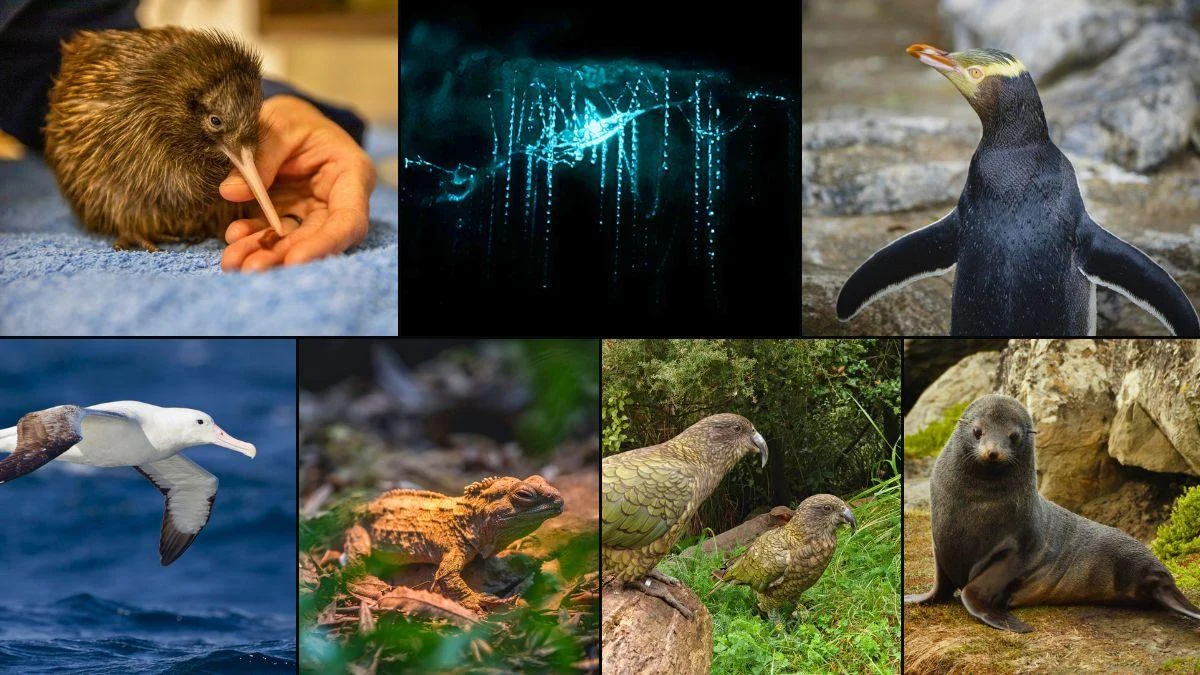
The story of New Zealand’s wildlife is one of profound isolation and radical adaptation. Roughly 85 million years ago, the ancient supercontinent of Gondwana fractured, casting the islands that would become Aotearoa New Zealand into the vast expanse of the South Pacific. For millions of years, these islands remained a world without terrestrial mammals. In this evolutionary vacuum, birds, reptiles, and insects ascended to fill ecological niches occupied elsewhere by mammalian predators and grazers. Giant flightless birds became the browsers of the forest; insects became the scavengers of the floor.
Today, this unique biological heritage survives in fragile fragments. Across the North and South Islands, a monumental effort is underway—not merely to preserve what remains, but to aggressively roll back centuries of ecological decay. Through a combination of high-tech pest-exclusion fences, indigenous guardianship (kaitiakitanga), and world-class wildlife tourism, New Zealand is attempting to rebuild an ecosystem that was nearly dismantled by human arrival and the introduction of invasive species.

Main Facts: The Sanctuary Model and the "Island on the Mainland"
The centerpiece of modern New Zealand conservation is the "mainland island" concept. Nowhere is this more visible than at Sanctuary Mountain Maungatautari in the Waikato region. This 3,400-hectare ecological sanctuary is enclosed by a 47-kilometer pest-proof fence—the longest of its kind in the world.
By removing mammalian threats such as stoats, rats, and possums, the sanctuary has created a safe haven where native birds now outnumber predators. Inside this enclosure, the forest sounds "unnervingly alive," a cacophony of birdsong that offers a glimpse into what the country sounded like before the 14th century.

Key Restoration Successes at Maungatautari:
- Kiwi Recovery: The sanctuary now hosts an estimated 3,000 kiwi, the iconic flightless bird that serves as a national symbol.
- Reintroduction of the Takahē: Once thought extinct, this large, prehistoric-looking flightless rail has been successfully reintroduced to the mountain.
- Avian Biodiversity: The canopy is home to the tīeke (saddleback), hihi (stitchbird), tūī, korimako (bellbird), and the noisy kākā (forest parrot).
Further south, in Christchurch, the Willowbank Wildlife Reserve serves as a critical breeding and education hub. It houses the Tuatara, a reptilian survivor of an evolutionary lineage dating back 200 million years, and the Kea, the world’s only alpine parrot, renowned for its problem-solving intelligence and "mischievous" behavior.

Chronology: From Gondwana to the Treaty of Waitangi
The ecological history of New Zealand is defined by two major "ruptures":
- The Polynesian Arrival (c. 1300s): When the first settlers arrived from Polynesia, they encountered a landscape dominated by the Moa—a genus of giant flightless birds, the largest of which stood over three meters tall. Within approximately 100 years, the Moa were hunted to extinction. This triggered a secondary collapse: the disappearance of the Haast’s Eagle, the world’s largest eagle and the Moa’s only natural predator.
- The European Era and the Treaty of Waitangi (1840): The arrival of European settlers introduced a secondary wave of devastation. Vast tracts of native forest were cleared for agriculture, and a suite of invasive predators—stoats, ferrets, and weasels—were introduced to control rabbits, only to decimate the native bird populations instead.
Bodie Tihoi Taylor, a cultural educator and iwi representative at Maungatautari, notes that conservation today is a direct response to this history. "For Māori communities, the country’s wildlife is inseparable from the memory of what was already lost," Taylor explains. The disappearance of the Moa serves as a multi-generational warning: in an isolated island system, once a species is gone, it is gone forever.

Supporting Data: The Fragility of Endemic Species
The scale of the challenge is reflected in the population data of New Zealand’s most famous residents.
- The Kiwi: Before human settlement, kiwi numbers were estimated to exceed 12 million. Today, despite intensive conservation efforts, the population sits at roughly 70,000.
- The Northern Royal Albatross: Located at Taiaroa Head on the Otago Peninsula, this is the only mainland breeding colony of royal albatross in the world. These birds possess a wingspan of three meters and spend 85% of their lives at sea, traveling up to 190,000 kilometers annually.
- The Yellow-Eyed Penguin (Hoiho): One of the rarest penguins globally, the hoiho is under extreme pressure. Austin Hamilton, a ranger with the Otago Peninsula Eco Restoration Alliance (The OPERA), highlights that these birds are facing threats from warming ocean temperatures, disease, and human disturbance.
| Species | Status | Key Threat |
|---|---|---|
| Kiwi | Vulnerable | Invasive predators (stoats/cats) |
| Kea | Endangered | Habitat loss and lead poisoning |
| Hoiho | Endangered | Climate change and declining food supply |
| Tuatara | At Risk | Habitat fragmentation |
Official Responses: Partnership and Kaitiakitanga
Modern New Zealand conservation is increasingly defined by Partnership. Following generations of Māori land dispossession under colonial rule, ecological recovery is now intertwined with cultural reclamation.

Bodie Tihoi Taylor emphasizes the concept of kaitiakitanga, or guardianship. He argues that the future of Aotearoa’s ecology depends on balancing modern scientific management with ancestral knowledge. "There’s a destiny behind why partnership was created," Taylor says, referencing the Treaty of Waitangi.
Government agencies like the Department of Conservation (DOC) now work alongside iwi (tribes) and private trusts. At Maungatautari, iwi groups are reasserting authority over ancestral lands and waterways, viewing the restoration of native species as a way to heal the landscape and the community simultaneously.

In the tourism sector, operators like Spellbound Glowworm Caves in Waitomo have adopted low-impact models. By limiting group sizes and maximizing periods of darkness, they protect the delicate Arachnocampa luminosa (glowworms) while providing an ethereal experience that boosts the local economy. The owner of Spellbound notes that international interest—bolstered by New Zealand’s role as a filming location for franchises like The Lord of the Rings and the upcoming The Legend of Zelda—is a double-edged sword that requires careful management to ensure tourism funds conservation without degrading the environment.
Implications: The Future of Aotearoa’s "Living Laboratory"
The implications of New Zealand’s conservation strategy extend far beyond its borders. The country serves as a global "living laboratory" for invasive species management and island restoration.

1. The Climate Crisis
Marine species like the Northern Royal Albatross and the Yellow-eyed penguin are "sentinel species." Their health reflects the health of the Southern Ocean. Austin Hamilton of The OPERA notes that if hoiho feel stressed by rising temperatures or lack of food, they may abandon their nests. This sensitivity makes them early indicators of the broader impacts of climate change on marine ecosystems.
2. The Economic Link
Wildlife tourism is no longer a niche market; it is a pillar of the national economy. The influx of tourists from Australia and the United States, driven by direct flights to regional hubs like Hamilton, provides the capital necessary to maintain expensive infrastructure like pest-proof fences. However, this creates a dependency on global travel, which carries its own carbon footprint.

3. The Moral Imperative of Extinction
New Zealand’s conservationists operate with a unique psychological burden: the "memory of absence." Unlike continents where species might migrate, New Zealand’s evolutionary isolation means there is no "backup" for the kiwi or the tuatara.
As Bodie Taylor suggests, the drive to protect the forest is an "innate desire for Nature to thrive." The success of projects like Maungatautari suggests that while humans were the primary agents of destruction in the past, they are now the only hope for the future. The ultimate goal is to ensure that the next generation of native wildlife survives in the bush, rather than as "bones in a museum."

Conclusion: A Biologically Improbable Success
Aotearoa New Zealand was, from a biological standpoint, an improbable experiment in avian dominance. The fact that it survived for millions of years is a miracle of geography; the fact that it survived the last 700 years is a testament to the resilience of its species and the dedication of its people.
Whether it is a ranger in Otago rehabilitating a stranded penguin during its moulting season, or a Māori guide explaining the spiritual connection to the rimu trees of the Waikato, the message is consistent: the land and its creatures are a single, inseparable entity. In the race against extinction, New Zealand is not just fighting to save birds; it is fighting to preserve its identity.
