

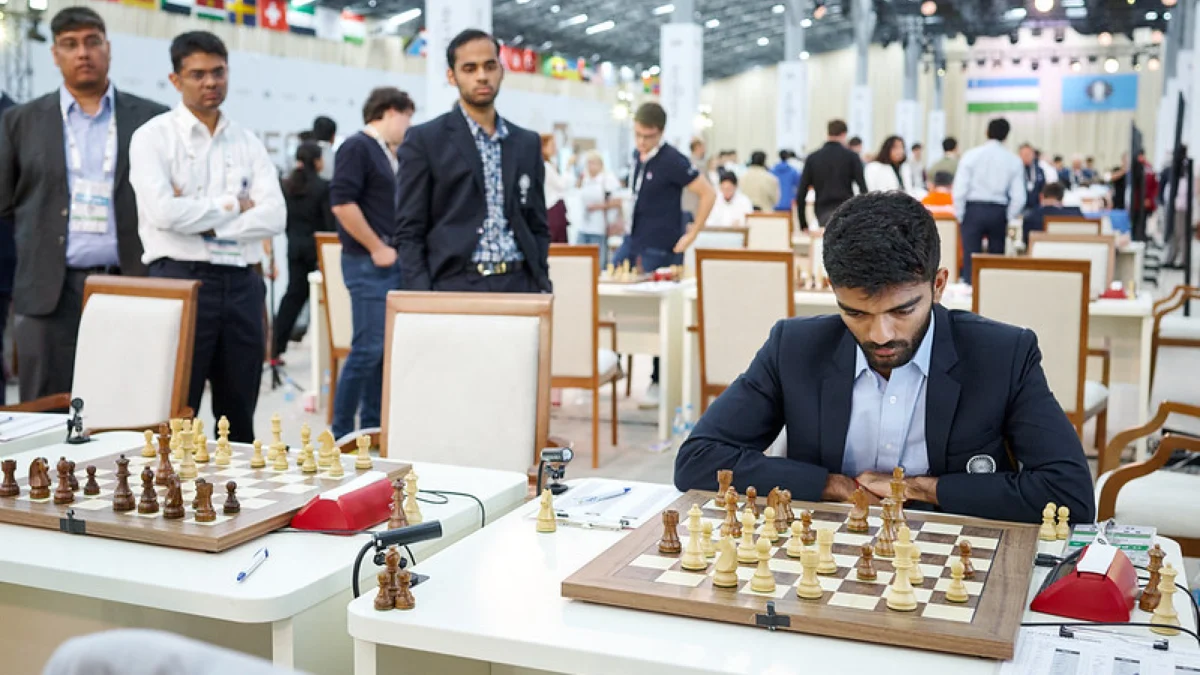
Samarkand, Uzbekistan – September 2026 – The ninth round of the 2026 Chess Olympiad in Samarkand delivered a breathtaking spectacle, culminating in a performance of near-mythical resilience that saved India’s gold-medal defence from the precipice of disaster. For over five agonizing hours, reigning World Champion D Gukesh, usually the epitome of calm, found himself in a crucible of pressure, battling not just an inspired Alexander Donchenko but the suffocating heat of a seemingly lost position. Yet, in a testament to his extraordinary talent, Gukesh orchestrated a 54-move ‘Houdini act,’ flipping certain defeat into a miraculous turnaround and snatching an improbable 2.5-1.5 victory from the jaws of a formidable German team.
The dramatic conclusion sent ripples of relief through the Indian camp, keeping their championship aspirations alive in a tournament where every half-point feels like gold. This miraculous escape, however, simultaneously underscored the glaring vulnerabilities within the defending champions’ lineup, as key players grapple with inconsistent form, leaving the burden of clutch performances squarely on Gukesh’s shoulders.
A Houdini Act: Gukesh’s Miracle Saves India’s Gold Dream
The air in the playing hall was thick with tension as India’s gold-medal defence teetered on the brink. With Nihal Sarin having already navigated a treacherous encounter to secure a draw, and neither R Praggnanandhaa nor Arjun Erigaisi able to break the stubborn resistance of their German counterparts, all eyes – and India’s hopes – turned to the board where D Gukesh faced Alexander Donchenko. The situation was dire. For more than five relentless hours, Gukesh, renowned for his unflappable swagger and trademark casual strolls, was stripped of his usual composure. He was visibly consumed by the "suffocating heat" of a lost position, his hands no longer casually buried in his pockets, his quiet aura farming momentarily forgotten amidst the relentless pressure.
Donchenko, part of Germany’s ‘giant-slayer’ contingent, was pushing hard, sensing an opportunity to deliver another famous scalp. The German team, having already stunned top-seeded America and tournament favourites Uzbekistan, had proven their mettle, and now they were on the verge of claiming the defending champions. The clock ticked, the position worsened, and the prospects for India’s 2026 Chess Olympiad campaign looked bleak.
What transpired next was nothing short of a chessic miracle, a "daylight robbery" executed with the precision and nerve of a true champion. Over 54 painstaking moves, Gukesh, the current World Champion, meticulously unravelled Donchenko’s advantage, finding obscure resources and weaving a defensive net that defied logic. He sidestepped threats, created counterplay where none seemed to exist, and exploited the slightest inaccuracies from his opponent. The tension was palpable; spectators, coaches, and fellow players watched in awe as the Indian prodigy, against all odds, transformed what should have been a certain loss into a stunning victory. The final sequence of moves was a masterclass in endgame play and psychological fortitude, a testament to Gukesh’s ability to perform under the most extreme pressure. His improbable win, a 2.5-1.5 triumph, pulled India back from the brink, breathing new life into their campaign and keeping their gold-medal dreams flickering brightly in Samarkand.
Germany’s Meteoric Rise: The Tournament’s Giant-Slayers
Germany has emerged as the undisputed surprise package of the 2026 Chess Olympiad, transforming from a respectable national team into the most feared side in the open section. Their journey has been marked by a series of monumental upsets that have sent shockwaves through the chess world. Prior to their encounter with India, the Germans had already pulled off two astonishing victories, first by toppling the mighty Americans – a perennial powerhouse stacked with Grandmasters – and then by overcoming tournament favourites and formidable hosts, Uzbekistan. These victories were not flukes but rather the result of meticulous preparation, steely nerves, and inspired individual performances across their boards.
Their reputation as "giant-slayers" was well-earned, and for the better part of Round 9, they made sure defending champions India understood exactly why. The German players, including Vincent Keymer and Matthias Bluebaum, showed remarkable resilience and tactical acumen, frustrating India’s top talents. Alexander Donchenko’s inspired play against Gukesh was emblematic of the team’s fighting spirit, pushing the World Champion to his absolute limits. Their aggressive yet solid approach has disrupted the established hierarchy of the tournament, proving that on any given day, meticulous preparation and collective resolve can overcome even the highest individual ratings. Their performance has added an unpredictable and thrilling dimension to the Olympiad, making every one of their matches a must-watch event.
The Unsettling Silence: Indian Men’s Team Grapples with Form
While Gukesh’s heroics provided a vital lifeline, the broader performance of the Indian men’s team in Round 9, and indeed throughout much of the Olympiad, has laid bare some "glaring vulnerabilities" that the field will undoubtedly seek to exploit. The match against Germany was a stark illustration of this unsettling pattern, highlighting a growing reliance on Gukesh’s singular brilliance.
Nihal Sarin, drafted back into the playing four after a challenging period of two consecutive defeats, found himself immediately pressed hard by Frederik Svane. Despite the early pressure and the psychological weight of recent losses, Nihal showcased commendable resilience. He meticulously neutralised the position, finding precise defensive resources that steered the game into a threefold repetition, ultimately securing a crucial draw. While a half-point was welcome, it underscored a struggle to convert positions into full points, a trend that has plagued the team.
On the top board, R Praggnanandhaa, arguably India’s most in-form player heading into the Olympiad, collided with German No. 1 Vincent Keymer. Praggnanandhaa, known for his tactical prowess and ambitious play, found Keymer to be an unyielding opponent, a "rock-solid" presence that denied the Indian prodigy any significant inroads. The game, a testament to Keymer’s defensive mastery, ended in a draw, marking Praggnanandhaa’s sixth draw in eight rounds, with only two wins. While his stability is commendable, the lack of decisive victories from a player of his calibre adds to the team’s scoring pressure.
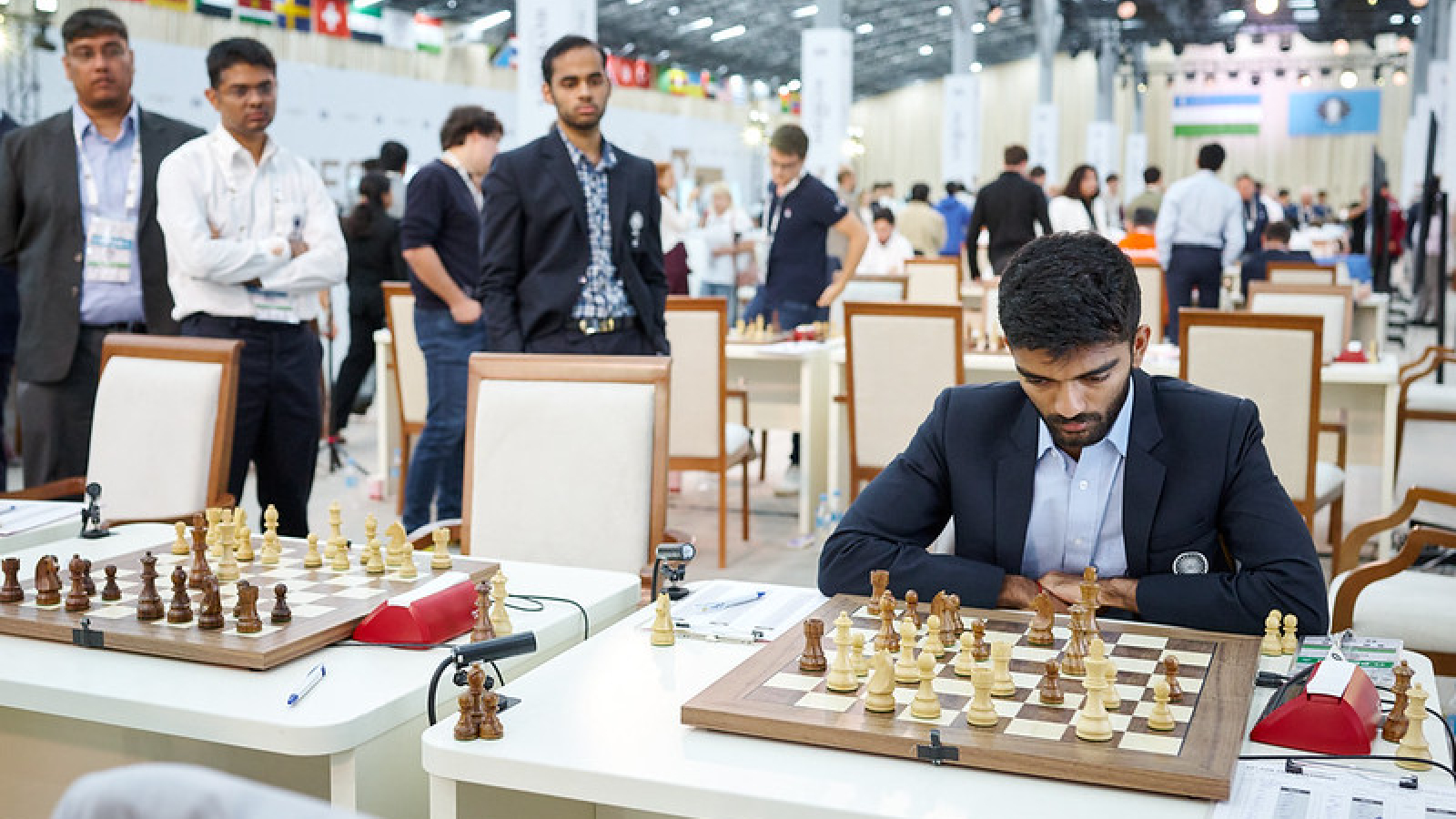
Similarly, on Board 2, Candidates participant Matthias Bluebaum proved equally unyielding against Arjun Erigaisi. Arjun, usually the player who thrives in utter chaos over the board, has been "strangely quiet" in Samarkand. His ruthless streak, which saw him dismantle the field on Board 3 in Budapest for an individual gold, has conspicuously failed to materialise in this edition. Ever since an opening-round ambush by Thailand’s 2363-rated Prin Laohawirapap, Arjun’s "engine has sputtered," scraping together just a solitary win across his subsequent seven games. Against Bluebaum, he "tried every trick in the book to manufacture an edge," but the German shut the door firmly, resulting in another frustrating draw.
This pattern of struggles and draws among India’s formidable young talents is impossible to miss. With the rest of the board grappling to finish games and convert favourable positions, the immense burden of securing full points has fallen squarely on Gukesh. This over-reliance, while currently yielding results thanks to Gukesh’s extraordinary form, creates a precarious situation for the defending champions as the tournament enters its critical final stages.
Gukesh: The Olympiad Maestro
D Gukesh’s connection with the Chess Olympiads is, as many observers note, "simply a match made in heaven." Across three editions spanning four years – from Mahabalipuram in 2022 and Budapest in 2024 to the current spectacle in Samarkand in 2026 – Gukesh has maintained an almost unparalleled record. His infamous endgame heartbreak against Nodirbek Abdusattorov remains the solitary occasion he has ever conceded a full point on this grand stage. This remarkable consistency underscores his exceptional temperament and ability to perform at the highest level under team pressure.
In this current edition, despite widespread chatter surrounding his patchy form leading up to the event and his tactical demotion from Board 1 to Board 4 – a move aimed at optimising team points by matching him against relatively lower-rated opposition – Gukesh has consistently delivered when India needed him most. While facing lower-rated opponents comes with the territory of playing on the lower boards, it is Gukesh’s "clutch match-winning points" that have single-handedly kept India’s pursuit of gold alive. His ability to turn losing positions into draws, and draws into wins, has been the critical difference between the team’s survival and potential early elimination. His latest ‘Houdini act’ against Donchenko is not an isolated incident but a continuation of a pattern of heroic performances that define his Olympiad legacy. He is not just a World Champion; he is India’s anchor, the unwavering force in a team grappling with fluctuating fortunes, a true maestro of the Olympiad stage.
Indian Women’s Team: A Clinical Ascent
While the men’s team endured a nail-biting encounter, the Indian women’s team delivered a more straightforward, yet equally significant, performance. They did their gold-medal credentials a world of good by powering past hosts Uzbekistan with a decisive 3-1 victory, showcasing a clinical efficiency that bodes well for their final rounds.
The veteran Koneru Humpy, leading the charge on the top board, engaged Afruza Khamdamova in a steady and well-controlled game that ultimately concluded in a draw. Humpy’s consistent performance and ability to secure half-points against strong opposition provide a crucial foundation for the team. On Board 4, the tournament’s breakout star, Savitha Shri B, faced an arduous challenge from Guldona Karimova. The high-flying teenager, who had enjoyed a blistering seven-match winning streak, was pushed to the absolute brink. However, displaying "nerves of steel," Savitha Shri B meticulously wriggled out of trouble, securing a hard-fought draw – her first split point of the event – and preserving her unbeaten record.
Once again, it was the "star duo from Budapest," Divya Deshmukh and Vantika Agrawal, who delivered when it mattered most. Vantika, armed with the white pieces, capitalised on a string of inaccuracies from Nilufarkhon Imomkuzieva. Her aggressive yet precise play led to an emphatic 54-move victory, a testament to her sharp tactical eye and opening preparation. Beside her, Divya Deshmukh rolled up her sleeves for a marathon grind against Gulrukhbegim Tokhirjonova. In a display of methodical determination, Divya patiently broke down her opponent’s resistance, squeezing out a hard-fought win in a gruelling 72-move battle. These clinical victories on the middle boards were instrumental in securing the overall match win, propelling the Indian women’s team further up the leaderboard.
The Road Ahead: High Stakes in Samarkand
With just two rounds remaining in Samarkand, the stakes for both Indian teams could not be higher. Both the Open and Women’s sections now occupy a precarious but promising second place on their respective leaderboards, setting the stage for a thrilling climax to the 2026 Chess Olympiad.
For the women’s team, the path to gold is clear, albeit challenging. Their penultimate round sees them square off against leaders China in what is being widely billed as a "virtual gold-medal decider." This head-to-head clash will undoubtedly be a high-pressure encounter, with the winner gaining a significant, if not insurmountable, advantage in the race for the coveted title. The strategic depth of the Chinese team will test India’s mettle, and the performances of Humpy, Divya, Vantika, and Savitha Shri B will be under intense scrutiny.
Srinath Narayanan’s men’s team, meanwhile, faces a different kind of challenge. They are set to square off against a "tricky Uzbekistan B side." While India is undeniably the firm favourite to pick up crucial match points in this encounter, their destiny is not entirely in their own hands. To keep their pursuit of gold alive and potentially in their own control for the final round, they desperately need Armenia to take something – ideally a win – off Uzbekistan’s senior A team. Any slip-up by Armenia could complicate India’s path significantly, regardless of their own result. The pressure on the Indian team to secure a dominant victory against Uzbekistan B will be immense, while simultaneously keeping a watchful eye on the results of their direct competitors. The final two rounds promise an exhilarating blend of strategic brilliance, nerve-wracking suspense, and the relentless pursuit of glory on the 64 squares of Samarkand.
