

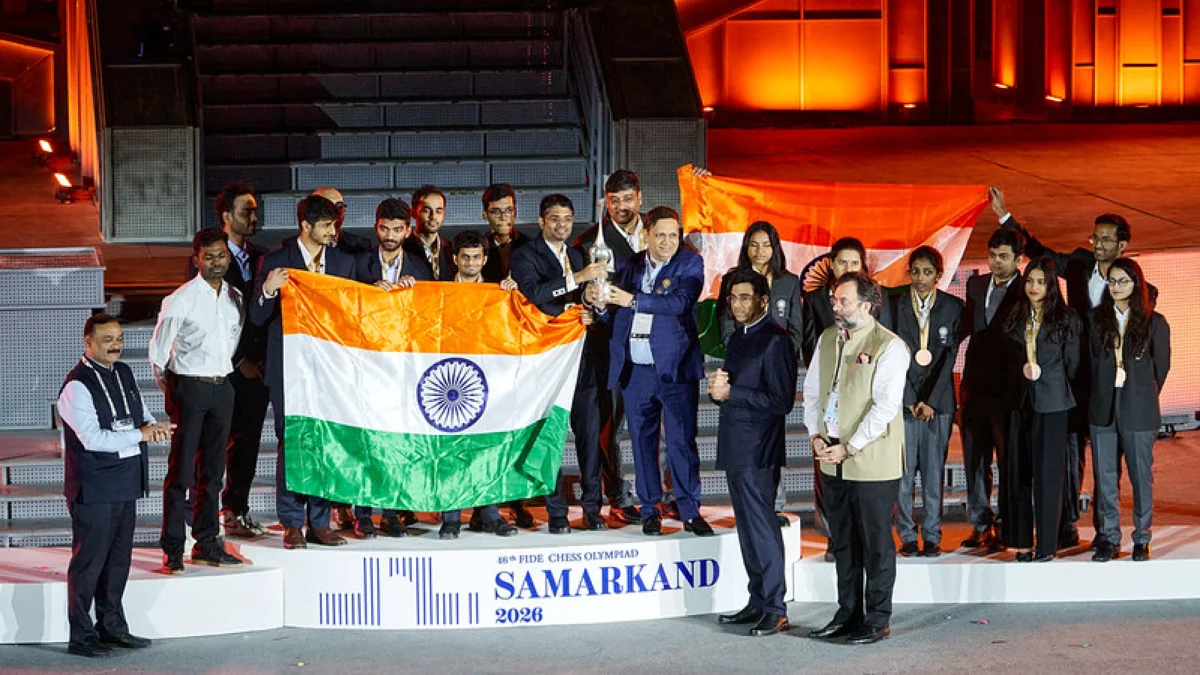
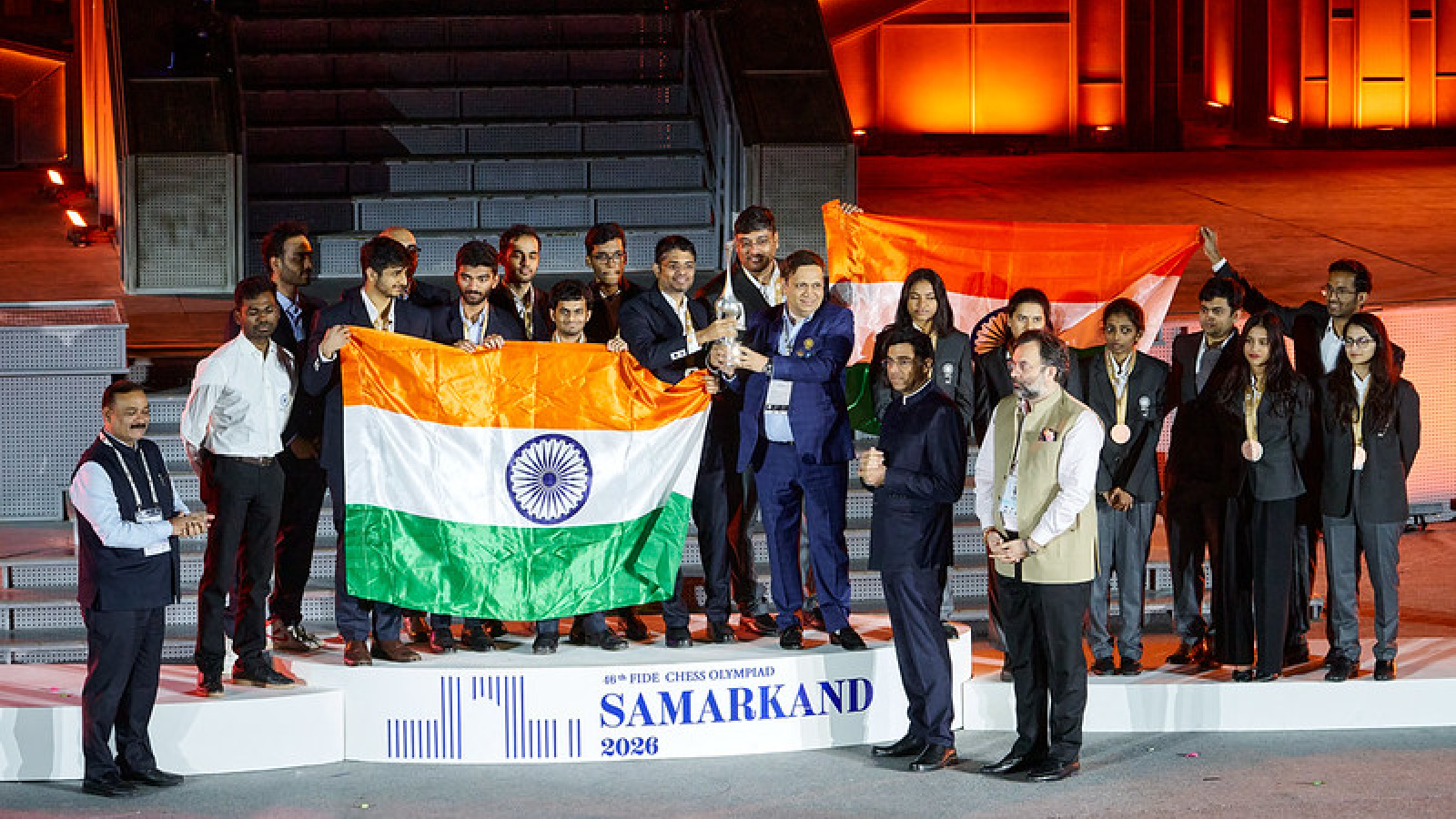
Samarkand, Uzbekistan – The Indian chess contingent returned from the 2026 Chess Olympiad in Samarkand bearing a significant haul of medals and accolades, a testament to their formidable presence on the global stage. Yet, beneath the gleam of silver and bronze, a discernible undercurrent of disappointment lingered. Despite securing a silver medal in the coveted Open section, a bronze in the Women’s event, the prestigious Nona Gaprindashvili Cup for the best overall side, and individual medals for six of their ten players – including a shining gold for the remarkable Savitha Shri – the ultimate prize, the gold medals from both sections, eluded them. These coveted titles were ultimately claimed by the host nation Uzbekistan in the Open section and by China in the Women’s event, leaving India with a profound sense of what might have been.
Grandmaster Vidit Gujrathi, a seasoned member of the Indian team, articulated the complex emotions within the camp. "The last Olympiad was so special that we created an unrealistic benchmark," Gujrathi reflected, referring to India’s historic triumph at Budapest 2024. "Results like those from Budapest – where you don’t lose a single match and claim the title with a round to spare – will probably not be achieved in many Olympiads. It’s never happened before. That’s why this silver was not a big cause of celebration. But we are proud of the silver because it was not an easy Olympiad." His words encapsulate the paradoxical nature of their achievement: a truly exceptional performance, yet one measured against the unprecedented brilliance of their immediate past.
The Unrealistic Benchmark: A Look Back at Budapest 2024
To fully grasp the sentiment surrounding India’s Samarkand performance, one must revisit the extraordinary events of the 2024 Chess Olympiad in Budapest. That year, the Indian Open team delivered a flawless exhibition of strategic prowess and tactical execution, storming through the tournament undefeated. Their victory, secured with a round to spare, was not merely a win but a statement – a definitive declaration of India’s emergence as a dominant force in world chess. The team’s cohesion, individual brilliance, and tactical discipline converged to create a perfect storm, setting an unparalleled standard that, as Vidit Gujrathi rightly points out, was arguably "unrealistic" to replicate.
The clean sweep in Budapest, where every player seemed to be in peak form, taking every available chance, fostered a new era of expectation. Indian chess fans, accustomed to individual stars, now looked to their national teams with an almost insatiable hunger for collective glory. This success recalibrated the definition of "achievement" for the Indian contingent, transforming anything less than gold into a subject of critical scrutiny, regardless of the inherent difficulty and competitive landscape of an Olympiad.
The Samarkand Narrative: A Campaign of Near Misses
The journey through the 11 rounds of the 2026 Chess Olympiad in Samarkand was marked by moments of brilliance, resilience, and, crucially, a few critical missteps that ultimately proved decisive. Both Indian teams navigated the gruelling tournament with remarkable consistency, each suffering only a single loss throughout their respective campaigns. However, the fine margins inherent in top-tier chess meant that these singular defeats, coupled with a few crucial draws, prevented them from ascending to the top of the podium.
Open Section: A Hostile Takeover and Frustrating Draws
The Indian Open team’s sole defeat came at the hands of the formidable host nation, Uzbekistan. This loss was a significant blow, not just for the points dropped but also for the psychological advantage it handed to a direct competitor. The home crowd’s fervent support undoubtedly energised the Uzbek players, who capitalised on key moments to secure a crucial victory.
Beyond this loss, the team’s campaign was also hampered by two draws that, in hindsight, felt like missed opportunities. The matches against Azerbaijan and Hungary both ended in tied scores, leaving the Indian players and coaching staff with a lingering sense of frustration. These were games where, according to internal analysis, winning chances were present but not converted. Grandmaster Vaibhav Suri, part of the coaching set-up for the Open section team, acknowledged these "misses." "There were misses from us. That’s undeniable. But we want to be slightly careful micro-analysing these mistakes because that’s just how games at an Olympiad go," Suri explained. "In 2024, it was super clean. Every person was in really good shape. We were taking every chance we were getting. This time, it was a little dicey. There were situations where evidence showed that not everyone was in their best shape. Pragg was missing some wins. Arjun missed a few too. Nihal lost against the Uzbeks. Gukesh also missed once (in the final round)."
The individual performances on the boards painted a picture of both strength and subtle inconsistencies. On Board 1, the dynamic R Praggnanandhaa, arguably India’s most in-form player entering the Olympiad, delivered a solid performance with three wins and no defeats, showcasing his consistency under immense pressure. Board 2 saw Arjun Erigaisi achieve two wins and a single defeat across ten rounds, a performance that, while respectable, might have been expected to yield more victories. Nihal Sarin on Board 3 recorded four wins but also suffered two defeats, including the crucial loss against Uzbekistan.
The strategic masterstroke for India often lay on Board 4, where the reigning World Champion, D Gukesh, was positioned. Gukesh, despite his world champion status, provided a formidable "surprise element," often overwhelming lower-rated opponents. Until his final-round defeat, he amassed an impressive seven wins in ten rounds without a loss, becoming a critical scoring engine for the team. Vidit Gujrathi himself played a limited but effective role, contributing one win and two draws in his three games.
Team captain Srinath Narayanan shed light on their strategic approach: "With most teams having a pretty strong 1 and 2, boards 3 and 4 were generally where we wanted to put maximum pressure. In a lot of cases, it felt nice to have Nihal and Gukesh exerting that pressure." This strategy largely paid dividends, but the aggregate effect of missed conversions on other boards ultimately impacted the overall standings.
Women’s Section: Battling Nemesis and Close Calls
The Indian Women’s team faced a similarly challenging path, culminating in a bronze medal – a significant achievement that nonetheless felt bittersweet given the gold ambitions. Their single loss came against "old nemesis" Poland, a team known for its tenacious play and ability to upset stronger opponents. This defeat proved to be a critical setback in a tightly contested field.
However, the women’s team demonstrated immense resilience in holding title rivals such as China, Kazakhstan, and Georgia to draws. These hard-fought stalemates showcased their ability to stand firm against the world’s best, preventing further damage to their medal hopes.
Individual performances were equally varied. Veteran Koneru Humpy, on Board 1, proved to be a pillar of stability, contributing four wins and remaining undefeated across ten games. Her experience and solid play were invaluable. In contrast, the form of R Vaishali on Board 2 was a cause for concern. After winning her first-round match, she endured a difficult patch of three draws and two defeats, leading to her not playing in the final three crucial rounds. Stepping into the breach was Divya Deshmukh, who admirably deputised on Board 2 for five of the eleven rounds, securing four wins and only one loss, demonstrating her potential and adaptability.
The true stars for the women’s team were often found on the lower boards. Vantika Agrawal on Board 3 delivered a strong performance with five wins and only one loss in eight games. But the standout player was undoubtedly Savitha Shri on Board 4. Described as a "sledgehammer," Savitha Shri was previously unheralded on such a grand stage but emerged as a revelation, winning an incredible eight games and drawing two, earning herself a well-deserved individual gold medal. Her explosive play and high scoring rate were crucial to India’s overall bronze.
Swayams Mishra, the captain for the women’s team, highlighted the excruciatingly fine margins that separated them from gold. "We had a good chance of beating China (in the penultimate round) and things would have been very different. Kazakhstan was losing in that round but won with a miracle. That changed everything, in terms of the pairing in the final round as well," Mishra recounted, underscoring how a single result in another match could dramatically alter the landscape. He also touched upon the physical and psychological toll of such a demanding tournament, noting that the players were "drained out physically, psychologically and emotionally."
Supporting Data: A Deep Dive into Team Dynamics and Individual Brilliance
The Samarkand Olympiad provided a fascinating case study in team dynamics, strategic adaptation, and the emergence of new talent alongside established stars.
Gukesh’s Strategic Placement: The decision to place the reigning World Champion, D Gukesh, on Board 4 for the Open team was a bold and highly effective strategic move. While typically a top board player, this allowed India to unleash a world-class talent against generally lower-rated opposition, almost guaranteeing points. Gukesh’s near-perfect score until the final round validated this strategy, providing a strong foundation for the team. His ability to convert advantages reliably made him a fearsome weapon.
Savitha Shri’s Breakout Performance: Savitha Shri’s individual gold on Board 4 in the Women’s section signals a significant addition to India’s chess talent pool. Her aggressive and highly successful play not only garnered her personal glory but also elevated the entire team’s performance. Her ability to consistently score big wins in critical matches demonstrated a maturity and killer instinct beyond her experience, marking her as a player to watch closely in future international competitions.
The Depth of Indian Chess: Despite the golden ambitions, the overall medal haul – two team medals, the Nona Gaprindashvili Cup (awarded to the nation with the best combined performance in the Open and Women’s sections, reflecting comprehensive strength), and six individual medals – underscores the remarkable depth of Indian chess. This isn’t just about one or two superstars; it’s about a broad base of talent capable of competing at the highest levels across multiple boards and categories. The fact that Divya Deshmukh could step in for Vaishali on Board 2 and perform admirably highlights the strong bench strength.
The Psychological Burden of the "Unrealistic Benchmark": The candid admission by Vidit Gujrathi about the "unrealistic benchmark" set by Budapest 2024 offers crucial insight into the mental game at play. Such unprecedented success, while exhilarating, can inadvertently create immense pressure. Every subsequent performance is then measured against that peak, making even excellent results feel like underperformance. This psychological burden can manifest as a slight dip in confidence or a tendency to play it safe, potentially leading to missed opportunities – the "dicey" situations Vaibhav Suri mentioned. The challenge for the Indian contingent moving forward will be to celebrate their substantial achievements while recalibrating expectations to a more sustainable, yet still ambitious, level.
Official Responses: Navigating Expectations and Criticism
The responses from the Indian camp reflect a blend of pride in their accomplishments and a frank assessment of the areas where they fell short. Vidit Gujrathi’s thoughtful analysis set the tone, acknowledging the difficulty of the Olympiad and the inherent value of their silver, despite the initial lack of celebration for gold.
Coaching staff members like Vaibhav Suri provided practical insights into the "misses" and the difference in "shape" compared to the Budapest triumph. Their emphasis on avoiding "micro-analysing" mistakes too harshly speaks to the understanding that chess, especially at the Olympiad level, is inherently prone to human error under pressure. The acknowledgment that "not everyone was in their best shape" for every single game is a realistic appraisal of the demands of a long, gruelling tournament.
Srinath Narayanan’s explanation of the strategic focus on boards 3 and 4 in the Open section highlights the intelligent planning that goes into these team events. It shows a clear understanding of opponent strengths and weaknesses, and how to best deploy their own formidable lineup.
Swayams Mishra’s perspective on the women’s team’s campaign provides a poignant reminder of the razor-thin margins in elite sports. His recounting of the near-win against China and Kazakhstan’s "miracle" victory illustrates how external factors and unexpected turns can dramatically alter the outcome of an entire tournament. The exhaustion felt by the players – "drained out physically, psychologically and emotionally" – is a critical factor often overlooked by external observers.
Perhaps the most significant official response came in the form of addressing the unprecedented amount of social media criticism. "India has developed as a chess-playing nation in the last few years. The amount of criticism the players and coaches received was unbelievable," stated one official, echoing a sentiment widely felt within the team. This points to a new phenomenon in Indian chess: the double-edged sword of success. While the burgeoning fan base and heightened public interest are positive indicators of the sport’s growth, they also bring increased scrutiny and often, unrealistic expectations from armchair critics. The official’s concluding remark, "But I see this as fans having big expectations from us," attempts to reframe this criticism as a sign of progress, a testament to how far Indian chess has come in capturing the national imagination. This response shows a mature understanding of the evolving landscape of sports fandom in the digital age.
Implications: Learning, Growth, and the Road Ahead
The 2026 Chess Olympiad in Samarkand, while not yielding the desired gold, carries significant implications for the future of Indian chess.
Continued Growth and Depth: The sheer volume of medals and the Nona Gaprindashvili Cup unequivocally demonstrate that India remains a powerhouse in world chess. The depth of talent, particularly with the emergence of players like Savitha Shri and the consistent performance of the younger Grandmasters, suggests a sustainable future for Indian chess at the highest level. This Olympiad reinforces that India is not just a contender but a consistent medal-winning nation across both genders and various age groups.
Lessons in Converting Opportunities: The "misses" and "dicey" situations highlighted by the coaches serve as crucial learning points. The team will undoubtedly undertake a detailed post-mortem analysis to understand where winning chances were not converted and how to improve in those critical moments. This could involve further psychological conditioning, specific training regimes, or refinement of strategic approaches in high-pressure situations. The fine margins between silver and gold often come down to these critical junctures.
Managing Expectations: The "unrealistic benchmark" set in Budapest and the subsequent social media criticism underscore the need for the Indian chess fraternity to manage both internal and external expectations. While ambition is vital, a healthy perspective on the extreme difficulty of winning consecutive Olympiad golds is equally important. Celebrating substantial achievements like silver and bronze, alongside individual accolades, will be crucial in fostering a positive and sustainable environment for player development and performance. The challenge will be to balance the pursuit of ultimate glory with an appreciation for the journey and the immense effort required to consistently be among the world’s best.
Global Chess Landscape: India’s strong showing, even without gold, reaffirms its position as a top-tier chess nation alongside traditional powerhouses like China and the rising force of Uzbekistan. The competitive landscape is becoming increasingly fierce, with more nations investing in and producing top-tier talent. This makes every Olympiad a monumental challenge, and India’s consistent podium finishes are a testament to its robust chess ecosystem.
As the dust settles on Samarkand, the Indian chess contingent will undoubtedly look back with mixed feelings. The pride in their impressive medal haul, the individual brilliance of players like Savitha Shri, and the overall strength demonstrated by winning the Nona Gaprindashvili Cup are undeniable triumphs. Yet, the lingering desire for gold, fueled by the memory of Budapest 2024, will serve as a powerful motivator. The journey to the next Chess Olympiad will be one of learning, refining, and relentlessly striving to turn those near misses into golden victories, all while navigating the ever-increasing expectations of a nation that has truly embraced chess as its own.
