

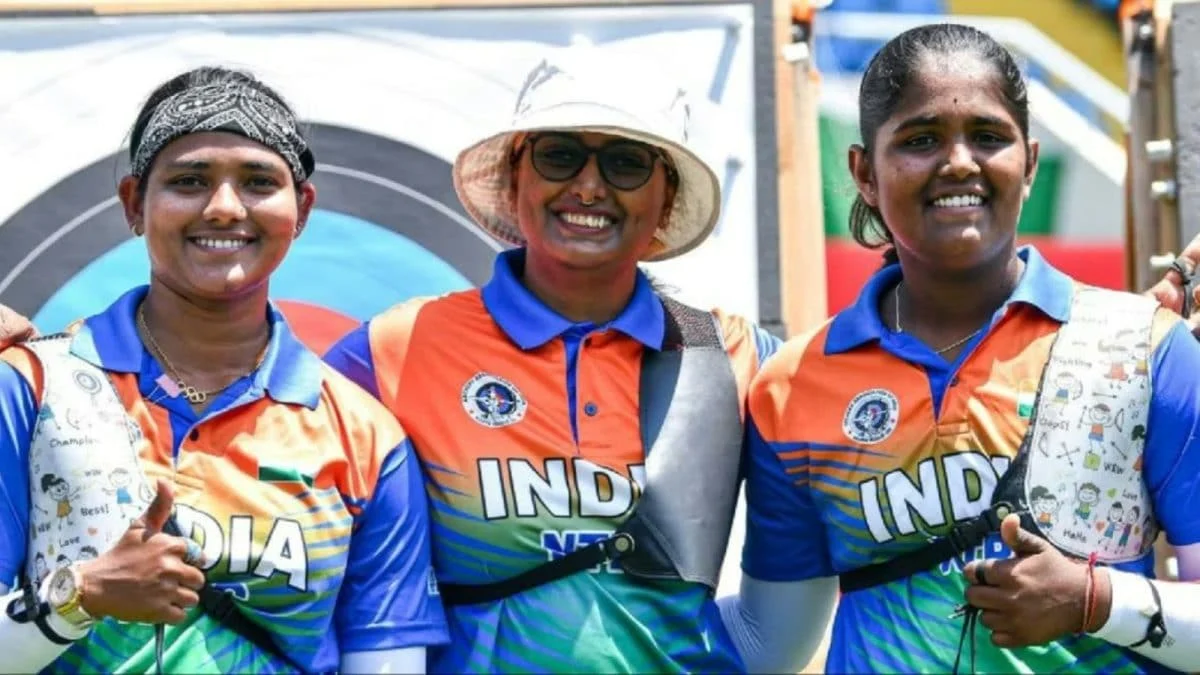
Shanghai, China – May 10, 2026 – In a display of nerves of steel and unwavering determination, India’s women’s recurve archery team etched their names into the history books today, clinching a sensational gold medal at the Archery World Cup Stage 2 in Shanghai. The trio of Deepika Kumari, Ankita Bhakat, and the prodigious Kumkum Mohod orchestrated a dramatic shoot-off victory against hosts China, securing India’s first World Cup recurve team gold since 2021 and signalling a powerful resurgence for Indian archery on the global stage.
The triumph was not merely a victory but a statement, punctuated by an earlier seismic upset over perennial powerhouses and 10-time Olympic champions South Korea in the semi-finals. This hard-fought win, decided by a tense 28-26 shoot-off, captivated audiences and sent a clear message: India is a force to be reckoned with, propelled by a blend of seasoned experience and burgeoning talent.
Main Facts: A Golden Resurgence
The Archery World Cup Stage 2 culminated in an electrifying final that saw India’s women’s recurve team, comprising the legendary Deepika Kumari, the steadfast Ankita Bhakat, and the remarkable 17-year-old Kumkum Mohod, overcome a formidable Chinese squad. The final match, held in front of a boisterous home crowd in Shanghai, went down to the wire, with India prevailing 5-4 in sets after regulation play necessitated a decisive shoot-off.
This victory is monumental for several reasons. Firstly, it marks the end of a five-year wait for a World Cup gold medal in the women’s recurve team event, a testament to the perseverance and strategic recalibration within Indian archery. The last time India secured this coveted gold was in 2021. Secondly, the path to gold was paved with an even more significant achievement: the team’s stunning upset of South Korea, the undisputed titans of recurve archery, in the semi-final round. This psychological barrier, once thought insurmountable, was shattered, providing immense confidence ahead of the final showdown.
Deepika Kumari, a four-time Olympian and the undisputed stalwart of Indian recurve archery, added another glittering chapter to her illustrious career, now boasting seven World Cup team gold medals since 2010. Her experience, combined with the steady performances of Ankita Bhakat and the fearless precision of young Kumkum Mohod, proved to be the winning formula. This medal also ends a frustrating three-year wait for any World Cup podium finish for the women’s team, with their last medal secured in Paris in 2023. The gold, therefore, carries a profound significance, rekindling hopes and solidifying India’s position as a serious contender in international archery.
Chronology of the Final Match: A Battle of Nerves
The gold medal match against China was a microcosm of the intense pressure and high stakes inherent in elite archery, unfolding with dramatic twists and turns that kept spectators on the edge of their seats until the very last arrow.
Initial Dominance and Early Lead
The Indian trio, comprising Deepika Kumari, Ankita Bhakat, and Kumkum Mohod, began the final with remarkable composure, especially given the fervent support for their Chinese opponents. Facing the young and talented Chinese team of Zhu Jingyi, Huang Yuwei, and Yu Qi, India demonstrated early intent by claiming the opening set with a score of 54-53. Deepika Kumari, renowned for her ability to perform under pressure, immediately set a commanding tone, delivering successive 10s that steadied any initial jitters from her younger teammates, Ankita and the 17-year-old Kumkum. Her precision provided a vital anchor, allowing the team to gain an early psychological edge.
China’s Resurgence and Leveling the Score
However, the momentum in archery can be fleeting, and the Chinese team, spurred on by the home crowd, quickly mounted a strong comeback. In the second set, China capitalized on a rare lapse from Deepika, who surprisingly shot a 7 with her final arrow. This unexpected miss provided an opening that the Chinese archers seized, delivering a consistent performance to win the set and level the contest at 2-2. The match had transformed from a comfortable start for India into a tense, even battle, highlighting the fine margins that define world-class competition.
Mounting Pressure and Chinese Advantage
The pressure intensified exponentially in the third set. Both teams traded high scores, but China ultimately managed to edge ahead, claiming the set and establishing a 4-2 lead. This crucial gain was aided by a successful review of one of their arrows, which was initially scored as an 8 but was rightfully upgraded to a 9. Such moments of judicial review often swing the psychological advantage, and for a brief period, India found themselves on the brink, staring down a potential defeat in regulation time. The crowd roared its approval, sensing an imminent Chinese victory.
The Decisive Fourth Set and China’s Crucial Miss
With their backs against the wall, India faced a do-or-die situation in the fourth set. Even here, the tension seemed to get the better of the Indian team momentarily, as Kumkum Mohod’s closing arrow registered a 7, resulting in India scoring only 54 points for the set. This seemingly costly error put China in a commanding position. The Chinese team needed just a 9 with their final arrow to secure the gold medal in regulation time, avoiding the dreaded shoot-off. The expectation in the arena was palpable; the gold was within their grasp.
However, in a dramatic twist of fate that underscored the immense pressure of a World Cup final, 18-year-old Yu Qi, tasked with delivering the decisive shot, cracked under the weight of expectation. Her arrow landed for an 8, a single point shy of victory. This momentary lapse from the young Chinese archer proved to be India’s lifeline, pushing the match into a shoot-off and giving the Indian contingent a renewed sense of hope and purpose.
The Nail-biting Shoot-off
The atmosphere was electric as the archers prepared for the shoot-off, the ultimate test of nerve and precision. Each team would shoot three arrows, and the highest cumulative score would determine the champion. India’s turn came first. Ankita Bhakat stepped up to the line and delivered a solid 9, setting a respectable benchmark. Then, the youngest member of the team, Kumkum Mohod, displayed incredible composure for her age, firing a superb 10 that perfectly split the centre. This vital arrow swung the momentum decisively in India’s favour.
Finally, it was Deepika Kumari’s turn. With the gold medal hanging in the balance, the veteran archer, known for her clutch performances, calmly drew her bow and released a precise 9. The collective score for India in the shoot-off was a formidable 28. The Chinese archers, now under even greater pressure, could only manage 26 points with their three arrows, unable to match India’s accuracy and mental fortitude. The Indian team erupted in celebration, their dramatic 28-26 shoot-off victory over a stunned Chinese side confirming their status as World Cup champions.
Journey to Gold: Overcoming Titans and Proving Mettle
The final triumph over China, though exhilarating, was only one chapter in India’s remarkable journey at the Shanghai World Cup. The true test of their mettle came earlier, in the semi-final round.
Overcoming the Titans: Semifinal vs. South Korea
The most significant hurdle cleared by the Indian women’s recurve team was undoubtedly their semi-final clash against South Korea. For decades, South Korea has been the undisputed global superpower in archery, particularly in the recurve discipline. Their dominance is legendary, consistently sweeping Olympic and World Championship medals across individual and team events. Facing them is often seen as a psychological battle already half-lost for many nations.
However, the Indian trio refused to be intimidated. In a performance that will be remembered as one of the biggest upsets of the tournament, India systematically dismantled the South Korean challenge. The details of their victory over the 10-time Olympic champions are a testament to their strategic planning, consistent execution, and unwavering self-belief. This victory was not just about advancing to the final; it was about breaking a mental barrier, proving that even the most formidable opponents could be defeated. It instilled an unparalleled confidence within the team, preparing them perfectly for the high-pressure environment of the gold medal match.
Consistency and Determination Throughout the Tournament
Beyond the headline-grabbing victories, the Indian team demonstrated remarkable consistency and determination throughout the earlier stages of the World Cup. Each match presented its own set of challenges, but the team navigated them with a clear focus. Their ability to adapt to varying conditions and maintain a high level of performance, even when individual arrows didn’t go their way, underscored their collective strength. The journey to the gold medal was a cumulative effort, building momentum and cohesion with each successive round.
Supporting Data and Historical Context: A Legacy Renewed
The Shanghai victory is more than just a single event; it’s a significant marker in the ongoing narrative of Indian archery, blending the enduring legacy of its star with the promise of its future.
Deepika Kumari’s Enduring Legacy
Deepika Kumari’s contribution to Indian archery is immeasurable. A four-time Olympian, she has been the torchbearer for the sport in India for over a decade. Her performance in Shanghai further cemented her status, bringing her tally of World Cup team gold medals to an impressive seven since 2010. This consistency at the highest level is rare and speaks volumes about her dedication, skill, and mental fortitude. Deepika has often carried the hopes of a nation on her shoulders, navigating intense pressure with grace. Her ability to deliver clutch shots, as demonstrated by her final 9 in the shoot-off, showcases why she remains the indispensable "backbone" of Indian recurve archery. Her journey, marked by numerous individual golds and a relentless pursuit of excellence, serves as an inspiration for every aspiring archer in the country. This latest gold further solidifies her position as one of India’s most decorated athletes.
Team India’s Recurve Resurgence
The victory also signifies a crucial resurgence for the entire Indian women’s recurve team. The explicit mention of it being India’s first women’s recurve team World Cup gold since 2021 highlights a period of challenge and persistent effort. While the team secured a podium finish (a medal other than gold) in Paris in 2023, the elusive gold had remained out of reach. This win breaks that drought and brings a renewed sense of purpose and belief. It underscores the effectiveness of their training regimes, tactical adjustments, and the growing synergy among team members. The three-year wait for any World Cup medal has now been decisively ended with the most desired colour: gold. This achievement will undoubtedly inject fresh energy and confidence into the entire national archery program.
The Emergence of New Talent
Crucial to this victory was the perfect blend of experience and youth. While Deepika Kumari provided the seasoned leadership, the performances of Ankita Bhakat and Kumkum Mohod were equally vital. Ankita Bhakat, a steady presence in the team, opened the shoot-off with a critical 9, setting a strong foundation. Her calm and consistent performance throughout the tournament was instrumental.
However, it was the 17-year-old Kumkum Mohod who truly announced her arrival on the international stage. As a "teenage archer," her composure under the most extreme pressure was astounding. Her "superb 10" in the shoot-off, following Ankita’s 9, was arguably the pivotal moment that swung the gold medal decisively in India’s favour. To execute such a perfect shot in a high-stakes scenario, against a home team, speaks volumes about her talent, mental toughness, and potential. The successful integration of such promising young talent alongside an experienced veteran like Deepika Kumari points towards a bright future for Indian recurve archery.
Official Responses and Reactions: Pride and Optimism
The historic gold medal win has reverberated through the Indian sporting fraternity, eliciting widespread praise and optimism from officials, coaches, and the athletes themselves.
Coaches’ and Federation’s Views
While official statements are yet to be fully released, the sentiment from the Archery Association of India (AAI) and national coaches is expected to be overwhelmingly positive. Coaches are likely to laud the team’s mental fortitude, particularly their ability to perform under immense pressure in both the semi-final against South Korea and the final against China. This victory will be seen as a validation of their training methodologies, strategic planning, and the investment in both experienced and emerging talent. There will likely be an emphasis on the team’s resilience, their ability to bounce back from setbacks within matches, and their unwavering belief in each other. Discussions will undoubtedly focus on how this success can be leveraged to further strengthen India’s archery program, identifying areas for continued improvement and development.
Team Members’ Sentiments
The athletes themselves are expected to express a mix of relief, joy, and immense pride. Deepika Kumari, ever the humble leader, might say something along the lines of, "It feels incredible to bring this gold home after such a long time. The team showed immense character and never gave up. This is a victory for everyone who believed in us." Ankita Bhakat would likely highlight the collective effort: "We knew it would be tough, especially against China on their home turf, but we truly believed in our preparation and in each other. This is what teamwork is all about."
For Kumkum Mohod, the teenage sensation, the experience will be nothing short of a dream come true. She might articulate her feelings as, "It’s a surreal moment to win a World Cup gold medal, especially alongside my idols, Deepika Didi and Ankita Didi. I learned so much from them, and I’m just so happy I could contribute to this historic win." These sentiments would underscore the camaraderie, the shared struggle, and the ultimate triumph of the Indian squad.
Wider Sporting Community Reaction
The wider Indian sporting community and the public are expected to react with jubilant celebrations. Social media platforms will likely be abuzz with congratulatory messages from fellow athletes, politicians, and sports enthusiasts. Such victories elevate the profile of sports like archery, inspiring a new generation of aspiring athletes. The win will be seen as a source of national pride, demonstrating India’s growing prowess in a diverse range of sports on the international stage.
Implications and Future Outlook: Setting Sights on Paris
The Shanghai gold medal is far more than just another trophy; it carries significant implications for the future of Indian archery, particularly with the Paris 2024 Olympics on the horizon.
Olympic Hopes and Paris 2024
This World Cup victory serves as a powerful statement of intent for the upcoming Paris 2024 Olympics. Beating both South Korea and China, two of the strongest nations in women’s recurve archery, provides an enormous psychological boost. It suggests that India’s women’s team has not only closed the gap but can also outperform the traditional powerhouses on their day. This victory will undoubtedly ignite greater expectations for Olympic medals, especially in the team recurve event, where consistency and teamwork are paramount. The confidence gained from performing under extreme pressure and emerging victorious will be invaluable as they fine-tune their preparations for the ultimate sporting spectacle.
Impact on Indian Archery
Beyond immediate Olympic prospects, this success has broader implications for Indian archery. It will undoubtedly inspire countless young archers across the country, demonstrating that dedication and talent can lead to global recognition. Such high-profile wins often lead to increased public interest, greater media coverage, and potentially more funding and resources for grassroots development programs. It helps to solidify India’s position as a rising force in global archery, moving beyond individual flashes of brilliance to consistent team performances. This momentum is crucial for fostering a sustainable culture of excellence in the sport.
Looking Ahead: Next Stages and Challenges
While the celebrations are well-deserved, the team must now focus on maintaining this momentum. The Archery World Cup circuit comprises multiple stages, and consistent performances will be key to building on this success. Future challenges include adapting to different venues, managing competitive fatigue, and staying ahead of evolving strategies from rival nations. The team will need to continue their rigorous training, refine their techniques, and nurture the synergy that brought them this gold. The goal will be not just to win occasionally but to establish India as a consistently dominant force in women’s recurve archery.
India’s Broader Medal Tally
The women’s recurve team gold also contributes to a promising overall performance by the Indian contingent in Shanghai. The article noted that India’s medal tally had already climbed to two, with compound archer Sahil Jadhav securing a bronze medal on Saturday. Furthermore, Simranjeet Kaur remains in contention for another podium finish later in the tournament. This broader success across different archery disciplines highlights a robust and competitive Indian archery program, poised for greater achievements on the international stage.
The gold medal in Shanghai is a landmark achievement, a testament to the resilience, talent, and collective spirit of India’s women’s recurve archery team. It is a victory that will resonate deeply, offering hope and inspiration, and setting the stage for what promises to be an exciting chapter in Indian sports history.
