

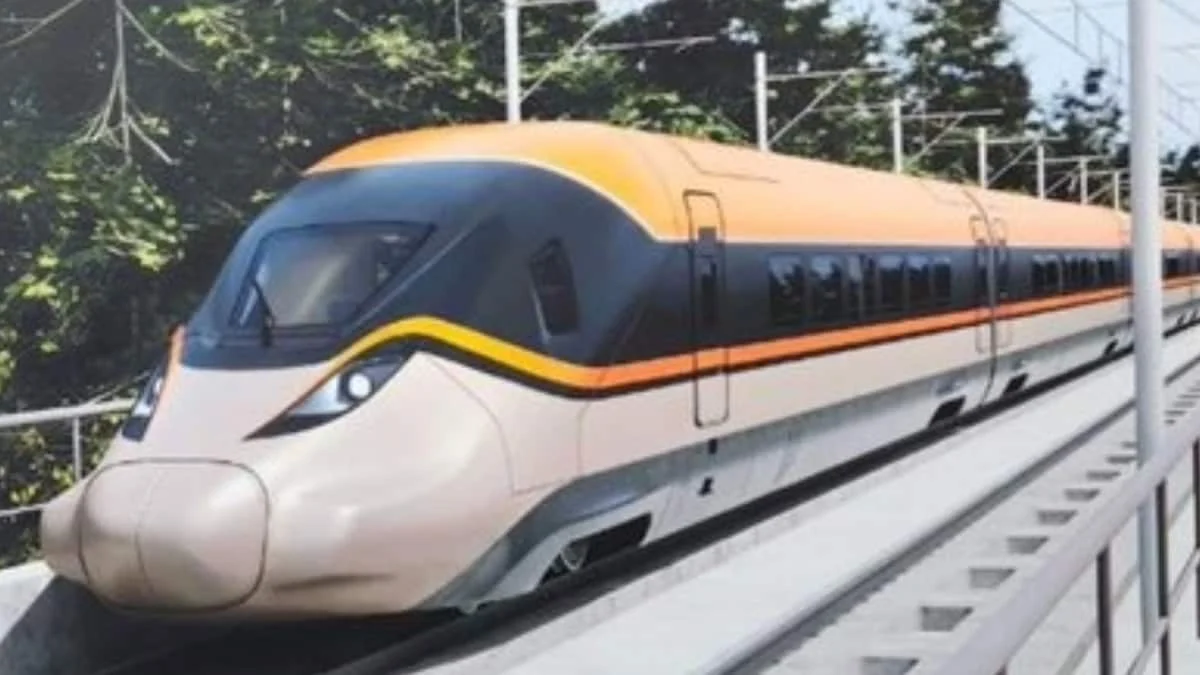
NEW DELHI – In a landmark moment for India’s infrastructure landscape, the Ministry of Railways has officially unveiled the first look of the nation’s inaugural high-speed rail—the Mumbai-Ahmedabad High-Speed Rail (MAHSR). The unveiling, which took place on Monday, May 18, 2026, serves as a visual testament to a decade of planning, engineering prowess, and international collaboration. An oversized high-resolution display of the proposed bullet train has been installed at Gate Number 4 of the Ministry of Railways’ headquarters in New Delhi, drawing crowds of officials and citizens alike, symbolizing a new era in Indian transit.
The image showcases a sleek, aerodynamic trainset, reflecting a fusion of Japanese Shinkansen technology and indigenous design refinements. As the project moves from the phase of heavy civil engineering into the integration of rolling stock and signaling, this unveiling marks a psychological and developmental milestone for the Multi-billion dollar project.
1. Main Facts: The Blueprint of a Revolution
The Mumbai-Ahmedabad High-Speed Rail corridor is a 508-kilometer stretch designed to bridge India’s financial capital, Mumbai, with the industrial powerhouse of Ahmedabad. Once operational, the bullet train is expected to reduce travel time between the two cities from the current six to seven hours to a mere two hours and seven minutes (for limited-stop services).
Technical Specifications and Rolling Stock
While the project initially drew heavily from the E5 Series Shinkansen technology of Japan, the latest updates from the Ministry highlight a significant pivot toward the "Make in India" initiative. The train sets, as depicted in the newly unveiled images, are designed for a top speed of 320 kmph, though the current indigenous development by the Integral Coach Factory (ICF) and BEML Limited is targeting a design speed of 280 kmph for the initial domestic variants.
The Route and Reach
The corridor traverses three distinct regions:
- Gujarat: 348.04 km
- Maharashtra: 155.76 km
- Dadra and Nagar Haveli: 4.3 km
The project is being executed by the National High-Speed Rail Corporation Limited (NHSRCL), a special-purpose vehicle created to manage the complexities of high-speed infrastructure, which includes the construction of 28 steel bridges, 7 mountain tunnels, and a 21-kilometer-long undersea tunnel.
2. Chronology: From Vision to Reality (2017–2026)
The journey of the MAHSR project has been one of both immense ambition and significant logistical challenges. Understanding the timeline is crucial to appreciating the current state of progress.
- September 2017: Prime Minister Narendra Modi and then-Japanese Prime Minister Shinzo Abe officially laid the foundation stone for the project in Ahmedabad. This marked the start of the joint venture between India and Japan, backed by a soft loan from the Japan International Cooperation Agency (JICA).
- 2018–2020: The project faced headwinds regarding land acquisition, particularly in the Palghar district of Maharashtra. Legal battles and local protests slowed the pace of work in the Maharashtra section, while Gujarat moved ahead with land procurement.
- 2021–2022: A change in the state administration in Maharashtra accelerated the land acquisition process. By late 2022, nearly 98% of the required land across the entire corridor had been acquired.
- 2023: Massive civil contracts were awarded. The construction of the "Bullet Train" stations in Gujarat began in earnest, and the first reinforced concrete (RC) track bed started taking shape in Surat.
- 2024–2025: Construction reached a fever pitch. The Ministry of Railways reported the completion of several major river bridges. Work began on the Bandra Kurla Complex (BKC) station, the project’s only underground terminus.
- May 18, 2026: The Ministry unveils the official look of the trainset, signaling that the project is entering its final stages of civil completion and moving toward the testing of rolling stock.
3. Supporting Data: Engineering a Marvel
The scale of the MAHSR project is best understood through the staggering data points released by the Indian Railways and NHSRCL.
Station Progress
The corridor will house 12 strategically located stations. The progress as of May 2026 is as follows:
- Mumbai (BKC): 91% of excavation work completed. This is a multi-story underground station designed to integrate with the Mumbai Metro.
- Thane, Virar, and Boisar: Construction is in full swing, with station layouts and platform structures emerging.
- Gujarat Hubs (Vapi, Billimora, Surat, Bharuch, Vadodara, Anand, Ahmedabad, Sabarmati): Foundation work is 100% complete. Finishing works, including concourse levels and roofing, are currently underway at Surat and Anand.
Bridges and Tunnels
- River Bridges: Out of the 24 major river bridges planned for the corridor, 17 have been completed. This includes significant crossings over the Narmada, Tapti, and Mahi rivers. The bridge over the Narmada in Gujarat stands as a testament to engineering, spanning 1.2 kilometers.
- The Undersea Tunnel: A crowning achievement of the project is the 21-km tunnel between BKC and Shilphata. A 7-km portion of this tunnel will run under the sea at Thane Creek. As of the latest update, 4.8 km of excavation between Ghansoli and Shilphata has been successfully completed using massive Tunnel Boring Machines (TBMs).
Economic and Labor Impact
The project has been a massive job creator. At its peak, the MAHSR project has employed over 25,000 workers daily across various sites. It has consumed over 1.6 million metric tons of steel and 35 million cubic meters of cement, providing a significant boost to India’s heavy industry sectors.
4. Official Responses: Leadership and Vision
The unveiling of the bullet train’s image was accompanied by statements from high-ranking officials, emphasizing the project’s role in the "Viksit Bharat" (Developed India) 2047 vision.
Railway Minister Ashwini Vaishnaw, speaking previously in the Lok Sabha and reiterated through Ministry channels on Monday, emphasized the technological leap:
"The Mumbai-Ahmedabad High-Speed Rail is not just about speed; it is about the transformation of the Indian Railways’ DNA. By collaborating with Japan and now moving toward indigenous manufacturing through ICF and BEML, we are ensuring that India becomes a global hub for high-speed rail technology."
The Ministry’s statement further noted that the placement of the image at Gate Number 4 is intended to serve as an inspiration. "It is a symbol of the nation’s ambitious plans to transform rail travel with advanced technology and faster transit systems. This is no longer a dream on paper; it is a reality in concrete and steel."
The NHSRCL Spokesperson added:
"The progress in the undersea tunnel and the completion of 17 river bridges are milestones that many thought were impossible within this timeframe. We are working around the clock to ensure that the trial runs on the Surat-Bilimora section can begin as per the revised schedules."
5. Implications: Beyond the Tracks
The introduction of the bullet train carries profound implications for India’s economy, urban planning, and environmental goals.
Socio-Economic Integration
The MAHSR corridor is expected to create a "mega-region" effect. By bringing Mumbai and Ahmedabad within two hours of each other, cities like Vapi, Surat, and Vadodara will effectively become suburbs of these major metros. This "de-urbanization" of the main metros will allow people to live in more affordable cities like Billimora or Bharuch while working in Mumbai or Ahmedabad, stimulating real estate and local economies in Tier-2 cities.
Technological Spillover
The "Make in India" component is perhaps the most significant long-term implication. By tasking the Integral Coach Factory (ICF) and BEML with the development of 280 kmph trainsets, India is building a domestic ecosystem for high-speed rail. This expertise can eventually be exported to other developing nations looking for cost-effective high-speed rail solutions, positioning India as a competitor to established players in Europe and East Asia.
Environmental Impact
High-speed rail is one of the most sustainable modes of mass transport. By shifting a significant portion of air and road traffic to the electric-powered bullet train, India will see a marked reduction in carbon emissions. The MAHSR is expected to reduce the carbon footprint of the Mumbai-Ahmedabad corridor by thousands of tons annually, aligning with the nation’s Net Zero targets.
The Diamond Quadrilateral
The success of the MAHSR project is the litmus test for the proposed "Diamond Quadrilateral" high-speed rail network, which aims to connect Delhi, Mumbai, Kolkata, and Chennai. The engineering lessons learned in the marshy lands of Maharashtra and the river plains of Gujarat will provide the blueprint for the next 10,000 kilometers of high-speed tracks planned across the subcontinent.
Conclusion: A New Horizon
The unveiling of the first look of India’s bullet train is more than just a public relations exercise by the Ministry of Railways; it is a declaration of intent. As the 508-km corridor nears completion, the image at Gate Number 4 serves as a reminder of the sheer scale of Indian ambition.
With 17 bridges finished, 91% of the BKC excavation done, and indigenous trainsets in development, the "bullet train" is no longer a futuristic concept—it is an imminent reality. As the nation watches, the tracks are being laid for a faster, more connected, and technologically sovereign India. The Mumbai-Ahmedabad line is merely the first chapter in what promises to be a total overhaul of how a billion people move.
