

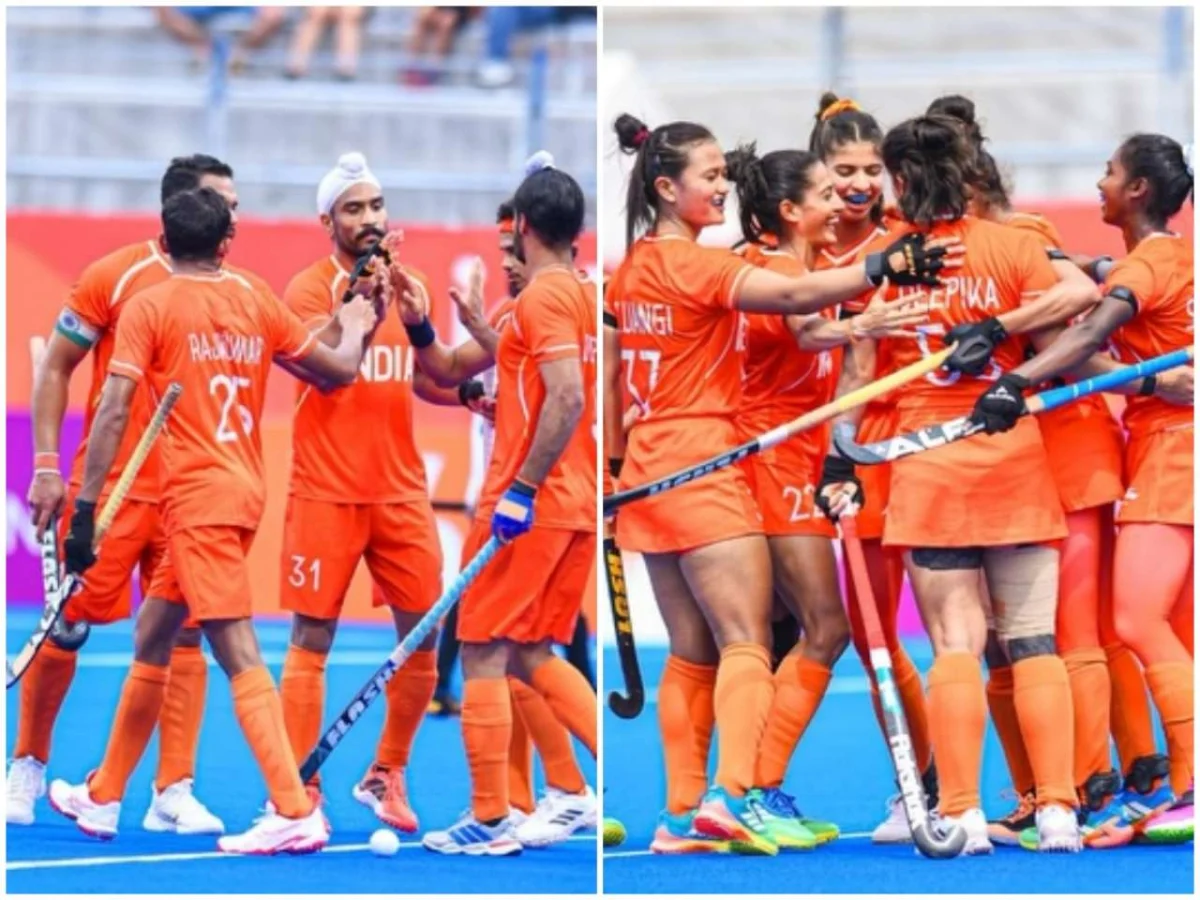
Nagoya, Japan – September 22, 2026 – India’s national hockey teams, both men’s and women’s, have ignited a significant debate off the field at the Asian Games 2026 in Nagoya, Japan, by appearing in saffron-coloured jerseys for their opening matches. This sartorial choice stands in stark contrast to an earlier official announcement by Hockey India (HI) president Dilip Tirkey, who had explicitly stated that blue would be the nation’s primary kit colour for the prestigious continental event, with saffron relegated to the secondary option.
The unexpected appearance of the saffron kits has triggered widespread discussion among fans, media, and sporting observers, raising questions about communication protocols, decision-making processes, and the symbolic representation of national teams. While both Indian squads delivered dominant performances on the pitch, securing emphatic victories against their respective opponents, the colour of their attire has inadvertently stolen some of the spotlight, prompting demands for clarity from the sport’s governing body.
The Unforeseen Saffron: A Departure from Announced Policy
The controversy began to unfold as the Indian men’s team stepped onto the field to face Indonesia in their Pool A opener, followed by the women’s team’s encounter with Uzbekistan. In both instances, the players were uniformly clad in vibrant saffron, a distinct deviation from the blue jerseys that many had anticipated following Hockey India’s prior announcement.
Hockey India president Dilip Tirkey had, earlier this month, made a definitive statement regarding the team’s official kit colours for the Asian Games. "The Indian Olympic Association (IOA) had given us options regarding the team kit colours, and Hockey India selected blue as the first choice for the Indian team’s kit. Orange [saffron] will be the second choice," Tirkey had affirmed, setting a clear expectation for the Indian contingent’s visual identity at the Games. This public declaration was widely reported and accepted as the official stance, making the saffron debut all the more perplexing.
)
Despite the ensuing kit debate, the teams themselves showcased formidable prowess. The men’s team commenced their campaign with a resounding 13-1 victory over Indonesia, demonstrating their intent to vie for the gold medal. Not to be outdone, the women’s team delivered an equally commanding performance, trouncing Uzbekistan 19-0 in their inaugural fixture. These impressive results, however, have not entirely eclipsed the discussion surrounding their jerseys, highlighting the deep emotional and symbolic connection between national colours and sporting identity.
Chronology of a Kit Controversy
The timeline of events leading up to and during the Asian Games 2026 reveals a communication gap or a last-minute change in strategy that has left many puzzled.

Early September 2026: The Blue Mandate
The month began with a clear directive from the highest echelons of Indian hockey. Hockey India president Dilip Tirkey, a legendary former player himself, publicly announced that blue would be the primary kit colour for both the men’s and women’s teams at the Asian Games 2026. This decision, he stated, was made after consultation with the Indian Olympic Association (IOA), which had presented various options. The choice of blue as the first-choice and saffron (referred to as orange) as the second-choice seemed to establish a definitive framework for the teams’ appearance. This announcement was widely disseminated through media channels, cementing the expectation among fans and stakeholders that India would primarily wear blue.
September 20, 2026: Men’s Team Dons Saffron
The first instance of deviation occurred when the Indian men’s hockey team took to the field for their opening match against Indonesia. Contrary to the official announcement, the players emerged in full saffron kits, complete with saffron jerseys, shorts, and socks. This immediate visual contradiction sparked initial murmurs and confusion among commentators and viewers watching the broadcast. While the team’s dominant 13-1 victory over Indonesia was the main story, the kit choice became an undeniable talking point.
)
September 21, 2026: Women’s Team Follows Suit
The following day, the Indian women’s hockey team mirrored their male counterparts, appearing in saffron jerseys for their inaugural match against Uzbekistan. Their staggering 19-0 triumph was a powerful statement of intent, yet the consistent use of saffron across both teams further solidified the notion that this was not an isolated incident or a one-off mistake, but a deliberate decision that ran counter to the public statement.
Post-Match Scrutiny: Questions Arise
Following these matches, the discrepancy became a prominent subject of media inquiry. Journalists and pundits questioned Hockey India’s rationale, referencing Tirkey’s earlier announcement. The lack of an immediate, comprehensive official explanation from Hockey India only served to deepen the mystery and fuel speculation regarding the underlying reasons for the sudden change.
)
Deciphering the Discrepancy: Conflicting Narratives
In the wake of the growing controversy, media reports emerged, citing an anonymous source within Hockey India attempting to shed light on the situation, though this clarification itself introduced further complexity.
Hockey India’s Internal Account
According to reports from news agencies like PTI, a Hockey India source offered a different perspective on the kit selection. This source claimed that the approved kit options for the Asian Games were always saffron and a combination of white and sky blue, not an "all-blue" kit as previously suggested. "The two colours for the Indian teams’ playing kits for the Asian Games 2026 were always saffron and the combination of white and sky blue, which was approved by the HI president himself. As to why the president then said that India will wear all-blue at the Asian Games is something you need to ask the president himself," the unnamed Hockey India source was quoted as saying.
)
This statement creates a direct conflict with President Tirkey’s initial public declaration. It suggests either a profound miscommunication within Hockey India, a misunderstanding of the approved designs, or a deliberate change of stance without transparent communication to the public and potentially even to key stakeholders. The reference to "white and sky blue" as the alternative kit further complicates the understanding, moving away from the "all-blue" concept that Tirkey initially articulated.
The Role of the IOA
Tirkey’s original statement highlighted that the Indian Olympic Association (IOA) had provided options for the team kits. This suggests a multi-layered approval process involving both the national federation (Hockey India) and the overarching Olympic body. If the IOA presented a range of choices, and Hockey India made a selection, then any deviation from that selection would ideally require further consultation and approval, or at least a clear explanation. The current situation, where Hockey India’s internal source contradicts its president’s public statement, suggests that the process, whether involving the IOA or purely internal, might not have been as streamlined or transparent as it should be. The IOA, as the parent body, would naturally be interested in ensuring consistency and adherence to stated policies, particularly for a high-profile event like the Asian Games.
)
More Than Just a Colour: The Symbolism and Significance
In sports, a national team’s jersey is far more than just a piece of fabric; it’s a potent symbol of national identity, pride, and aspiration. The colours chosen resonate deeply with the populace and represent the nation on a global stage.
National Identity and Sporting Kits
For a diverse nation like India, sporting colours hold immense significance. They unify fans from different regions and backgrounds under a common banner. A consistent visual identity helps build brand recognition for the team and fosters a sense of continuity across tournaments and generations of players. Changes, especially abrupt ones or those shrouded in ambiguity, can lead to confusion and dilute this powerful symbolism.
)
The Traditional Blue
Historically, blue has been the predominant colour for many of India’s national sporting teams, including cricket, football, and often hockey. It is widely recognized as the ‘Men in Blue’ or ‘Women in Blue’ across various sports. This tradition has cemented blue as a de facto national sporting colour, representing India’s presence on the international stage. The expectation for India’s hockey teams to wear blue was therefore rooted in this long-standing tradition and brand association.
The Saffron Debate
Saffron, or Kesariya, is one of the three colours in India’s national flag, representing strength and courage. Its inclusion in the national flag gives it an inherent patriotic and symbolic value. However, in contemporary Indian socio-political discourse, saffron has also become strongly associated with certain political ideologies and parties. While its use in a national sporting kit can be justified by its presence in the flag, its sudden, unexplained adoption as the primary kit, especially after a blue announcement, inevitably raises questions about potential underlying motivations, whether intentional or perceived. For a sporting federation, maintaining neutrality and focusing purely on athletic performance is paramount, and any perception of political alignment through symbolic choices can draw unwanted scrutiny.
)
Past Precedents and Governing Body Dynamics
While specific instances of such high-profile kit controversies are rare, the dynamics of sporting federations often involve complex decision-making processes, sometimes leading to miscommunications or policy shifts.
A History of Kit Evolution
National sporting kits are not static. They evolve over time, influenced by sponsorship deals, design trends, and sometimes, a desire to refresh the team’s image. However, major changes are typically accompanied by official launches, clear explanations, and widespread promotion. The current situation lacks this transparency, suggesting a more ad-hoc or internally conflicted process. Previous kit changes for Indian teams, while sometimes debated for aesthetic reasons, rarely involved such a direct contradiction of an official statement regarding the primary colour.
)
Communication Gaps and Governance
The present episode highlights potential communication gaps within Hockey India itself, or between Hockey India and external stakeholders like the IOA or kit manufacturers. If the president’s public statement was based on outdated information, or if a subsequent decision was made without updating him or the public, it points to systemic issues in information dissemination. Effective governance in sports federations demands clarity, consistency, and accountability, particularly when representing the nation. This incident could prompt a review of how such decisions are made, communicated, and implemented.
Fan Engagement and Media Reaction
The Asian Games are a major sporting spectacle, and Indian fans are passionately invested in their national teams. The kit controversy has therefore resonated widely.
)
Public Discourse
Social media platforms have been abuzz with discussions about the saffron jerseys. While some fans appreciate the use of a national flag colour, others express confusion and even disappointment, having anticipated the traditional blue. Many have questioned the rationale behind the apparent flip-flop, demanding answers from Hockey India. The debate transcends mere aesthetics, touching upon national identity, transparency, and the integrity of official statements. For a fanbase as fervent as India’s, such discrepancies can lead to distrust or cynicism, even when the team’s performance is stellar.
Media Commentary
Journalists, tasked with reporting accurately and holding institutions accountable, have been quick to pick up on the inconsistency. Leading sports portals and newspapers have published articles highlighting the discrepancy, quoting Tirkey’s original statement and the anonymous source’s counter-narrative. The media’s role in scrutinizing such decisions is crucial for maintaining transparency in sports governance. The ongoing commentary serves as a pressure point for Hockey India to provide a definitive and coherent explanation.
)
Implications for India’s Asian Games Campaign
Despite the off-field distraction, the Indian hockey teams have started their Asian Games campaign on a high note, delivering dominant performances.
Focus on Performance Amidst Distraction
The most crucial aspect for any sporting team is its performance. The Indian men’s team, with their 13-1 win over Indonesia, and the women’s team, with their 19-0 rout of Uzbekistan, have emphatically demonstrated their focus on the game. Such overwhelming victories usually overshadow minor controversies, but the kit issue persists due to the direct contradiction of an official statement. The players, coached to concentrate solely on their game, appear unaffected, but the administrative implications remain.
)
Future Kit Choices
A significant question now looms over the remaining matches. Will the teams continue to wear saffron? Or will they revert to the "white and sky blue with saffron" combination hinted at by the anonymous source? And what about the "all-blue" kit that Tirkey initially promised? The inconsistency could lead to further confusion in subsequent matches. The men’s team is slated to face Sri Lanka next on Tuesday, September 22, while the women’s team will play Indonesia on Monday, September 21. The choice of jersey for these upcoming fixtures will be keenly watched.
Branding and Sponsorship
National team kits often carry sponsor logos, and consistent branding is vital for these commercial partnerships. Frequent or unexplained changes in kit colours can complicate branding efforts and might even affect future sponsorship negotiations. Clarity in kit policy is not just about national pride but also about commercial viability and partner relations.
)
Looking Ahead: Clarity and Consistency Needed
The incident at the Asian Games 2026 underscores the critical need for transparent communication and consistent policy implementation within national sporting federations.
The Need for Transparency
Hockey India owes its stakeholders – the players, coaches, fans, media, and the Indian Olympic Association – a clear and unambiguous explanation for the discrepancy. Was there a change in policy? Was the initial announcement erroneous? Or was there a logistical challenge? A direct and honest communication from President Dilip Tirkey or a designated official is imperative to address the confusion and restore confidence.
)
Upholding Sporting Integrity
Beyond the aesthetic aspect, the incident touches upon the integrity of official statements and the governance practices of a national sporting body. In an era where sports organizations are increasingly under scrutiny for transparency and accountability, such apparent contradictions can erode public trust. Ensuring that decisions regarding national representation are made and communicated with utmost clarity is fundamental to upholding the integrity of Indian sports.
Conclusion
As India’s hockey teams continue their promising campaigns at the Asian Games 2026, aiming for glory on the field, the debate surrounding their saffron jerseys serves as a salient reminder of the complexities inherent in national sports administration. While the players have admirably maintained their focus and delivered exceptional performances, the discrepancy between Hockey India’s stated policy and the on-field reality demands a thorough and transparent explanation. The eyes of the nation remain fixed not only on the scoreboard but also on Hockey India, awaiting clarity on why blue gave way to saffron, and what this signifies for the future of Indian hockey’s visual identity.
