

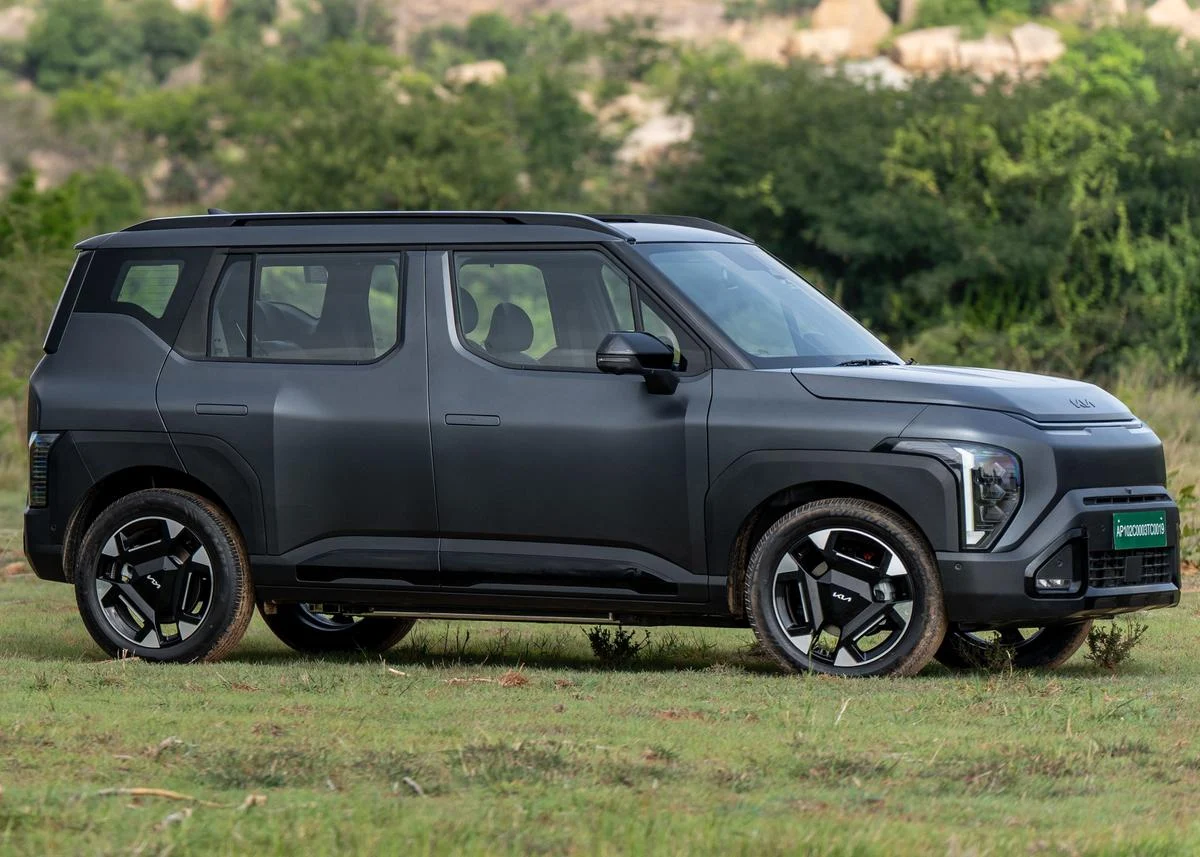
The Indian automotive landscape is currently witnessing a significant transition, moving from the novelty phase of electric vehicles (EVs) to a period of mature, mainstream adoption. At the forefront of this shift is the Kia Syros EV, a vehicle that challenges the conventional wisdom of the sub-four-metre category. Priced between ₹13.50 lakh and ₹20.00 lakh (ex-showroom), the Syros EV does not merely aim to be an electric alternative to a combustion engine; it seeks to redefine what a compact family SUV can offer in terms of performance, spatial efficiency, and technological integration.
Main Facts: The Core Propositions of the Kia Syros EV
The Kia Syros EV enters a highly competitive segment with a clear focus on "value-driven premiumization." While its dimensions—specifically a length of 3,995 mm—place it firmly within the tax-efficient sub-four-metre bracket, its engineering tells a different story.
Key Specifications at a Glance:
- Battery Options: 42 kWh (Standard) and 51.4 kWh (Long Range).
- Range: Up to 526 km (MIDC) for the 51.4 kWh variant; 443 km for the 42 kWh variant.
- Performance: 171 PS of power and 255 Nm of peak torque (Long Range).
- Acceleration: 0 to 100 km/h in a brisk 8.1 seconds.
- Cargo Space: A class-leading 465 litres of boot capacity.
- Safety: Six airbags, Level 2 ADAS, and all-wheel disc brakes as standard or available features.
The Syros EV’s primary objective is to bridge the gap between the compact dimensions required for urban maneuverability and the interior volume expected of a larger family vehicle. By leveraging a 2,550 mm wheelbase, Kia has managed to extract interior room that rivals vehicles from the segment above, specifically taking aim at the upcoming Maruti Suzuki e Vitara.

Chronology: From Concept to the Electric Frontier
The development of the Syros EV follows Kia’s global "Plan S" strategy, which emphasizes a rapid transition to electrification. The Syros was originally envisioned as a versatile platform capable of housing both Internal Combustion Engines (ICE) and Battery Electric Vehicle (BEV) powertrains.
- Platform Conceptualization: Kia identified the need for a tall-boy SUV that maximized vertical space, a departure from the low-slung profiles of many early EVs.
- ICE Launch and Feedback: The initial launch of the combustion-engined Syros allowed Kia to gauge consumer response to its unique styling and "space-first" philosophy.
- The Electric Transition: Unlike many manufacturers who simply "swap" engines for batteries, Kia re-engineered the Syros floorpan to accommodate a low-mounted battery pack. This move was crucial for maintaining a flat floor in the cabin and lowering the center of gravity.
- Market Entry: The Syros EV arrives at a time when charging infrastructure in India is maturing, allowing Kia to market the 51.4 kWh variant not just as a city commuter, but as a viable primary vehicle for inter-city travel.
Supporting Data: An In-Depth Analysis of Engineering and Design
Exterior Design: Functional Aesthetics
The Syros EV maintains the upright, boxy silhouette of its ICE sibling, a design choice that prioritizes utility. However, the EV variant introduces specific aerodynamic enhancements. The front fascia is closed off to reduce drag, and the bumpers have been reprofiled to optimize airflow around the wheels.
At 3,995 mm in length, the Syros sits at the limit of the compact segment, yet its height and 2,550 mm wheelbase provide a "substantial" road presence. The EV-specific wheels are designed not just for aesthetics but to minimize turbulence, contributing to the overall efficiency of the 526 km MIDC range.
The Cabin: A Masterclass in Packaging
The interior is where the Syros EV distinguishes itself from its rivals. The use of a sliding and reclining rear bench is a simple yet transformative feature.

- Versatility: Occupants can prioritize legroom for adults or slide the seats forward to expand the 465-litre boot.
- Technology: The dashboard is dominated by dual 12.3-inch displays. One serves as the digital instrument cluster, while the other handles infotainment.
- Ergonomics: In an era of "touch-screen fatigue," Kia has retained a separate interface for climate control, ensuring that drivers can adjust temperatures without navigating complex digital menus.
Performance and Drivetrain
The 171 PS electric motor is the heart of the Syros EV’s appeal. In the context of Indian urban traffic, the 255 Nm of torque—available instantly from zero RPM—allows for effortless overtaking. The 0-100 km/h time of 8.1 seconds puts the Syros EV in the company of much more expensive luxury sedans from a decade ago.
The braking system features disc brakes on all four wheels, a necessary inclusion given the additional weight of the battery packs. Furthermore, the regenerative braking system is highly customizable via steering-mounted paddles, allowing for "i-Pedal" or one-pedal driving, which can significantly reduce driver fatigue in stop-and-go traffic.
Official Responses and Strategic Positioning
Kia India’s strategy with the Syros EV revolves around "eliminating the compromise." Historically, buyers in the sub-₹20 lakh segment had to choose between a feature-rich small car or a base-model large SUV. Kia officials have indicated that the Syros EV is designed to offer the "best of both worlds."
By pricing the vehicle between ₹13.50 lakh and ₹20.00 lakh, Kia is positioning the Syros EV directly against the Maruti Suzuki e Vitara. While the Maruti Suzuki offering carries the weight of India’s largest service network, Kia is banking on superior "packaging efficiency" and a more premium cabin experience to win over buyers.

The inclusion of Level 2 ADAS (Advanced Driver Assistance Systems) is another strategic move. Kia has calibrated these systems—including Forward Collision Avoidance and Lane Keeping Assist—specifically for the unique challenges of Indian roads, where lane discipline is often fluid and non-motorized transport is common.
Implications: What the Syros EV Means for the Indian Market
The arrival of the Kia Syros EV carries several long-term implications for the Indian automotive industry:
1. The Normalization of High-Range EVs
With a 526 km MIDC range, the Syros EV effectively silences "range anxiety" for the average consumer. Even with a conservative real-world estimation of 350-400 km, the vehicle can handle a round trip from Delhi to Agra or Mumbai to Pune with significant energy to spare. This makes the EV a viable "only car" for a household.
2. Efficiency Over Size
The Syros EV proves that a car doesn’t need to be long to be spacious. By focusing on height and wheelbase, Kia has created a blueprint for future urban vehicles. This "vertical packaging" is likely to be emulated by other manufacturers looking to maximize utility within the constraints of crowded Indian cities.

3. The Democratization of Technology
Features like ventilated seats, dual 12.3-inch screens, and Level 2 ADAS were, until recently, reserved for vehicles costing upwards of ₹30 lakh. By bringing these to the ₹13.50–₹20 lakh bracket, Kia is forcing competitors to upgrade their equipment levels, ultimately benefiting the consumer.
4. Impact on Infrastructure
The support for 100 kW DC fast charging (10% to 80% in 39 minutes) sets a high bar for charging infrastructure providers. As more vehicles like the Syros EV enter the market, the demand for high-capacity chargers will accelerate, leading to a more robust national charging grid.
Verdict: A Compelling Compact Powerhouse
The Kia Syros EV is a remarkably well-judged product. It avoids the pitfall of being "just another electric car" by offering genuine innovation in interior packaging and daily usability. It acknowledges that for the Indian buyer, a car is often a shared family resource that must accommodate adults in the back, luggage in the trunk, and the occasional long-distance journey.
While the upright design may present aerodynamic challenges at high highway speeds, and the weight of the battery is felt during spirited cornering, these are minor trade-offs for the immense practicality on offer. In the battle against the Maruti Suzuki e Vitara and other emerging electric SUVs, the Syros EV stands out as a versatile, high-performance, and technologically advanced package that offers exceptional value for money.

For those looking to transition to electric mobility without sacrificing the comforts and capabilities of a traditional SUV, the Kia Syros EV is not just a choice—it is a benchmark.
The Kia Syros EV is priced from ₹13.50 lakh to ₹20.00 lakh, ex-showroom. This review was prepared in association with technical data provided by Motorscribes and market analysis from The Hindu.
