

Introduction
For nearly a decade, the Indian electric vehicle (EV) narrative was one of compromise and adaptation. Early adopters were primarily offered "converted" vehicles—internal combustion engine (ICE) models where the engine and fuel tank were swapped for a battery pack and an electric motor. While this approach allowed manufacturers like Tata Motors and Mahindra itself to seed the market quickly, it often resulted in compromises in cabin space, weight distribution, and software integration.
However, the landscape shifted dramatically with Mahindra & Mahindra’s "Electric Origin" strategy. By bypassing the incremental approach and investing heavily in a ground-up, dedicated electric architecture, Mahindra has redefined what an Indian-made EV can achieve. With the successful rollout of the BE 6, XEV 9e, and the flagship three-row XEV 9S, the company has not only captured the imagination of the domestic market but has also set a global benchmark for value-driven luxury technology. As of mid-2026, the brand has transitioned from an SUV specialist to a formidable tech-led EV powerhouse, as evidenced by surging sales and high-profile celebrity acquisitions.
Main Facts: The "Born Electric" Philosophy
The cornerstone of Mahindra’s success lies in its departure from the familiar. While competitors were refining ICE-derived platforms, Mahindra unveiled the INGLO platform—a modular, "born-electric" skateboard architecture. This platform serves as the foundation for the entire Electric Origin lineup, allowing for a level of design and engineering freedom previously unseen in Indian automotive manufacturing.
A New Hierarchy of Models
Mahindra’s EV offensive is spearheaded by three distinct models catering to different lifestyle segments:
- BE 6: A sporty, compact SUV designed for the driver-centric enthusiast. It features a radical "jet fighter-inspired" cockpit and aggressive, futuristic styling.
- XEV 9e: A premium, tech-laden SUV that bridges the gap between mainstream utility and luxury executive transport, famously featuring a triple-screen dashboard.
- XEV 9S: The flagship of the range and India’s first dedicated three-row electric SUV in its class, offering a blend of family utility and high-end sophistication.
Celebrity Endorsements and Cultural Impact
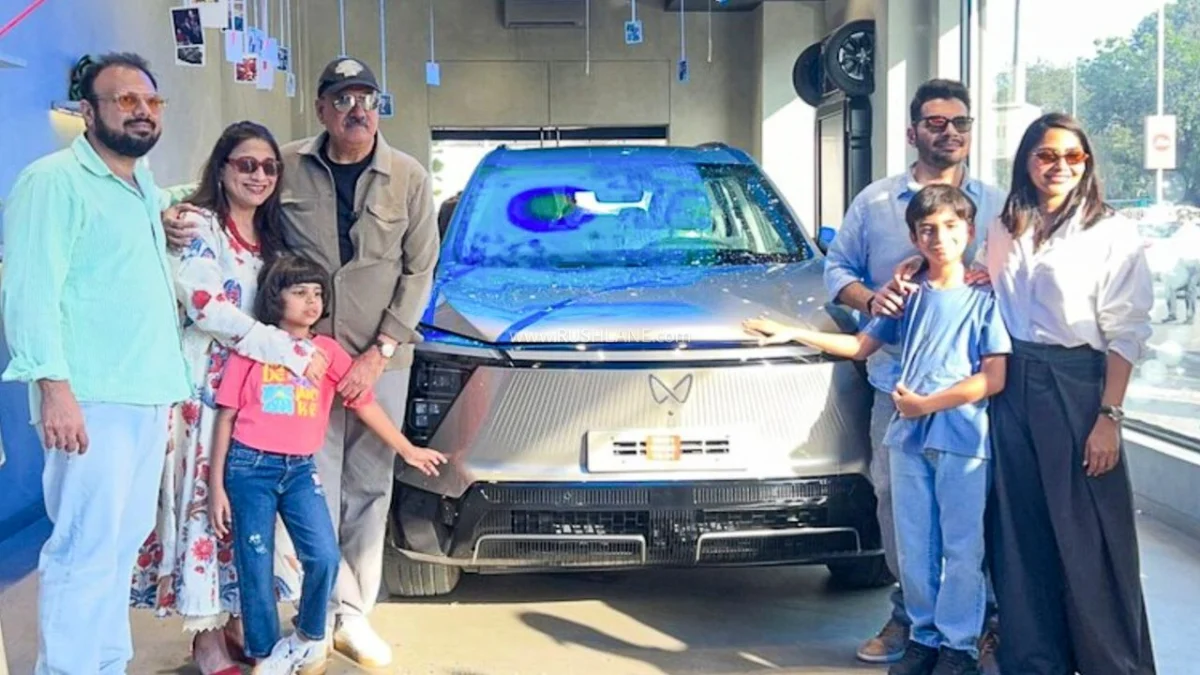
The market’s acceptance of these vehicles is perhaps best illustrated by the high-profile figures choosing them over established European luxury marques. Recently, veteran actor Boman Irani took delivery of his new XEV 9S, a move that signals the vehicle’s appeal to sophisticated, mature buyers who value engineering over brand heritage. Similarly, Kannada superstar Kichcha Sudeepa added a Mahindra BE 6 to his garage, highlighting the vehicle’s appeal to a younger, style-conscious demographic. These endorsements serve as social proof that Mahindra’s EVs are now considered "lifestyle" products, rather than just ecological alternatives.
Chronology: The Road to 50,000 Units
The journey of the Electric Origin SUVs has been one of rapid scaling and technological milestones.
- August 2022: Mahindra first showcased its vision in the UK, unveiling the BE (Born Electric) and XEV (eXtraordinary Electric Vehicle) sub-brands, promising a dedicated platform by 2025.
- Late 2024 – Early 2025: The commercial launch of the BE 6 and XEV 9e commenced. These vehicles introduced the INGLO platform to Indian roads, offering RWD as standard—a move that surprised the industry.
- Late 2025: The XEV 9S was introduced as the three-row flagship, completing the initial trio of "Origin" vehicles.
- April 2026: Mahindra hit a significant psychological and commercial milestone, crossing 50,000 cumulative sales for the Electric Origin SUV range. This achievement was reached in roughly 18 months, an unprecedented pace for premium EVs in India.
- Q2 2026 (March–June): Sales figures showed remarkable consistency and growth. Starting with 6,508 units in March, the brand saw a peak of 7,174 units in June 2026, indicating that the initial "hype" had matured into sustained market demand.
Supporting Data: Engineering and Market Performance
Mahindra’s dominance is backed by technical specifications that rival global leaders like Tesla and BYD.
Technical Benchmarks
The INGLO platform provides several structural and performance advantages that are standard across the range:
- Drivetrain: Rear-Wheel Drive (RWD) is the standard configuration, providing superior traction and driving dynamics compared to the Front-Wheel Drive (FWD) setups found in many competitors.
- Performance: The single-motor variants produce up to 282 bhp, enabling a 0-100 km/h sprint in just 6.7 seconds.
- Charging Infrastructure: The vehicles support 180 kW DC fast charging, allowing for a 5% to 80% charge in approximately 30 minutes, and 11.2 kW AC charging for home use.
- Luxury Tech: Features once reserved for the ₹80 lakh+ segment are now available in the ₹20–30 lakh bracket. This includes a 1400W 16-speaker Harman Kardon audio system, an Augmented Reality (AR) Head-Up Display, and Level 2+ ADAS.
2026 Sales Trajectory
The following table illustrates the sales momentum of the Electric Origin SUVs during the first half of 2026:
| Month (2026) | Sales Units | Key Milestone |
|---|---|---|
| March | 6,508 | Strong end to FY26 |
| April | 6,023 | 50,000 Cumulative Sales Milestone Crossed |
| May | 6,343 | Steady demand despite seasonal fluctuations |
| June | 7,174 | Record monthly high for the segment |
Comparative Pricing (Ex-Showroom)
Mahindra has positioned these vehicles to undercut luxury imports while offering comparable, if not superior, technology:
- BE 6: ₹18.90 Lakh – ₹24.90 Lakh
- XEV 9e: ₹22.90 Lakh – ₹28.90 Lakh
- XEV 9S: ₹24.90 Lakh – ₹29.90 Lakh
In comparison, luxury rivals like the BMW iX1 or the BYD Sealion 7 are often priced significantly higher, yet they offer similar range and software capabilities.
Official Responses and Strategic Vision
While Mahindra & Mahindra’s leadership has consistently emphasized "democratizing technology," the Electric Origin project represents a broader shift in corporate identity. Sources within the company suggest that the "Origin" SUVs were designed to be "software-first" machines.
Mahindra’s Internal Philosophy:
The engineering team’s focus was on the "Digital Architecture." By utilizing a centralized compute system rather than disparate ECUs (Electronic Control Units), Mahindra has enabled seamless Over-The-Air (OTA) updates. This allows the vehicle to improve over time—a hallmark of modern premium EVs.
Industry Analysts’ Perspective:
Market experts suggest that Mahindra’s success stems from its willingness to cannibalize its own ICE market. By offering EVs that are objectively better to drive and more technologically advanced than their diesel counterparts (like the XUV700 or Scorpio-N), they have convinced traditional SUV buyers to make the electric switch. The inclusion of features like "Drift Mode" in a family SUV shows a brand that is confident enough to experiment with "driving fun" as a selling point.
Implications: A New Era for the Indian Auto Industry
The success of the BE 6, XEV 9e, and XEV 9S has profound implications for the Indian automotive ecosystem and the global EV stage.
1. The End of the "Conversion" Era
Mahindra has effectively raised the bar for domestic competition. Tata Motors and other players are now accelerating their own dedicated EV platforms (such as Acti.ev and EMA), realizing that ICE-derived EVs can no longer compete at the premium end of the market. The "Born Electric" tag has become a vital marketing tool that consumers now actively look for.
2. Disruption of the Luxury Segment
By offering features like semi-active suspension, triple-screen cockpits, and high-fidelity audio at sub-₹30 lakh prices, Mahindra is challenging the value proposition of entry-level luxury brands. Buyers who might have previously stretched their budget for a Mercedes-Benz or BMW for the "tech factor" are now finding that Mahindra offers a more digitally advanced experience for a fraction of the cost.
3. Global Aspirations
The INGLO platform was designed with global safety and performance standards in mind. The success in India serves as a proof-of-concept for Mahindra’s planned expansion into markets like Europe and Australia. If Mahindra can maintain this sales momentum, it could become one of the few non-Chinese manufacturers to offer a credible, high-tech, and affordable alternative to Tesla.
4. Charging Infrastructure Pressure
With over 7,000 units hitting the road every month, the pressure on India’s fast-charging infrastructure is mounting. Mahindra’s support for 180 kW charging is ahead of many current public chargers, which usually top out at 50 kW or 60 kW. This discrepancy is expected to drive private and public investment into ultra-fast charging corridors across the country.
Conclusion
Mahindra’s Electric Origin SUVs represent more than just a new product line; they signify the coming-of-age of the Indian automotive industry. By choosing the difficult path of ground-up engineering over the easy path of ICE conversion, Mahindra has secured a dominant position in the premium EV segment. As celebrities like Boman Irani and Kichcha Sudeepa join the growing tribe of "Origin" owners, the message is clear: the future of Indian luxury is electric, and it is homegrown. With 50,000 units already on the road and sales continuing to climb, the BE 6, XEV 9e, and XEV 9S are no longer just concepts—they are the new benchmarks.
