

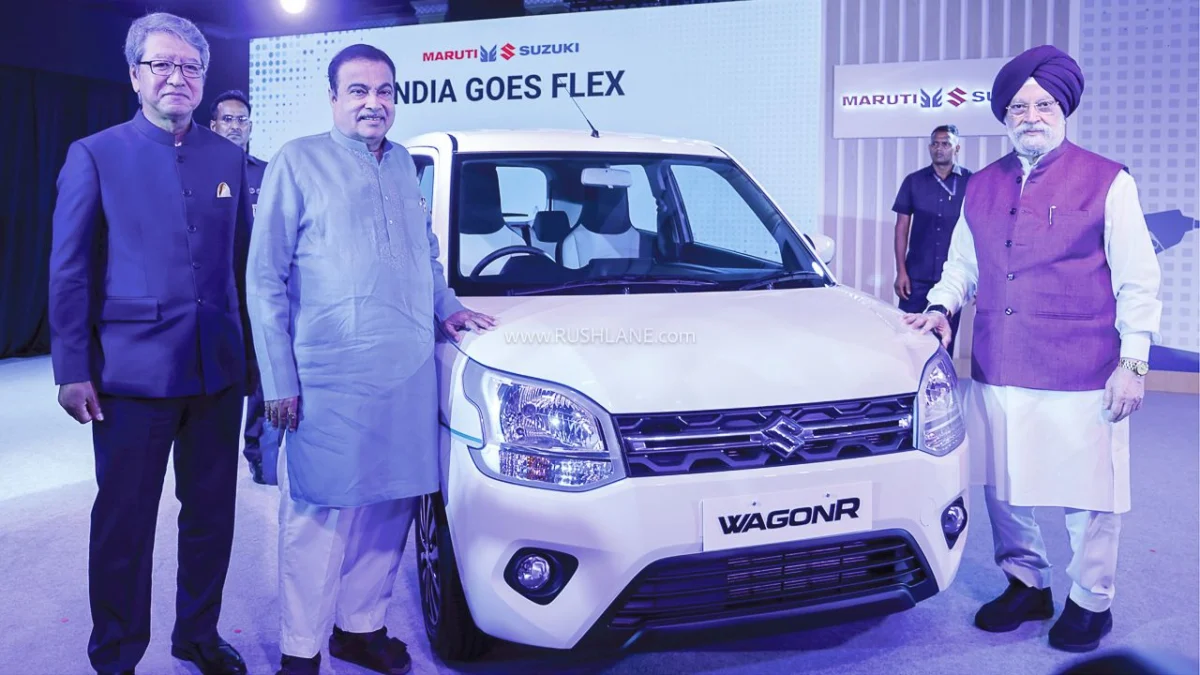
In a landmark move for the Indian automotive industry, Maruti Suzuki India Limited (MSIL) has officially introduced its first flex-fuel-capable vehicle, the WagonR BioFlex. Priced at ₹7.24 lakh (ex-showroom), this launch marks a significant milestone in India’s journey toward reducing its heavy reliance on imported fossil fuels and pivoting toward sustainable, indigenous energy sources.
While Maruti Suzuki is traditionally known for its exhaustive transparency—often providing granular details on everything from kerb weight to boot space in its brochures—the launch of the WagonR BioFlex has been somewhat unconventional. Despite its official pricing being announced, the vehicle has yet to appear on the company’s Arena or Commercial websites, and several key performance metrics remain under wraps.
Main Facts: The WagonR BioFlex at a Glance
The Maruti Suzuki WagonR BioFlex is a specialized version of the brand’s popular "tall boy" hatchback, specifically engineered to run on ethanol-gasoline blends ranging from 20% (E20) up to 85% (E85).
Pricing and Positioning
The WagonR BioFlex enters the market at ₹7.24 lakh (ex-showroom). For the initial phase of its rollout, Maruti Suzuki has restricted the availability of this model to the commercial sector. This strategic decision likely stems from the need to monitor the vehicle’s performance in high-usage cycles while waiting for the nationwide ethanol dispensing infrastructure to mature.
The BioFlex version is based on the top-tier ZX+ Manual Transmission (MT) trim of the standard WagonR. When compared to the standard 1.2L Petrol ZX+ MT, the BioFlex variant carries a premium of approximately ₹86,000.
Key Technical Specifications
Under the hood, the WagonR BioFlex is powered by a modified version of the 1.2-litre K12N naturally aspirated four-cylinder engine. To accommodate the corrosive nature of ethanol and its different combustion characteristics, Maruti Suzuki has implemented several hardware and software upgrades:
- Modified Fuel System: The fuel tank, fuel lines, and pump have been reinforced to prevent degradation caused by high ethanol concentrations.
- Advanced Fuel Injection: The injectors have been recalibrated to handle the higher flow rates required by ethanol.
- Dedicated ECU: A specialized Engine Control Unit is employed to detect the ethanol percentage in the fuel and adjust ignition timing and fuel mapping in real-time.
Chronology: The Road to India’s First Flex-Fuel Hatchback
The journey of the WagonR BioFlex began several years ago, spurred by the Indian government’s aggressive push for alternative fuels.

- December 2022: Maruti Suzuki first showcased the WagonR Flex-Fuel prototype at the Society of Indian Automobile Manufacturers (SIAM) Ethanol Seminar in New Delhi. The prototype was developed with technical support from Suzuki Motor Corporation, Japan.
- January 2023: The vehicle was a centerpiece at the Auto Expo 2023, where Maruti Suzuki reaffirmed its commitment to launching a production version by 2025-26.
- Late 2023 – Early 2024: Extensive testing was conducted across various climatic zones in India to ensure the engine could handle "cold start" issues, a common challenge with high-ethanol fuels.
- June 2024: Maruti Suzuki officially announced the launch price and commercial availability of the WagonR BioFlex, making it the first mass-market flex-fuel vehicle to be sold in India.
Supporting Data: A Comparative Analysis
To understand the economic and technical proposition of the WagonR BioFlex, it must be compared against its siblings in the Maruti Suzuki lineup.
The Cost of Innovation
The commercial sector typically prioritizes the "Tour" range for its cost-effectiveness. The WagonR BioFlex sits at a significantly higher price point than these traditional favorites:
| Variant | Engine/Fuel | Price (Ex-sh) | Price Gap vs. BioFlex |
|---|---|---|---|
| Tour H3 Petrol | 1.0L Petrol | ₹4.99 Lakh | + ₹2.25 Lakh |
| Tour H3 CNG | 1.0L Petrol + CNG | ₹5.89 Lakh | + ₹1.35 Lakh |
| WagonR ZX+ (Standard) | 1.2L Petrol | ₹6.38 Lakh | + ₹0.86 Lakh |
| WagonR BioFlex | 1.2L Flex-Fuel (E85) | ₹7.24 Lakh | – |
Features and Equipment
Despite being aimed at the commercial sector, the BioFlex does not compromise on creature comforts, as it inherits the feature list of the ZX+ trim:
- Safety: 6 Airbags, Electronic Stability Program (ESP), and rear parking sensors.
- Infotainment: 7-inch SmartPlay Studio touchscreen with wired Apple CarPlay and Android Auto connectivity, paired with a 4-speaker system.
- Convenience: Steering-mounted audio controls, manual air conditioning, and a manually dimmable Day/Night IRVM.
- Aesthetics: The exterior remains largely unchanged, save for "Flex Fuel" decals on the side panels and a "BioFlex" badge on the tailgate.
Official Context: The Government’s Green Mandate
The launch of the WagonR BioFlex is deeply intertwined with the "National Policy on Biofuels." Union Minister for Road Transport and Highways, Nitin Gadkari, has been a vocal advocate for 100% ethanol-powered vehicles, viewing them as a solution to India’s ₹16 lakh crore oil import bill and a way to support the domestic sugar industry.
The Ethanol Roadmap
The Indian government has accelerated its ethanol blending targets:
- E10 (10% Ethanol): Achieved nationwide in 2022.
- E20 (20% Ethanol): The current target for 2025-26, with many pumps already dispensing E20 fuel.
- E85 and Beyond: The government is encouraging OEMs to develop vehicles capable of running on E85 to eventually transition toward E100 (Pure Ethanol).
Maruti Suzuki’s BioFlex technology is a direct response to this roadmap. By enabling the vehicle to run on any blend from E20 to E85, the company ensures that the vehicle remains future-proof as the government increases blending mandates.
Implications for the Industry and Consumers
The introduction of the WagonR BioFlex carries profound implications for the Indian automotive landscape.

1. Environmental Impact
Ethanol is a renewable fuel derived from sugarcane, corn, and agricultural waste. Compared to pure gasoline, E85 can reduce tailpipe CO2 emissions by up to 79%. Furthermore, because the carbon emitted was originally absorbed by the plants during growth, the "well-to-wheel" carbon footprint is significantly lower than that of fossil fuels.
2. Economic Viability for Commercial Operators
The success of the BioFlex will depend heavily on the pricing of ethanol. For a commercial buyer to justify the ₹1.35 lakh premium over a CNG variant, the cost per kilometer of ethanol must be substantially lower than that of petrol and competitive with CNG. Currently, the pricing of E85 fuel at the pump is not yet standardized across India, which remains a hurdle for widespread adoption.
3. The "Missing Specs" Mystery
One of the most curious aspects of this launch is the absence of official power and mileage figures. Ethanol has a lower energy density than gasoline, which typically results in a 20-30% drop in fuel economy when running on E85. However, ethanol has a higher octane rating, which can allow for better engine performance if the compression ratio is optimized.
- Standard 1.2L K12N (Petrol): 91 bhp / 113 Nm / 23.56 km/l.
- BioFlex Predictions: It is expected that the BioFlex will offer similar power figures but may see a dip in mileage when running on higher ethanol blends. Maruti’s silence on these figures suggests they may be waiting for final ARAI certification or are managing consumer expectations regarding the trade-off between fuel price and fuel consumption.
4. Supply Chain Challenges
To support E85 vehicles, India needs a robust distribution network. While E20 is becoming common, E85 pumps are currently scarce. By launching for commercial buyers first, Maruti Suzuki may be targeting specific fleets that have access to private or localized ethanol dispensing hubs.
Conclusion: A Bold Step into an Uncertain Future
The Maruti Suzuki WagonR BioFlex is more than just a new car; it is a statement of intent. It proves that India’s largest carmaker is ready to diversify its powertrain portfolio beyond Petrol, CNG, and Hybrid, into the realm of biofuels.
While the upfront cost is higher and the infrastructure is still in its infancy, the WagonR BioFlex provides a vital proof-of-concept. As the government continues to incentivize ethanol production and standardize fuel prices, the "BioFlex" badge could soon become as common on Indian roads as the "CNG" sticker is today. For now, the industry watches closely to see how the commercial sector adopts this green pioneer and whether Maruti Suzuki will soon bring this technology to the private car buyer.
